Last updated Oct 22, 2026. This post explains a federal rule for admissions and enrollment teams. It is not legal advice.
The short answer: The main TCPA texting change for colleges in 2026 is an FCC order, adopted Sept 30, 2026, that lets a sender name one official way to opt out of its texts, such as a reply with "stop," as long as every text discloses it. The order is not in effect yet: it takes effect 30 days after it is published in the Federal Register, and as of Oct 22, 2026 it had not been published. Until then the current rules apply, and counsel should confirm how each type of admissions message is classified before an office relies on the new options.
What did the FCC change?
Since 2015, the FCC has held that a person can revoke consent to autodialed calls and texts in any reasonable manner, not only through a method the sender sets up. Its 2024 consent order listed examples of reasonable methods and required senders to honor opt outs within ten business days.
The new order, FCC 26 67, was adopted Sept 30, 2026 and released Oct 1, 2026. The FCC adopted the order unanimously, 3 to 0, according to Crowell and Moring and Kelley Drye. It lets a sender designate one or more of three methods as the exclusive way to revoke consent:
- an automated voice or key press opt out on a call;
- a reply text using one of seven standard words: "stop," "quit," "end," "revoke," "opt out," "cancel" or "unsubscribe";
- a website or phone number the sender designates for opt out requests.
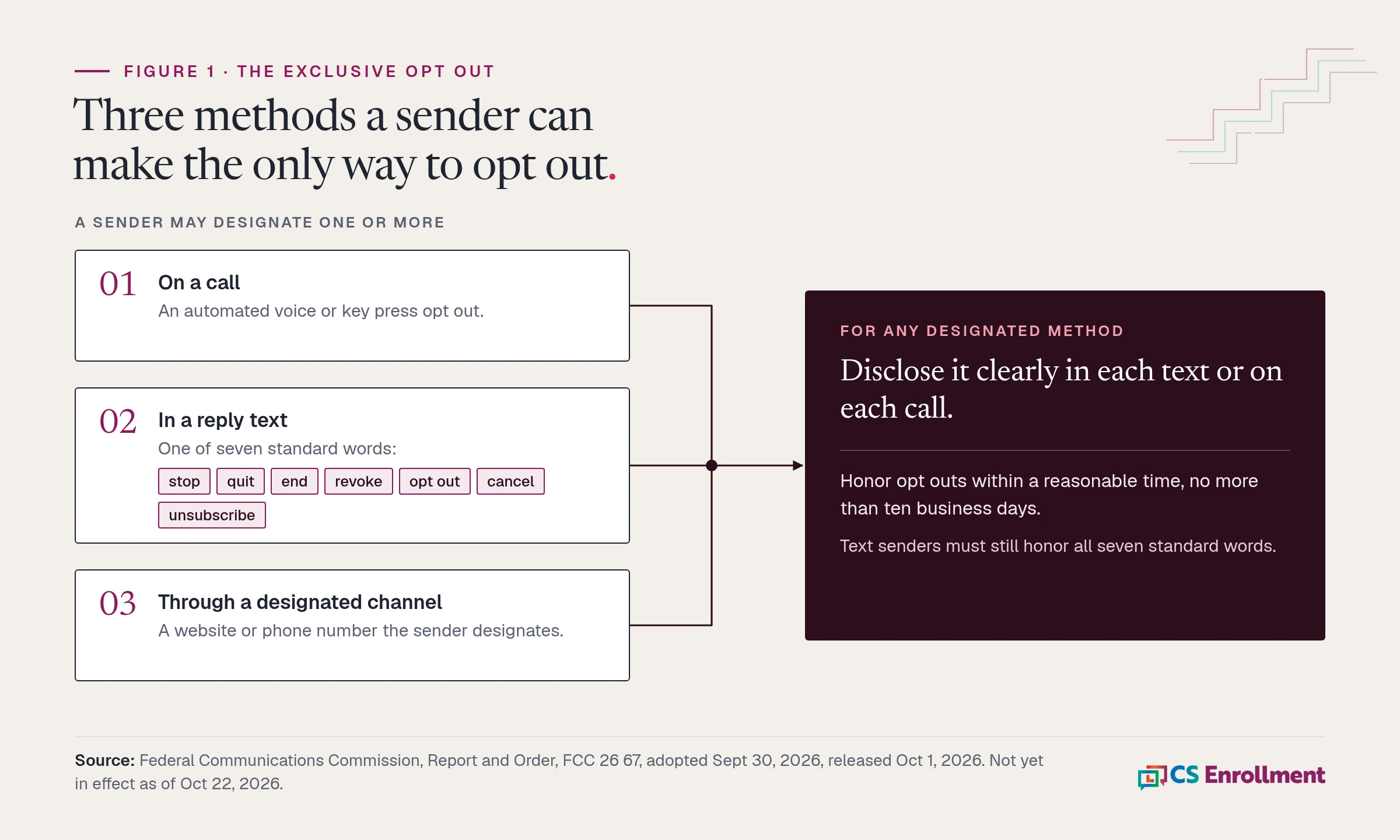
The method must be disclosed clearly and conspicuously on each call or in each text. A text sender can meet that rule by naming just one of the standard words in each message, for example "Reply STOP to opt out." The sender must still honor all seven words. DLA Piper notes that a notice in online terms and conditions alone does not satisfy the requirement.
A sender that designates a method this way is not required to process opt out requests made any other way. A sender that does not designate one must keep honoring requests made by any reasonable means. Either way, requests must be honored within a reasonable time, no more than ten business days. A confirmation text that only confirms the opt out, with no marketing content, is presumed to fall within consent if it goes out within five minutes.
How are informational and promotional texts treated?
The order defines an informational message as one that contains no advertisement and is not telemarketing. When a recipient opts out in response to an informational text, the sender may apply that request only to the category of informational messages it was directed at. When a recipient opts out in response to a text that contains an advertisement or is telemarketing, consent ends for all such messages from that sender.
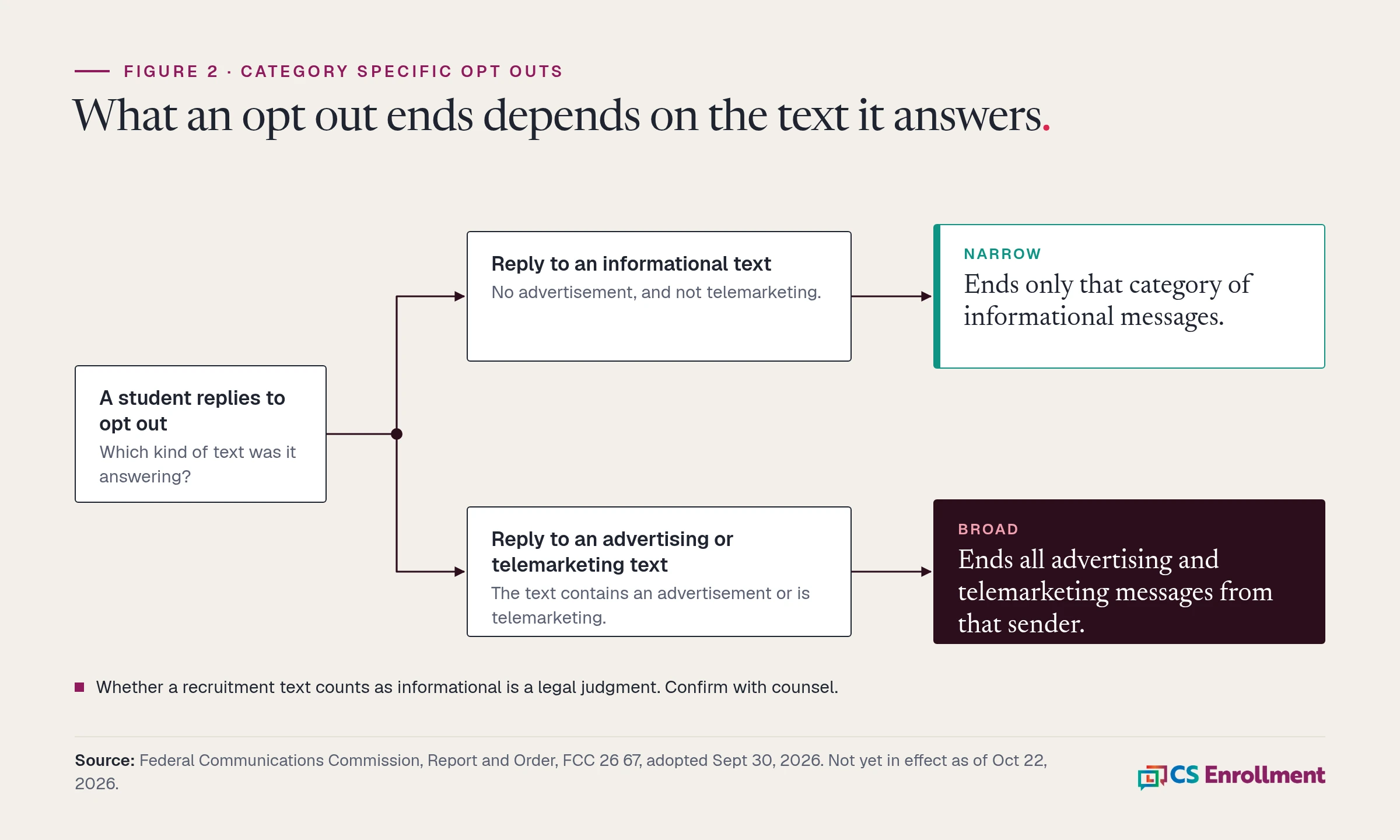
For admissions, the hard question is where each message falls. A reminder about a missing aid document reads differently from an invitation to an open house. Whether a given recruitment text counts as informational is a legal judgment, and it belongs with counsel.
Is the new opt out rule in effect?
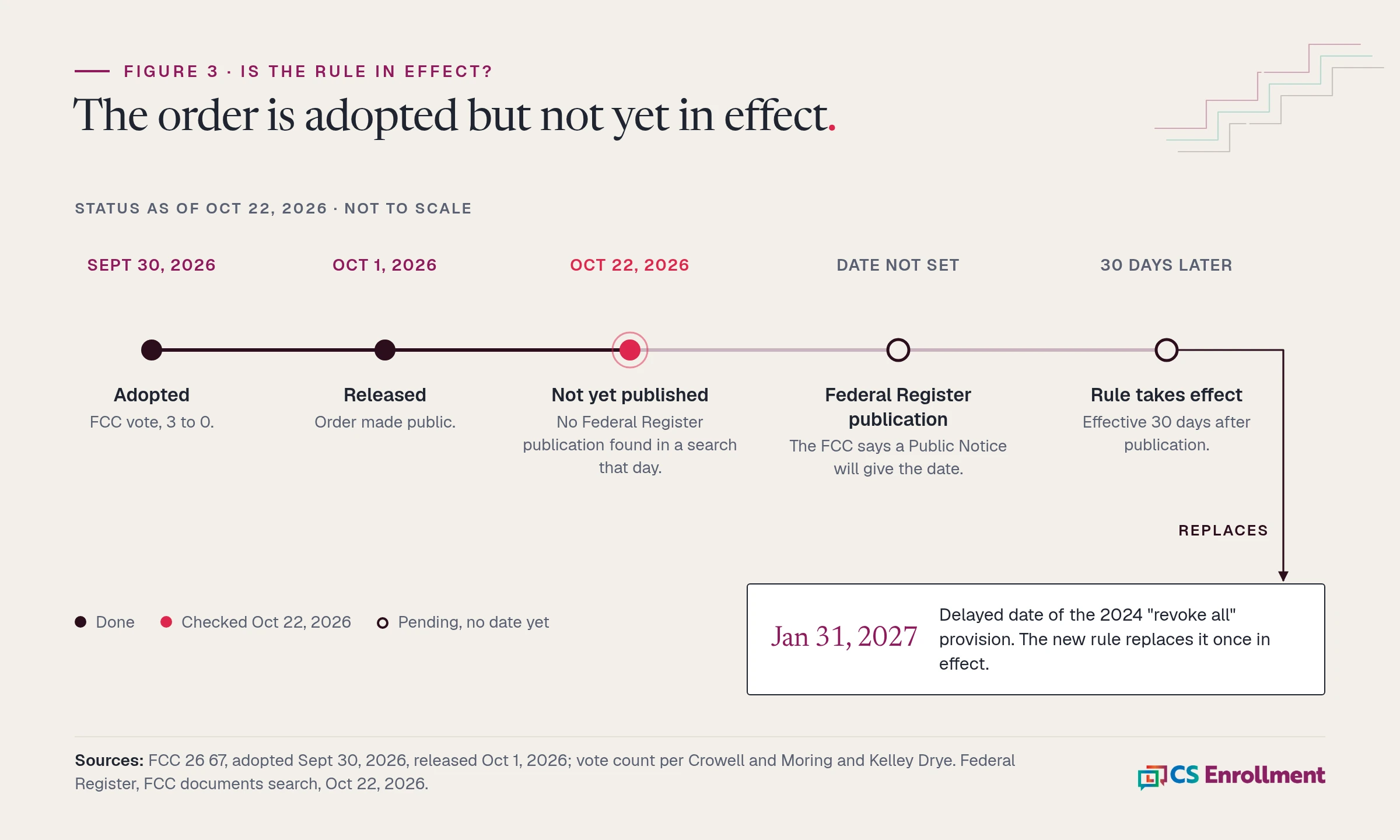
Not yet. The order takes effect 30 days after it is published in the Federal Register, and the FCC says it will release a Public Notice with the specific date. A search of the Federal Register on Oct 22, 2026 showed no publication. At least one AI generated search answer we checked on Oct 22, 2026 described the rule as already in effect. It is not.
When it does take effect, the order says it supersedes the delayed effective date of the 2024 "revoke all" provision, which had already been pushed back to Jan 31, 2027.
What does the order mean for an admissions office?
DLA Piper summarizes what commenters told the FCC about the old standard: opt outs could arrive through any channel and in any wording, and businesses often processed them by hand across separate platforms, at substantial cost and with more risk of error. In a small admissions office, those channels can include a counselor's texting account, an email reply, and a call to the front desk.
The new rule rewards the opposite setup: every message tagged by type, one disclosed opt out line on every text, and one system of record for opt outs across every counselor and tool.
Checklist: eight steps for admissions texting
1. Inventory every text stream. List who sends texts, from which accounts and platforms, and for what purpose: search, inquiry follow up, application reminders, aid documents, admitted student outreach, deposit and orientation.
2. Classify each stream with counsel. Decide which messages are informational and which contain advertising or telemarketing. Store that label with each message record so an opt out can be applied to the right category.
3. Choose the designated method and write it into every template. Put the disclosure, such as "Reply STOP to opt out," in each message, not only in terms and conditions or on a website.
4. Make all seven standard words work everywhere. Test "stop," "quit," "end," "revoke," "opt out," "cancel" and "unsubscribe" on every number and platform the office uses, including any shared or counselor accounts.
5. Keep one system of record for opt outs. An opt out received in one tool has to stop messages in that category from every tool and counselor.
6. Honor requests inside ten business days. That window from the 2024 order still applies under the new rule. Keep any confirmation text free of promotional content.
7. Keep honoring informal requests for now. Until the rule takes effect and the office has designated a method, the current standard applies, and an opt out made by any reasonable means still counts.
8. Write the decisions down. Record the designated method, the category of each message stream, and the date each template changed. That record is what the office will need if an opt out is ever disputed.
Questions for counsel
- Which of our message streams are informational, and which contain advertising or telemarketing?
- Which opt out method should we designate, and is our disclosure wording clear and conspicuous?
- How should an opt out received before the effective date be scoped once the rule applies?
- Do any of our vendors or counselor accounts process opt outs outside our system of record?
What is still open?
The order comes with a further notice that asks for comment on more changes: how quickly opt outs must be honored, when two way texting should be required, whether senders must offer one step to opt out of all messages, and how affiliates are treated. The order sets comments as due 30 days after publication in the Federal Register, with reply comments due 60 days after.
Where texting fits
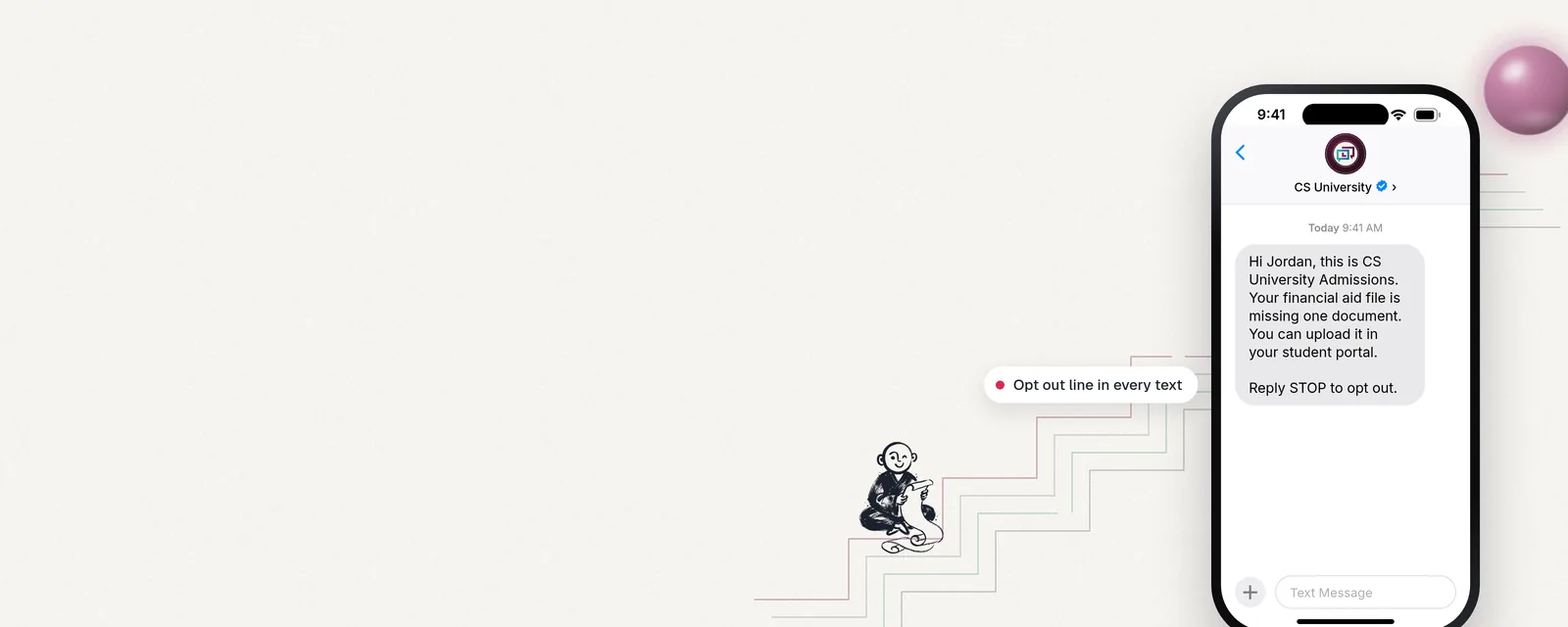
For teams using branded, verified text messaging, including CS Enrollment Pathways, the opt out line belongs in the message template itself, next to the verified sender name, so that no message goes out without it. A published terms page still matters as a record; CS Enrollment keeps its own messaging terms on its policies page. Under the new rule, the disclosure also has to appear in each text.
To see how a branded message and its opt out line appear on a student's phone, request the sample walkthrough.
Frequently asked questions
Is the new FCC opt out rule in effect? No. As of Oct 22, 2026 it had not been published in the Federal Register. It takes effect 30 days after publication, and the FCC will announce the date in a Public Notice.
Do colleges have to accept STOP? Yes. A sender that designates a reply text as its opt out method must honor all seven standard words, including "stop." A sender that designates no method must honor any reasonable request, and a reply of "stop" is one of the examples the FCC lists.
Sources
- Federal Communications Commission, Report and Order and Further Notice of Proposed Rulemaking, FCC 26 67.
- Andrew Sacks, DLA Piper client alert on the FCC rule allowing an exclusive opt out method.
- Crowell and Moring, client alert on the FCC's adopted TCPA rule amendments.
- Alysa Z. Hutnik and Jennifer Rodden Wainwright, Kelley Drye Ad Law Access post on the FCC's revised TCPA consent revocation rules.
- Bass, Berry and Sims, client alert on the FCC replacing the TCPA "revoke all" rule with category specific opt out rules.
- Federal Register, Federal Communications Commission documents.