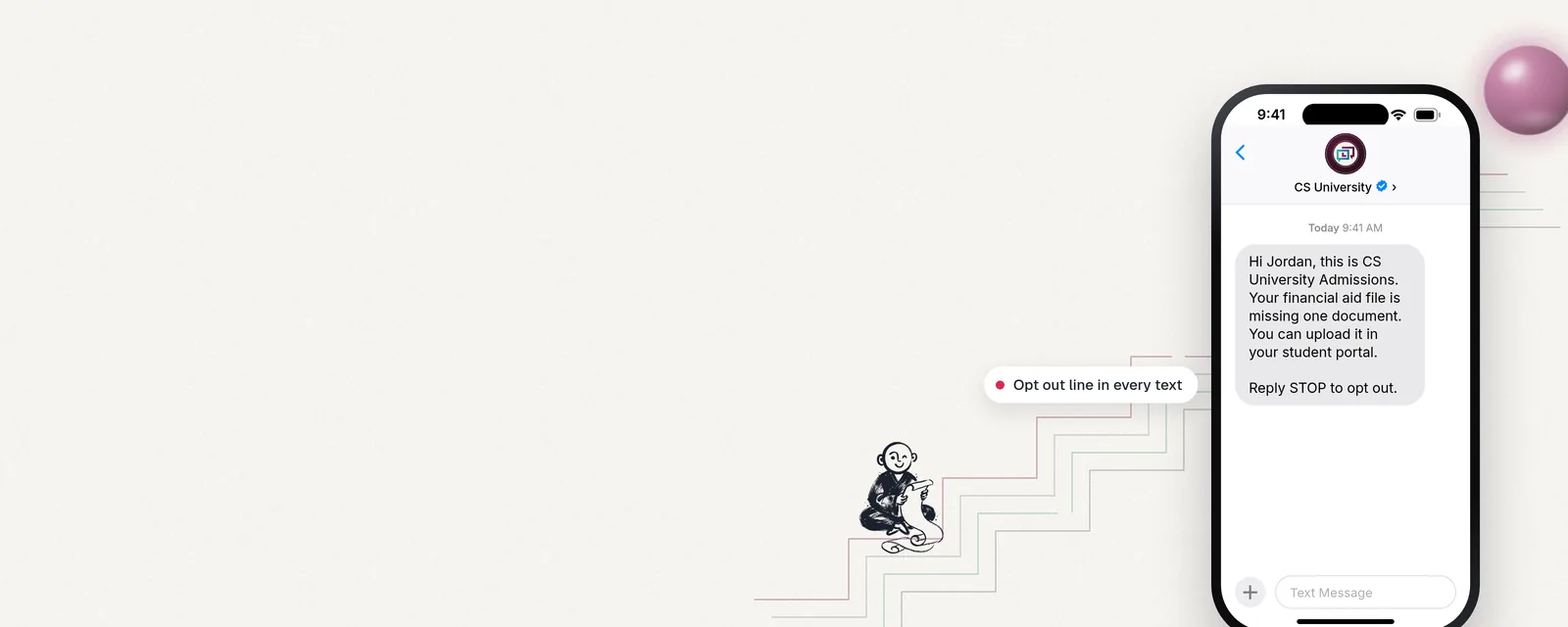
The short answer: How to reduce summer melt comes down to timely, personal messages that each ask a deposited student to finish one task, sent by a named person at the college and backed by a staff member who answers replies. In two randomized trials, two to three hours of summer support raised college enrollment by 3 percentage points overall and by 8 to 12 points among low income students, at $100 to $200 per student.
What is summer melt, and how big is it?
Summer melt is when a student who was admitted, said yes, and often paid a deposit never shows up in the fall. An EdResearch for Action brief by Lindsay Page and colleagues puts the national rate at about 10% to 20% of college intending students. Rates run higher among low income students. The range depends on how "college intending" is defined, and broader definitions produce higher rates.
The causes are practical. The brief names three: confusion about financial aid and unexpected costs such as housing deposits, meal plans and health insurance; unfamiliar enrollment tasks like forms, orientation signups and placement tests; and the doubts that grow over a summer, especially for first generation students.
Most of the published research is written for K to 12 districts and large universities. The same brief makes a point that matters for a small college: the college holds the detailed information about tasks, deadlines and which students are falling behind, but its outreach often starts only at orientation.
What does the research say works?
The EdResearch brief groups effective programs into four models: behavioral nudges by text or chatbot, counselor led summer outreach, peer or near peer mentoring, and summer bridge programs. A small office can run the first two without new staff lines.
The evidence on each is specific:
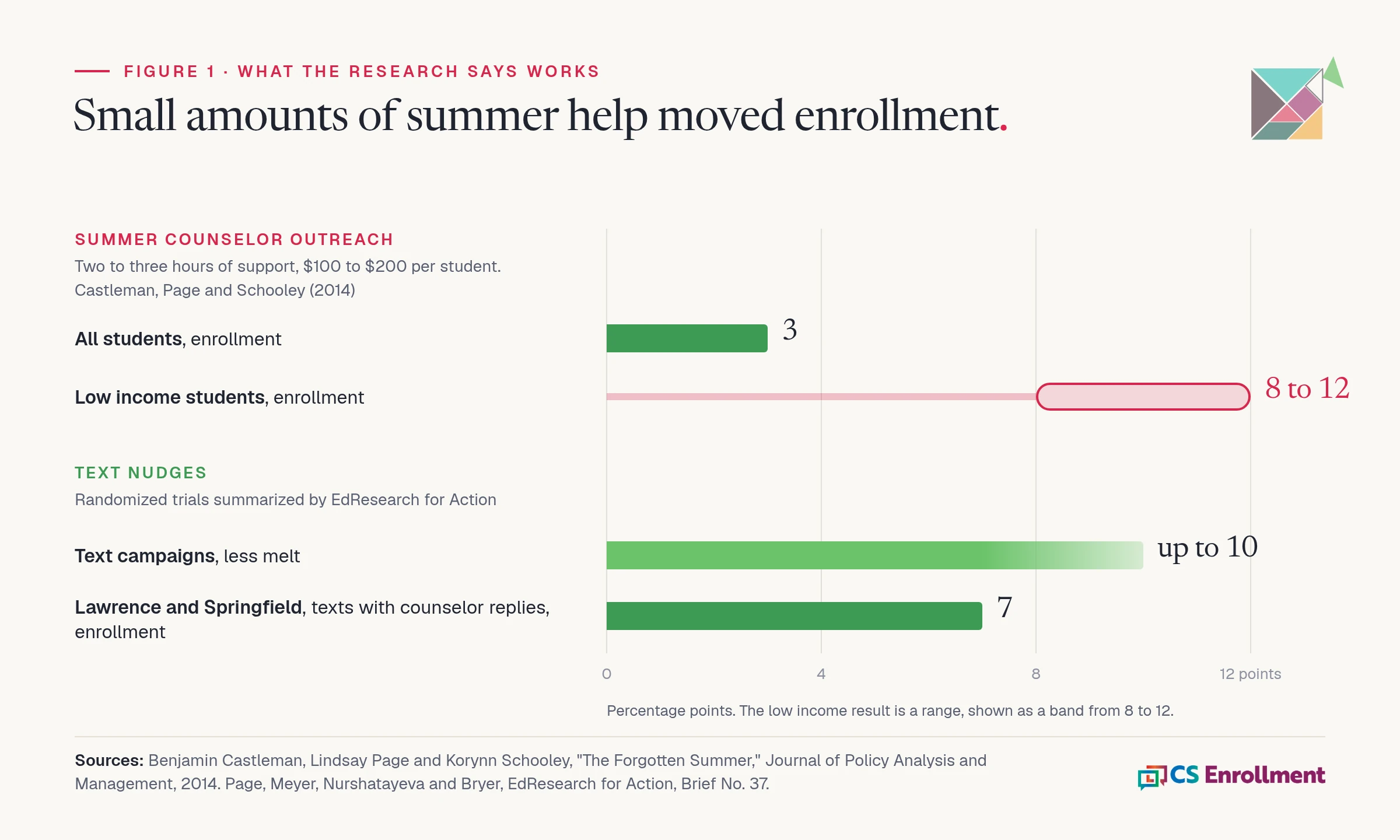
- Nudges. Randomized trials have found that text campaigns can reduce summer melt by up to 10 percentage points. In Lawrence and Springfield, Massachusetts, personalized automated texts with counselor support by reply raised enrollment 7 points among students with limited access to college planning help.
- Counselor outreach. In "The Forgotten Summer," Benjamin Castleman, Lindsay Page and Korynn Schooley report two randomized trials. Two to three hours of summer support raised enrollment 3 points overall and 8 to 12 points among low income students, at $100 to $200 per student, with effects on persistence several semesters into college.
- Trust. A national text campaign for low income graduates did not raise overall enrollment. A similar campaign in Texas, sent by mentors and advisors students already knew, did.
What did Georgia State learn from texting admitted students?
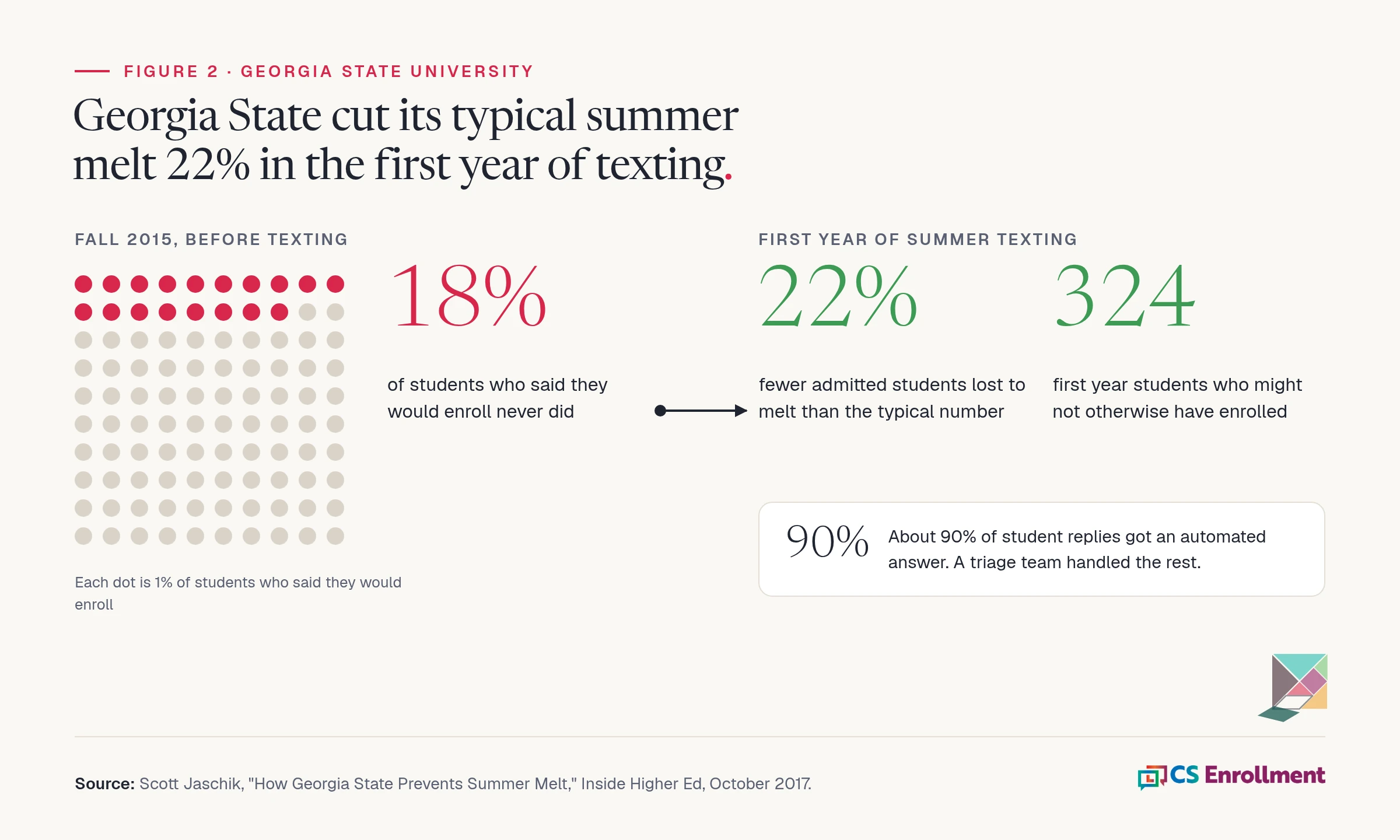
Inside Higher Ed reported in 2017 that 18% of students who said they would enroll at Georgia State in fall 2015 never did. New students were getting about 300 emails from 80 offices, and most went unopened. Nothing marked the financial aid message as more urgent than the one about a recreation center locker.
The university began texting admitted students over the summer. About 90% of student replies got an automated answer. A triage team handled the rest, including one student whose grant was missing because two digits of his Social Security number were transposed. In the first year, the typical number of admitted students lost to melt fell 22%. Inside Higher Ed reported that translates into 324 first year students who might not otherwise have enrolled.
The EdResearch brief adds that Georgia State's chatbot raised registration hold resolution by 7 to 8 points and timely course registration by 2 to 5 points. The lesson for a small office is the split: automate the routine answers, and put a person on the replies that reveal a real problem.
What should a small office send, week by week?
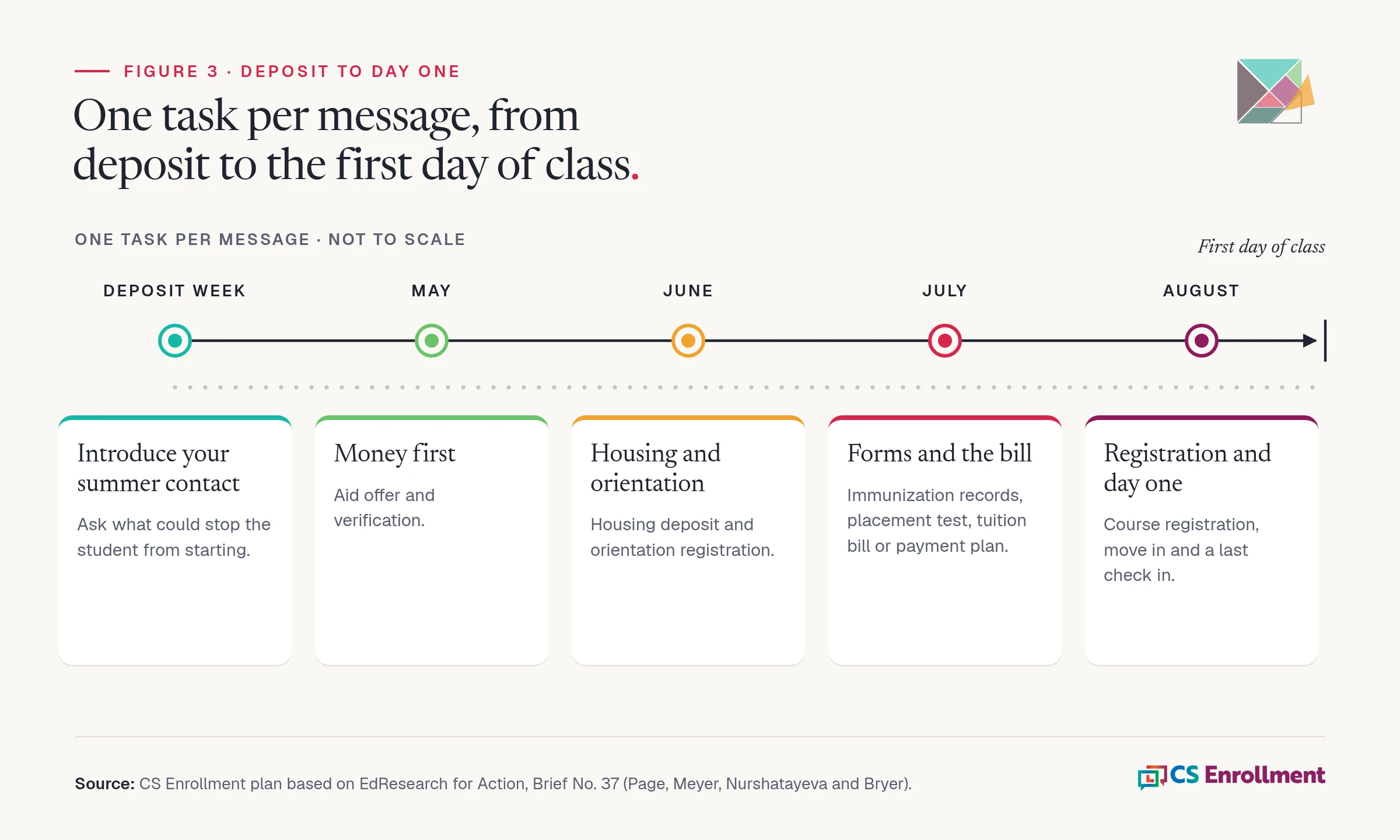
The research points to the same design: one high stakes task per message, tied to a real deadline, with a direct link and a person who answers. General encouragement draws less engagement than deadline driven tasks, according to the EdResearch brief. Here is a plan from deposit to the first day of class.
1. Deposit week. Thank the student by name and introduce the one person who will text them all summer. Ask one question: "Is there anything that could stop you from starting with us in the fall?" Every reply that names a problem goes to a person within a day.
2. May: money first. Ask whether the student has opened the aid offer and whether any verification documents are still outstanding. Link to the exact form. Offer a short call to walk through the award, since students often believe their aid is final while forms are still open.
3. June: housing and orientation. Send one message for the housing deposit and its date, and a separate one for orientation registration. Name the costs students tend to miss, such as meal plans and health insurance, and say where to get help with each.
4. July: forms and the bill. Cover immunization records, any placement test, and the first tuition bill or payment plan. Students with an open item get a personal follow up; students who are done get a short note saying so.
5. August: registration and the first day. Confirm course registration, move in time and where to go on day one. Send a last check in two weeks before classes start, asking the same question as deposit week.
Every text should carry the same clear opt out line. Our post on the FCC's new opt out order explains why that line now belongs in each message.
Who should send the messages?
A named person from the college, not an unknown number. The EdResearch brief finds outreach works better when it comes from a sender the student knows and trusts, such as their intended college. The contrast between the national campaign and the Texas campaign above is the clearest evidence.
In a four person office, that can be one admissions counselor per student group, with a shared inbox behind them. Automated replies can handle the routine questions. The brief recommends human oversight for any AI tool that answers students, so answers stay accurate.
How do you know the plan is working?
Track the deposit to enroll rate, the share of deposited students who are enrolled on the first day of class or census date. Break it out by the groups the research flags as higher risk: low income students, first generation students and students with open aid items. Track which task was still open for each student who melted, and which ones replied to the first check in.
That record tells next year's team which month and which task to move earlier. It also gives the cabinet a figure measured at move in, not at deposit.
Where does a summer check in survey fit?
The deposit week question is the most useful message in the plan, because it finds the students at risk before they go quiet. Our post on survey led student search covers why asking a question draws more replies than telling. CS Enrollment builds its yield work on short interactive surveys that need no account or login. Through CS Enrollment Pathways, those surveys arrive as branded, verified messages, so the student sees the college's name rather than an unfamiliar number.
To see how a summer check in looks on a student's phone, request the sample walkthrough.
Frequently asked questions
What is the fastest way to reduce summer melt? Send each deposited student short messages that ask them to finish one task at a time, from a named person at the college, and have staff answer replies quickly. Randomized trials found that two to three hours of summer support raised enrollment 3 points overall and 8 to 12 points among low income students.
Does texting admitted students reduce summer melt? It can. Randomized trials summarized by EdResearch for Action found text campaigns can cut melt by up to 10 percentage points. Results were stronger when the sender was someone students already knew, and weaker for a large national campaign.
Sources
- Lindsay Page, Katharine Meyer, Aizat Nurshatayeva and Ellen Bryer, Helping Students Make It to College, a research brief on design principles for reducing summer melt.
- Benjamin L. Castleman, Lindsay C. Page and Korynn Schooley, The Forgotten Summer.
- Scott Jaschik, How Georgia State Prevents Summer Melt.