The short answer: Nearly half of US high school students now use AI in their college search. EAB's survey of 5,095 students in fall 2025 found 46% had used an AI tool, and 18% had removed a college from consideration based on what AI surfaced. Capture Higher Ed, surveying nearly 6,000 seniors, put the share at 45%, close to the 47% it measured the year before. Trust is thin: only 2% of seniors in Capture's survey trust AI answers completely, and more than half go straight to the college's website with a question about a specific college. A small college's job is to make its own website the clearest, most current answer and its first direct contact with a student a real conversation.
What does the data say about students using AI to search for colleges?
The US: close to half, in two vendor surveys
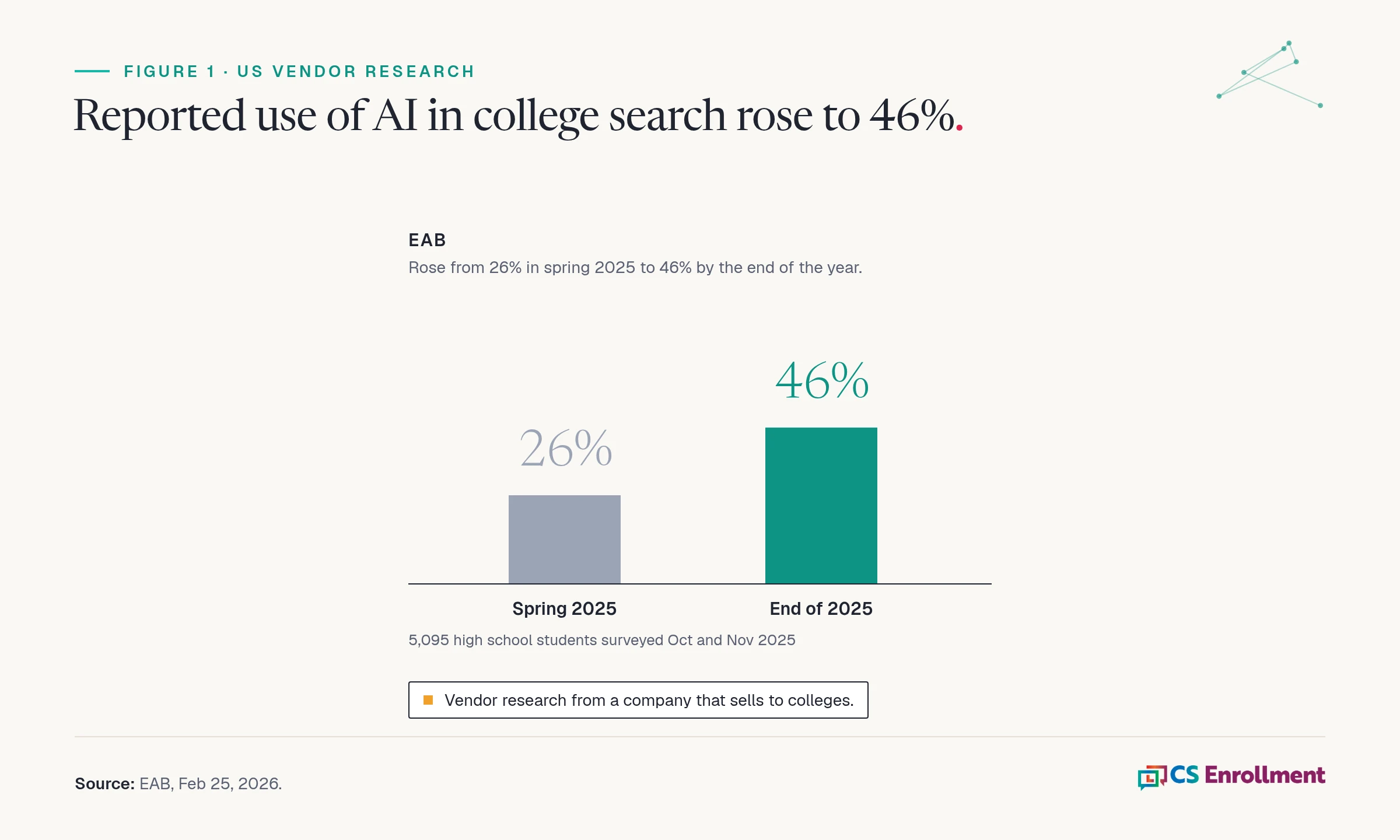
EAB surveyed 5,095 high school students in October and November 2025 and found 46% had used AI tools in their college search. In EAB's words, reported use "rose from 26% in spring 2025 to 46% by the end of the year."
How students use it is practical. In the same survey, 62% used AI to find schools that are a good fit and 48% used it to research application requirements. Trust has not kept pace. The share of students who name AI tools as one of their most trusted sources for accurate information grew from 3% to 7%, still behind other sources.
Capture Higher Ed, which surveyed nearly 6,000 high school seniors, reported: "45% of students have used an AI tool during their college search, which is basically flat from the 47% we measured last year. Only 3% use it daily, and 41% never use it at all." Capture's earlier figure came from high school juniors and seniors, so "flat" is Capture's own comparison of two slightly different groups.
Both are vendor research from companies that sell to colleges. They agree on the level, close to half, and differ on the trend: EAB reports a sharp rise, Capture a flat year. Either way, for many students an AI answer is now part of how a college first gets described to them.
At NACAC's annual conference in Minneapolis this month, Inside Higher Ed reported that attendees worried less about AI written essays and more about how students use chatbots to search for colleges. OpenAI added to that on Oct 7, when it announced College Planner for ChatGPT for Teens. It brings application requirements, deadlines, tasks and financial aid steps for the schools on a student's list into one plan. OpenAI says hundreds of thousands of US teens already use ChatGPT each week to plan for college.
Norway: primary data on where habits may be heading
Medietilsynet, Norway's media regulator, surveys children about their media use every two years. Its Barn og medier 2026 report is based on 1,753 students aged 9 to 18 from 71 schools, surveyed in late 2025 and January 2026.
Use of Google and similar search engines fell from 72% in 2024 to 47% in 2026. AI services, a new response option this year, were used by 51%. AI use climbs with age: 39% of 11 and 12 year olds use AI services, as do half of 13 and 14 year olds and more than 70% of 15 to 18 year olds. The regulator writes that the drop in search is naturally seen alongside the use of AI services.
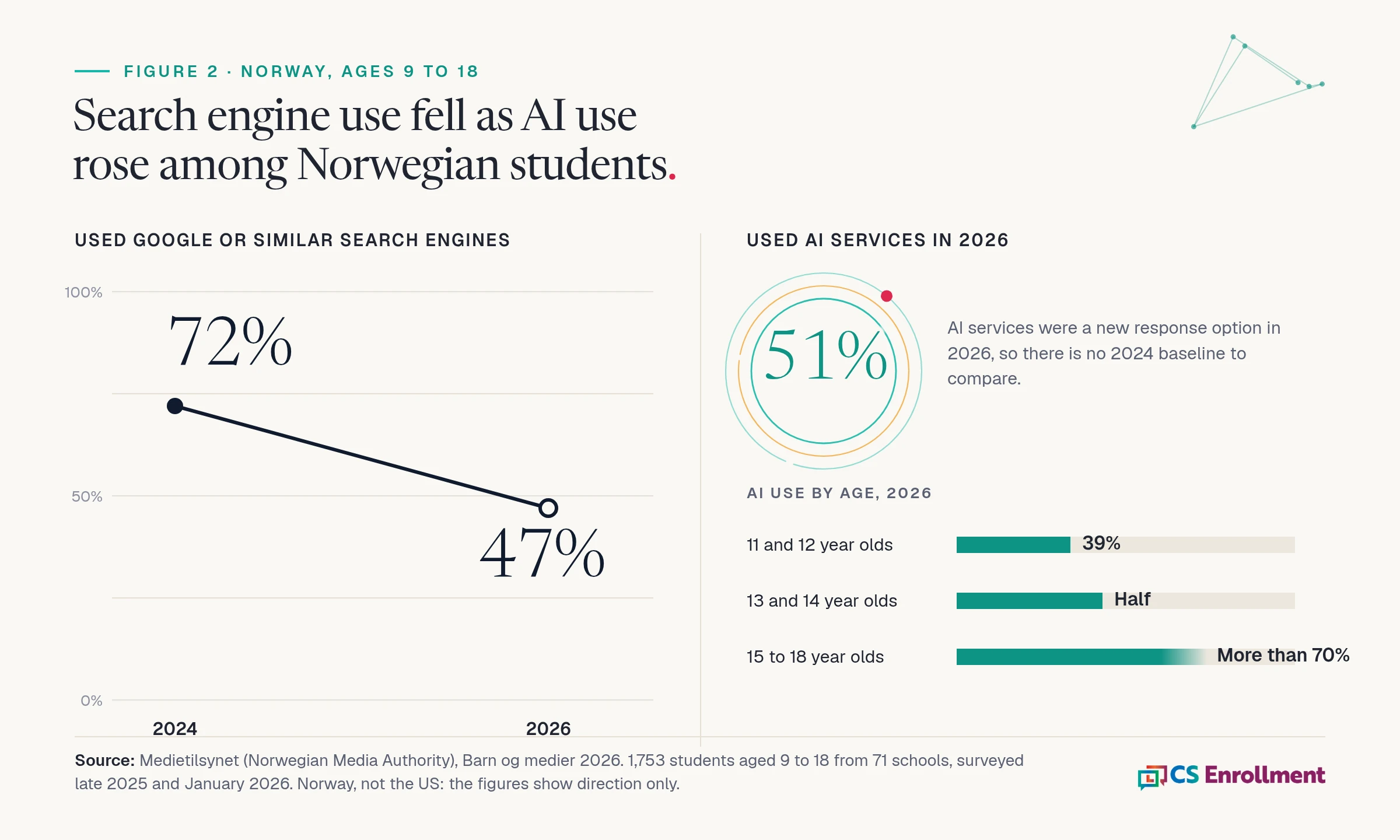
Norway is not the United States, so these figures show direction, not the size of any US shift. And AI was a new category in 2026, so there is no 2024 baseline for it.
What happens when an AI answer gets a college wrong?
The stakes are concrete. In EAB's survey, 18% of students said they removed a college from consideration based on information surfaced through AI generated search results. Inside Higher Ed reported that some students say they get all their information about some institutions from AI tools, and that colleges have focused on making sure the information in AI chats is accurate.
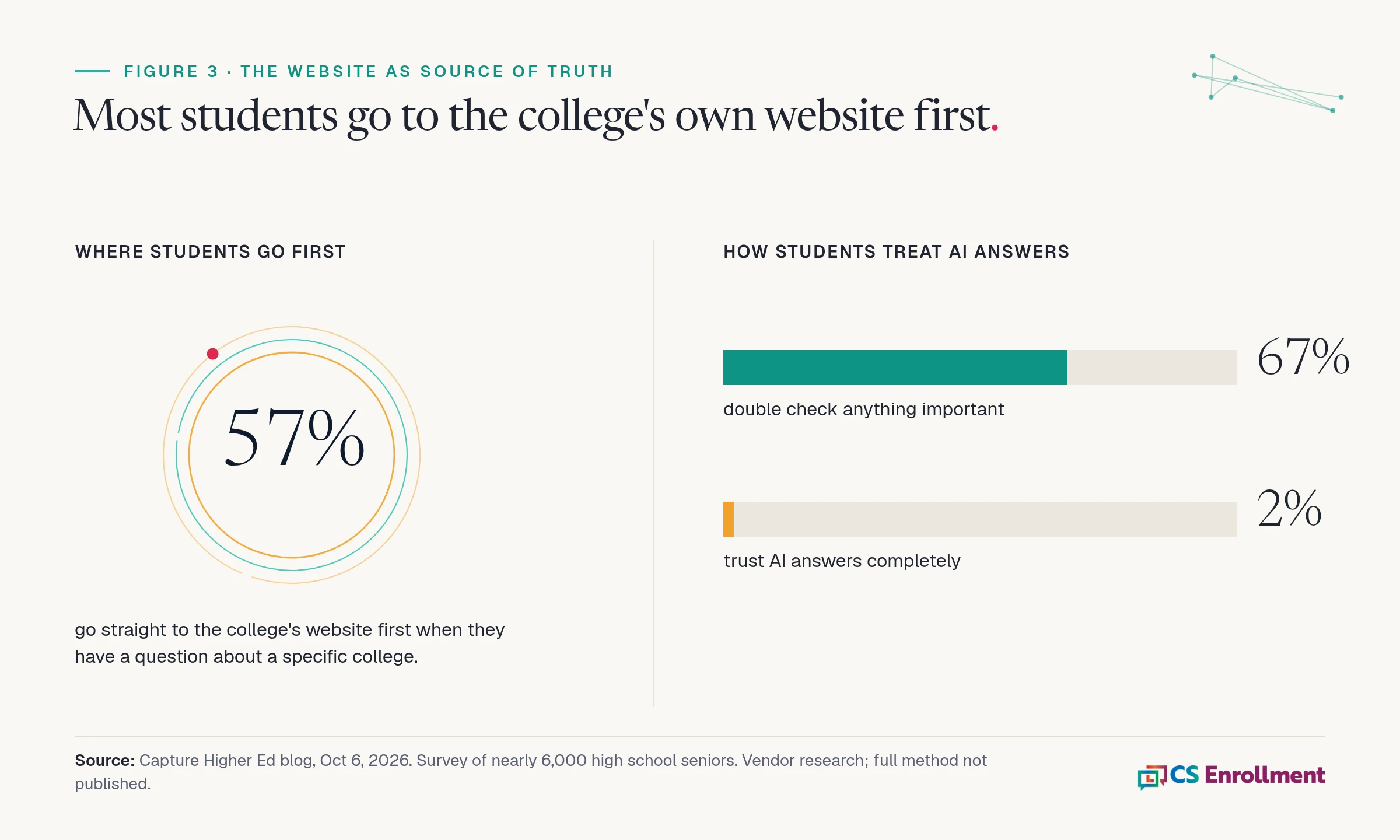
Students do not take those answers on faith. In Capture's survey, only 2% trust AI answers completely, and 67% say they double check anything important. Where AI errors come from is less clear. OpenAI has not said where College Planner gets each school's details. What a college controls is its own public record, and a deadline that appears one way on the admissions page and another way on the aid page leaves room for error, for a student or for a model.
How can a college measure AI's role in search?
Retail data shows how hard this is to see. PYMNTS Intelligence surveyed 2,191 US consumers in August 2026 and found 23.2% now name AI as their main starting point for retail research online. Yet only 6.3% of their most recent AI assisted purchases were completed on a brand's own website or app, and just 2.5% named a direct link from the AI tool as the main reason they bought where they did. The research happens in one place and the decision lands in another.
Colleges are not stores, but the lesson for measurement carries over. Set up a segment in web analytics for visits referred by AI tools such as chatgpt.com, perplexity.ai, gemini.google.com and copilot.microsoft.com. Search Engine Land reported that a ChatGPT tagging bug in mid October briefly caused some ChatGPT visits to be counted as direct traffic, and that the fix began rolling out on Oct 15. Annotate Oct 8 to 16, 2026 in GA4 so that window is not read as a real change. Then add two questions to the inquiry form or first outreach survey: whether the student used an AI tool to research colleges, and which one. Self reported answers fill part of the gap that referral data leaves.
What should a small college fix this cycle?
1. Publish a facts page in plain text. Put cost, aid steps, deadlines and programs on one public page, written in short sentences and dated. Retire prior year pages and stale PDFs that contradict it.
2. Keep your data consistent everywhere it appears. The numbers on your site should match what you report to IPEDS and what appears in your Common App profile. Fix conflicts at the source.
3. Write question shaped pages. Answer the questions families ask, in their words: what it costs after aid, when aid is due, what graduates do. In Inside Higher Ed's NACAC coverage, admissions officers said they are fielding more questions than ever about whether a degree is worth the price.
4. Check what AI tools say about you every month. Ask ChatGPT, Perplexity and Google for your application deadline, aid deadline, net price, fee waiver policy and best known programs. Compare each answer with your facts page. Log every error with the date and the tool.
5. Make the first direct touch a two way conversation. The first contact from the college has to carry substance and invite a reply: the real deadline, the real cost, a question, and a person to reach. EAB found that more than half of students said they would react negatively to messages they perceived to be generated by AI, so that first touch should sound like the college.
Why is the college's own website still the source of truth?
When students have a question about a specific college, more than half go straight to the college's website first, Capture reports; the FAQ on its blog page puts the share at 57%. That is the moment that decides whether an AI answer gets confirmed or corrected. A college whose own site gives the clearest, most current answer wins that check.
Where outreach fits
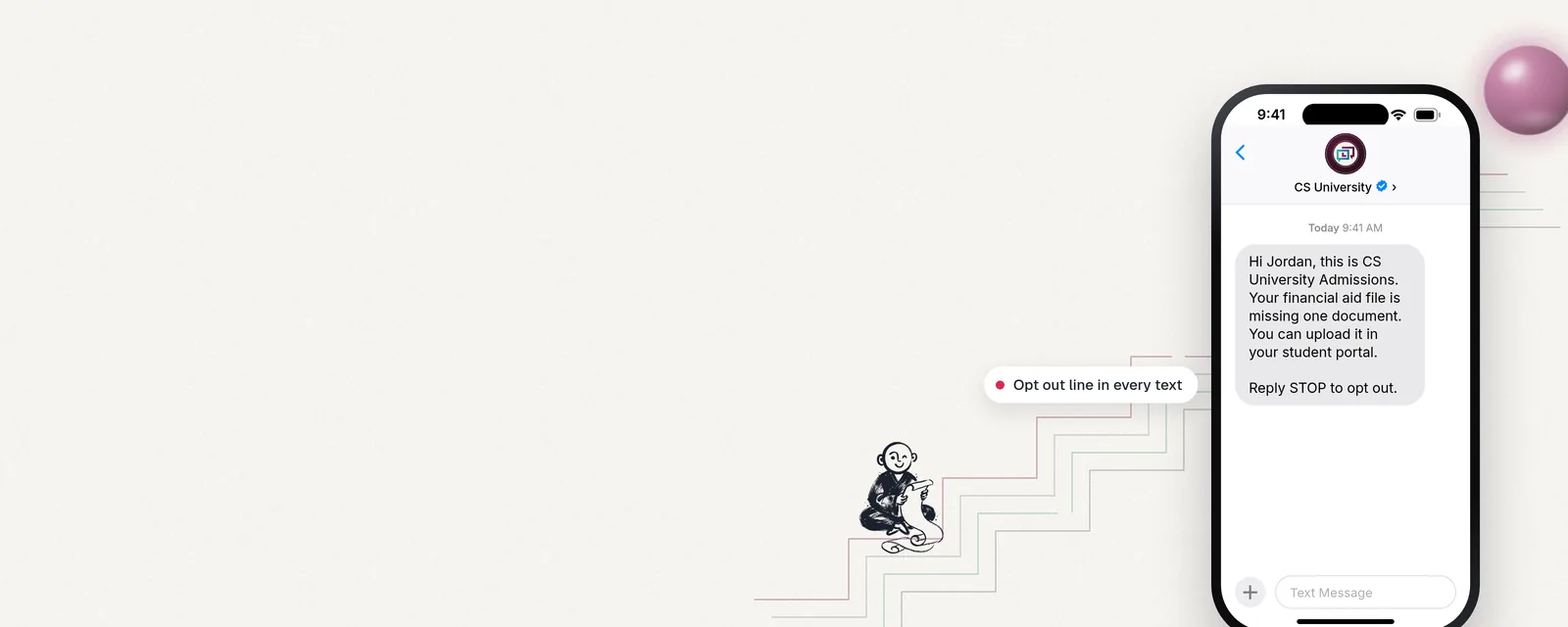
The website answers the student who comes looking. Outreach reaches the student who has not come yet. Survey led outreach turns that first direct contact into a conversation. A short question about how a student is researching colleges, or what they want to study, captures what the student actually wants, and that is the same information a college needs later for yield. A branded, verified message that carries the deadline, the cost and the next step inside the thread puts the college's own answer on the student's phone. CS Enrollment built CS Enrollment Pathways to do that work.
To see what a student sees on their own phone, request the sample walkthrough.
Frequently asked questions
How many students use AI to search for colleges? Nearly half. EAB found 46% of 5,095 high school students surveyed in October and November 2025 had used an AI tool in their college search. Capture Higher Ed found 45% of nearly 6,000 high school seniors had used an AI tool in their college search, close to the 47% it measured the year before. Both are vendor research.
How do I check what ChatGPT says about my college? Ask it, and other AI tools such as Perplexity and Google, the questions a student would ask: your deadline, cost after aid, aid deadline and top programs. Compare the answers with your own published facts, log the errors, and correct the pages they most likely came from.
Sources
- Capture Higher Ed, Responsible AI in College Admissions: How Gen Z Actually Wants Your Team to Use It. Survey of nearly 6,000 high school seniors. Vendor research; the full report is gated and its method is not published.
- EAB, How Students View and Use AI in College Search. The statement that reported use "rose from 26% in spring 2025 to 46% by the end of the year" and the trusted source share of 3% to 7% are on p. 11; the 62% and 48% uses are on p. 12. Vendor research.
- EAB, Nearly Half of High School Students Now Use AI in College Search.
- Medietilsynet (Norwegian Media Authority), Barn og medier 2026. 1,753 respondents aged 9 to 18 from 71 schools.
- Johanna Alonso, 4 Takeaways From NACAC's Annual Admissions Conference.
- OpenAI, Helping teens learn, plan, and shape the future of AI.
- PYMNTS Intelligence, From Prompt to Purchase: Who Wins the AI Shopper? Survey of 2,191 US consumers, August 2026.
- Anu Adegbola, ChatGPT drop in UTM tracking was a bug.