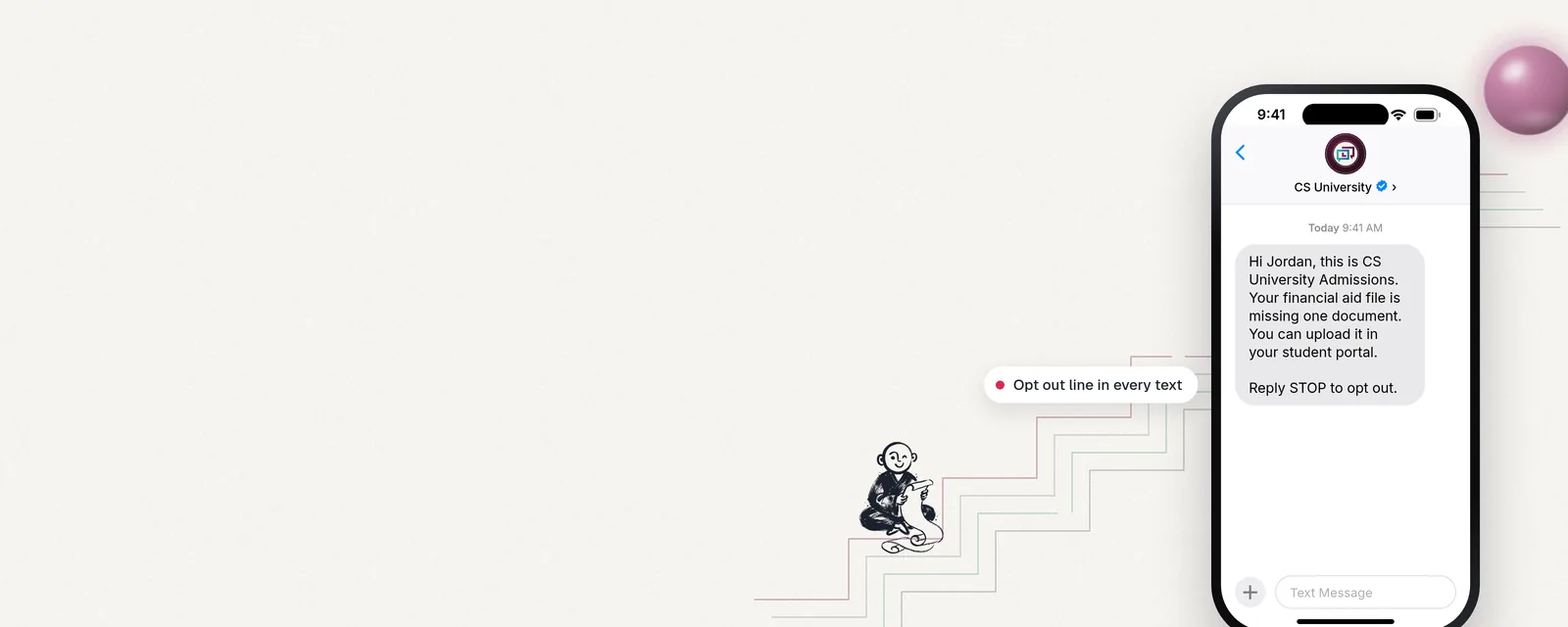
The short answer: Survey led student search is a way to run student search that opens with a short question instead of a pitch. The first message asks a prospective student what they think, what they want to study or what matters to them in a college, and the answers become the profile your counselors use for the next conversation. Search itself still works: in College Board research, students who received outreach through its Student Search Service were 23% more likely to apply to the college that contacted them. The survey changes what that first contact asks for and what the college learns from it.
Why does traditional student search struggle?
Traditional search tells. A college licenses names, then sends a sequence of emails and mailers that describe the campus, the programs and the deadline. The student is asked to read, click and fill out a form. Three problems sit inside that model.
The first is reach. Email sent in volume to students who never asked for it can land in a spam or promotions folder, or never arrive. A message that is not delivered cannot be read. Our post on why search emails never reach students shows how to check.
The second is the size of the ask. An inquiry form or an application is a heavy first step for a 16 year old who has never heard of the college. Most never respond, and the college learns nothing from the silence.
The third is competition for attention. In the College Board natural experiments study, students' contact information was licensed an average of 28.5 times. Every one of those licenses can turn into a stream of messages making the same case in the same format.
Meanwhile, 95% of US teens have or have access to a smartphone, and nearly half say they are online almost constantly, Pew Research Center found in a survey of 1,391 teens in fall 2024. Students are reachable. The question is whether the first message gives them a reason to respond.
What does College Board research say student search is still good for?
College Board sells Student Search Service, so read its research as a publisher studying its own product. The method is strong, though, and the findings are useful for any enrollment leader deciding whether search belongs in the budget.
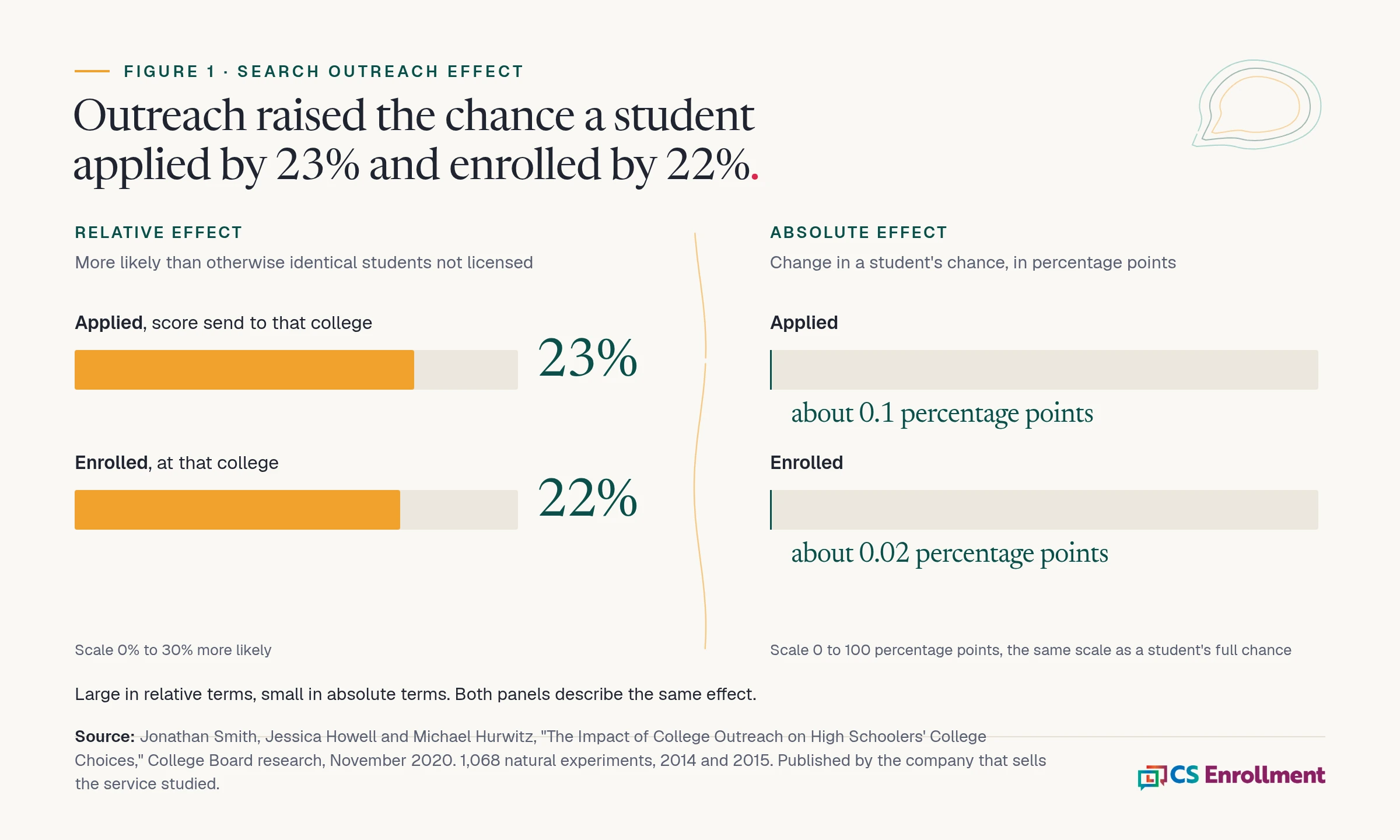
The most rigorous study used 1,068 natural experiments from 2014 and 2015. When a college's search order matched more students than it planned to license, a random subset was licensed. That made it possible to compare otherwise identical students. Students who received outreach were 23% more likely to send scores to (the study's stand in for applying to) the college that licensed them, and 22% more likely to enroll there. In absolute terms those are small moves, about 0.1 percentage points for applying and 0.02 percentage points for enrolling at a specific college. The effects were about twice as large for traditionally underserved students.
A second College Board brief, from April 2021, looked at SAT takers in the 2015 to 2018 graduating classes. Students found through Search enrolled in college at a rate 7.8 percentage points higher than similar students who did not take part. Among the 2015 and 2016 classes, the ones with four years of college data, they graduated within four years at a rate 5 percentage points higher. That study controls for student background, but it is a comparison, not an experiment.
What does student search cost per enrollee?
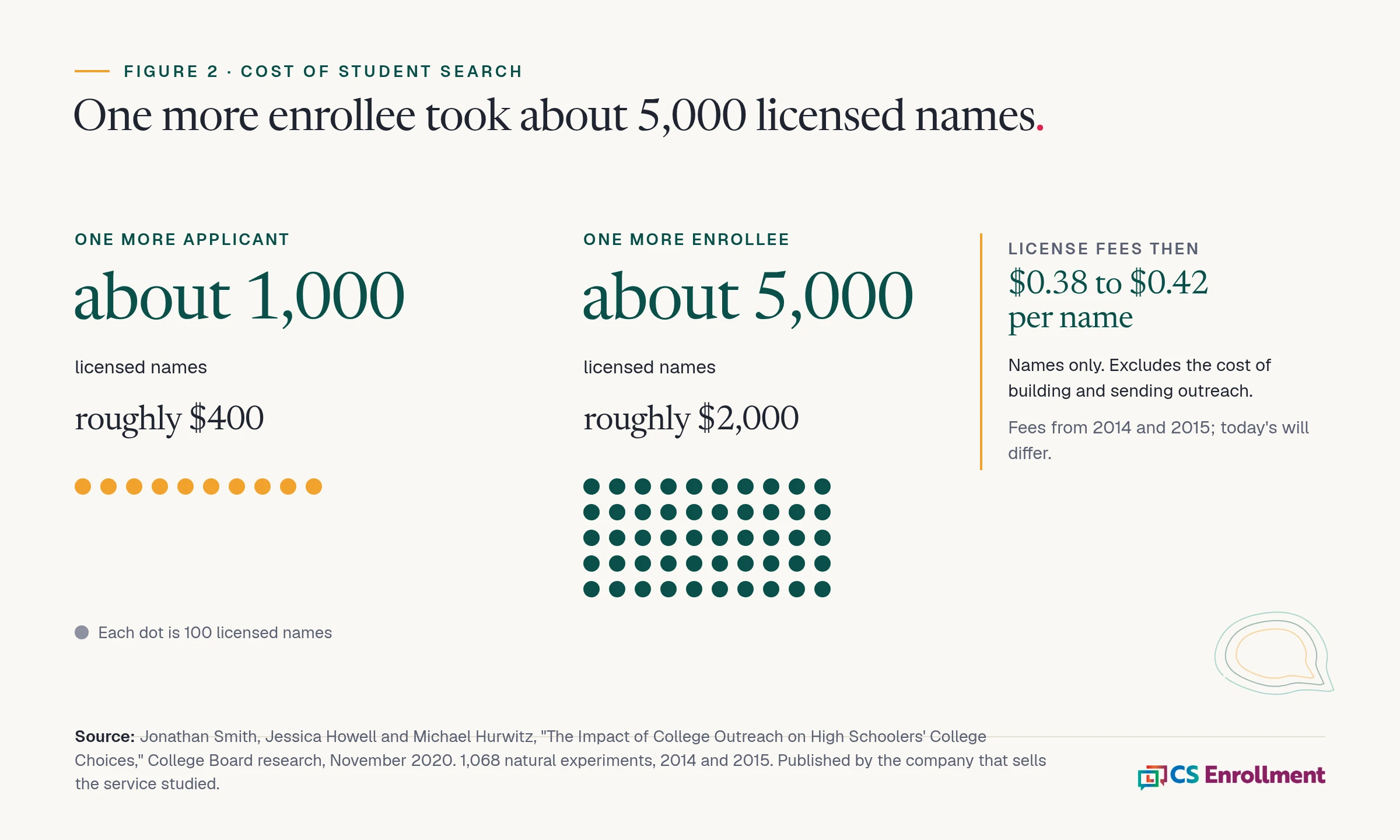
The same paper put a price on those effects. To gain one more applicant, a college needed about 1,000 additional licenses, roughly $400 at the license fees of the time, which ran $0.38 to $0.42 per name. To gain one more enrollee, it needed about 5,000 licenses, roughly $2,000.
Those figures cover the names only. The authors note that they leave out what colleges spend after licensing, on building the outreach and sending it. They also come from 2014 and 2015 fees, so today's numbers will differ. The ratio is the lesson: thousands of names per enrolled student, most of whom never reply.
How does a survey first touch work?
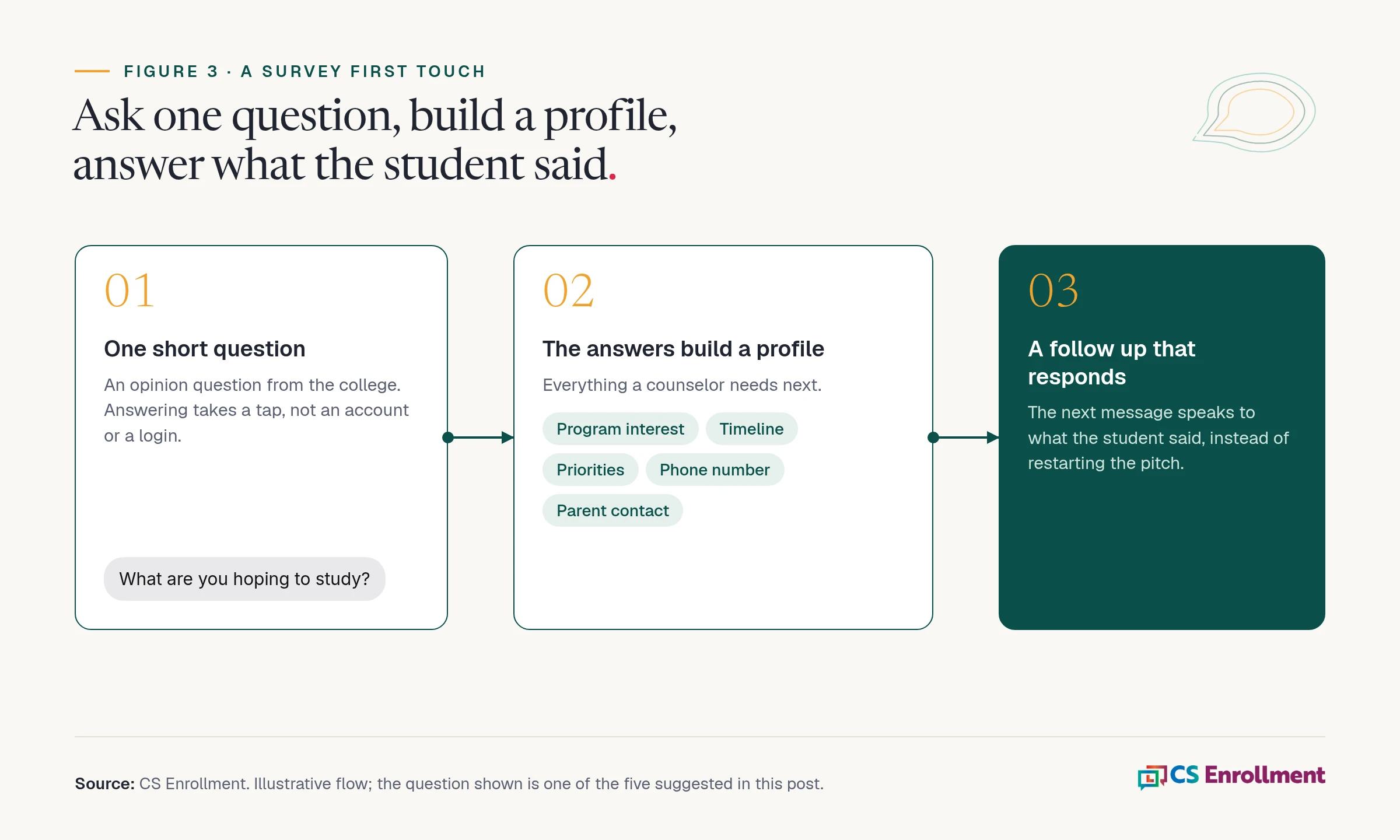
A survey first touch keeps the list and changes the first message. Instead of a brochure, the student gets one short question from the college, phrased as a request for their opinion. Answering takes a tap, not an account or a login.
Each answer does two jobs. It tells the student the college is interested in them, not just in a form submission. And it fills in the profile a counselor needs next: program interest, timeline, what the student cares about, a phone number and a parent contact. The follow up then speaks to what the student said, instead of restarting the pitch.
Parents are part of that profile for a reason. In EAB's 2026 survey of more than 2,500 parents of college bound students, 74% said they are highly involved in their student's search, and 69% said colleges do not give them the information they need. That is vendor research, but the gap is easy to act on. A survey that asks whether a parent should get information too gives the college a direct line to the person who is often asking the hardest questions about cost.
What should you ask in a first touch survey?
Keep it short. One question on the first screen, and no more than five in total. Each question should earn a fact your team will use.
1. "What are you hoping to study?" Offer your programs plus "not sure yet." The answer routes the student to the right faculty voice and the right follow up. 2. "What matters most to you in choosing a college?" Offer cost after aid, academic programs, distance from home, campus life and career outcomes. This tells counselors which conversation to have first. 3. "When do you plan to start college?" Timing separates a senior who needs a deadline this month from a junior who needs a reason to visit next spring. 4. "Who helps you make decisions about college? Should we send them information too?" This captures a parent or guardian contact with the student's permission. 5. "What is the best number to reach you about deadlines and scholarships?" Ask for the phone number after you have offered something useful, and state plainly what you will send.
How should you measure survey led search?
Measure it against the same outcome you use for traditional search: enrolled students and cost per enrollee. Then add the measures a survey makes possible. Track the share of contacts who answer the first question, the share who finish the survey, how many profiles include a phone number or a parent contact, and how many of those students apply and enroll.
Compare like with like. Run the survey first touch on part of a list and your usual sequence on a matched part of the same list, in the same weeks. That is the logic of the College Board experiments on a smaller scale, and it gives your cabinet a number it can trust.
When is survey led search not the right fit?
It is not a fit if no one will act on the answers. A survey that captures program interest and a parent contact, then sends the same generic follow up to everyone, wastes the student's time and the college's credibility.
It is not a fit when the survey turns into a form. Long question sets, required fields and logins bring back the heavy ask the approach is meant to remove.
It needs care where consent rules apply. Asking for a phone number means being clear about what you will send and honoring opt outs. Our post on the FCC's new opt out order covers what is changing, and counsel should confirm the details for each type of message.
And it does not replace brand awareness. A student who has never heard of a college may still need a reason to care before a question lands well.
Where CS Enrollment fits
CS Enrollment was founded on the idea that asking for a prospect's opinion gets a higher response than telling them something. CS Enrollment Pathways puts that idea into the first contact: a short survey inside a branded, verified message, with no account or login, that captures program interest, a phone number and a parent contact for the follow up.
To see what a student sees on their own phone, request the sample walkthrough.
Frequently asked questions
What is survey led student search? It is student search that opens with a short question instead of a pitch. The first message asks the student for an opinion, such as what they want to study or what matters in a college, and the answers become the profile counselors use to follow up.
Is student search still worth it? College Board research suggests it still moves students. In 1,068 natural experiments, students who received search outreach were 23% more likely to apply to and 22% more likely to enroll at the college that contacted them. The same study estimated about 5,000 licensed names, roughly $2,000 in 2014 and 2015 fees, per additional enrollee, before outreach costs. What a college asks in that first contact decides how much it gets back.
Sources
- Jessica Howell, Mike Hurwitz, Zachary Mabel and Jonathan Smith, Participation in Student Search Service Is Associated with Higher College Enrollment and Completion. SAT takers in the 2015 to 2018 high school graduating classes, matched to National Student Clearinghouse data. Research by the publisher of Student Search Service.
- Jonathan Smith, Jessica Howell and Michael Hurwitz, The Impact of College Outreach on High Schoolers' College Choices: Results From Over 1,000 Natural Experiments. 1,068 natural experiments in 2014 and 2015; cost estimates in the conclusion. Published by College Board research.
- EAB, Findings from EAB's 2026 Parent Survey. More than 2,500 parents of college bound students. Vendor research.
- Michelle Faverio and Olivia Sidoti, Teens, Social Media and Technology 2024. 1,391 US teens ages 13 to 17, surveyed Sept 18 to Oct 10, 2024.