Last updated Oct 22, 2026. Written for enrollment and admissions leaders who run student search by email.
The short answer: A common reason prospective students don't open college emails is that many never see them. Since February 2024, Gmail and Yahoo have required bulk senders to authenticate their mail, offer one click unsubscribe and keep spam complaints below 0.3%. Search campaigns sent to cold, purchased names are among the most likely to miss those marks, so they land in spam or get rejected before a subject line is ever read. Check deliverability first, then rewrite the copy.
Is it the subject line, or is the email never arriving?
Most advice on low open rates starts with the message: shorter subject lines, a clearer ask, a warmer tone. That advice assumes the email reached the inbox. A search email filtered to spam does not get read, however well it is written.
Students do describe college email as noise. CollegeVine surveyed 3,009 high school students with CollegeVine accounts for a report published in June 2024 (vendor research). The median student had received 1,040 college emails in the previous 12 months, and 68% agreed that "The college emails I've received feel like spam." Only 43% said the same about mail.
Those two problems feed each other. When students ignore or report search email, mailbox providers read that as a signal about the sender. Future messages from the same domain are then more likely to go to spam, including the ones students would have opened.
What changed for bulk email senders in 2024?
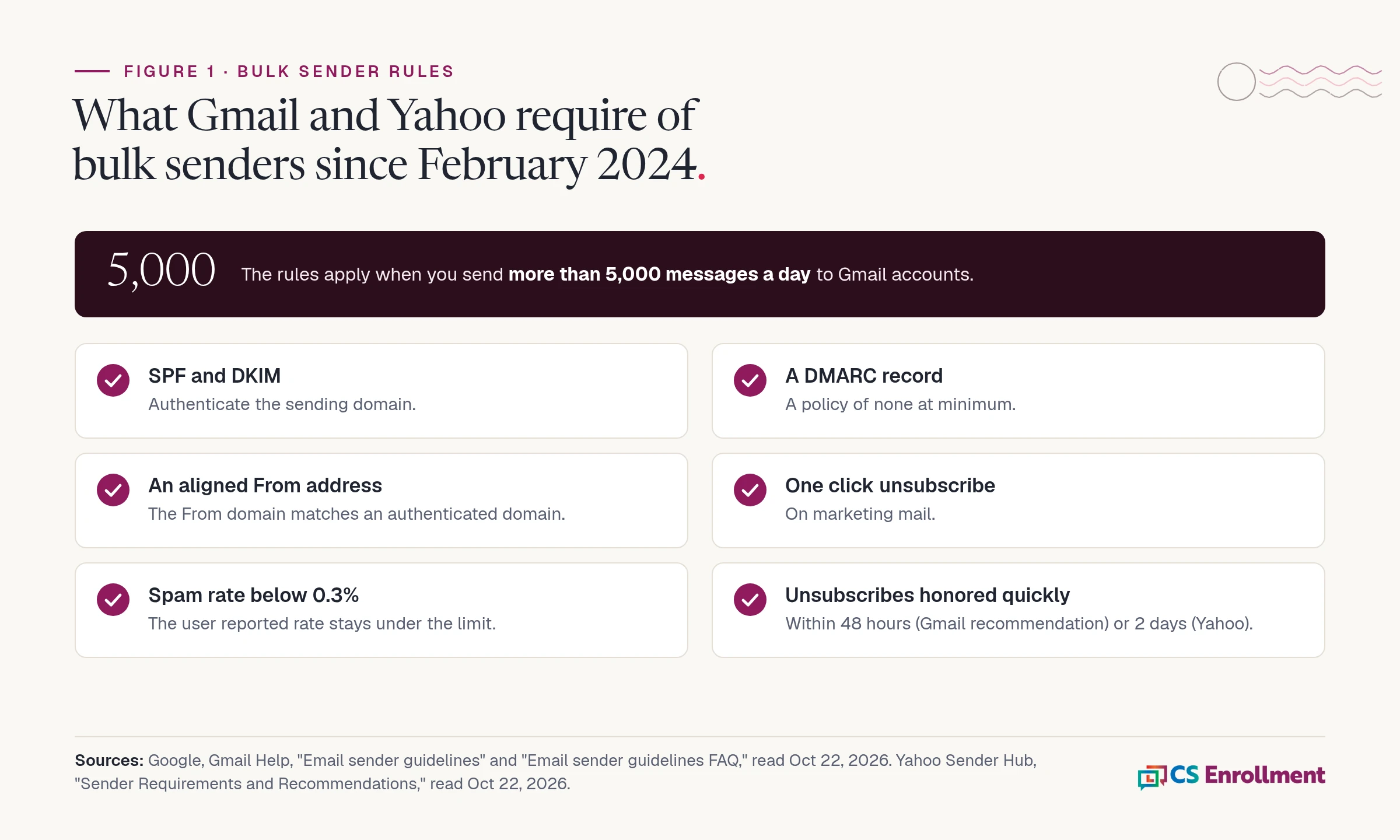
Starting Feb 1, 2024, Google began requiring every sender to Gmail accounts to set up SPF or DKIM authentication and keep the spam rate reported in Postmaster Tools below 0.3%. Senders of more than 5,000 messages a day to Gmail accounts face stricter rules. They must use SPF, DKIM and DMARC, align the From address with an authenticated domain, and support one click unsubscribe on marketing messages, with a visible unsubscribe link in the body.
Yahoo set the same core standards for bulk senders in February 2024. It also asks senders to honor unsubscribe requests within 2 days, and Google recommends 48 hours. Microsoft began enforcing similar authentication rules for Outlook.com in May 2025 for domains sending more than 5,000 emails a day. Its post says noncompliant messages may be routed to Junk or rejected.
Two details matter for colleges. Google counts every message sent from the same primary domain, subdomains included, toward the 5,000 a day threshold. And a sender that crosses it once is treated as a bulk sender permanently. Google's FAQ also says enforcement on noncompliant traffic increased in November 2025, with temporary and permanent rejections.
How much spam is too much?
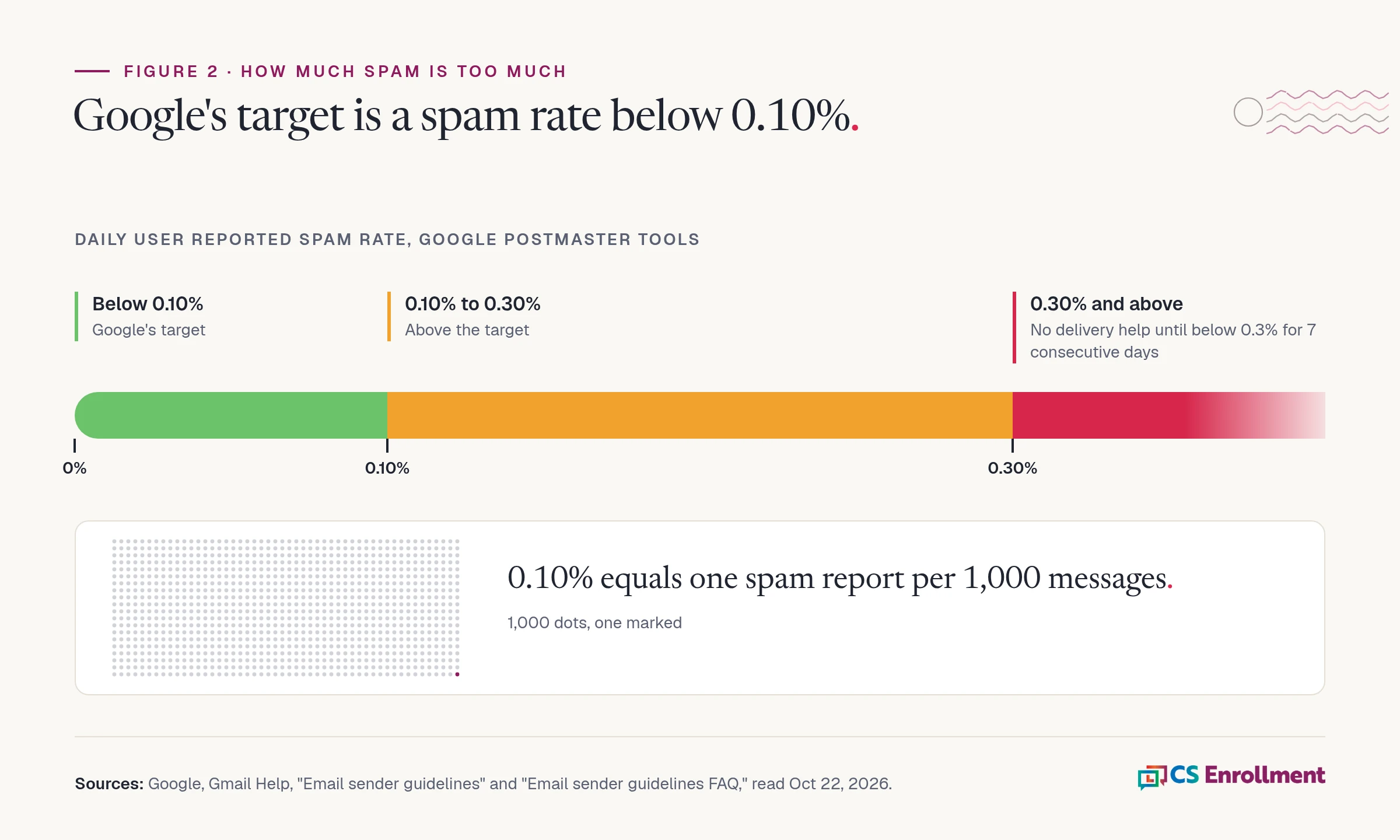
The ceiling is lower than most teams expect. Google tells senders to keep spam rates below 0.10% and to avoid ever reaching 0.30%. At 0.10%, that is one spam report for every 1,000 messages.
Above 0.3%, Google says a bulk sender is ineligible for delivery help, and stays that way until its rate has been below 0.3% for 7 consecutive days. Google also notes that it does not track open rates, and that low open rates are not a reliable sign of a spam problem. The spam rate in Postmaster Tools is the number to watch.
Why are student search sends so risky?
Search breaks most of the habits that mailbox providers reward. Google tells senders not to purchase email addresses and not to send to people who did not sign up. Yahoo says the same and asks senders to confirm each opt in. A search list is, by design, a list of students who have not yet heard from the college.
EAB, a research and services firm in enrollment, makes the same point in its guidance on spam filtering. Enrollment marketers rely on large lists sourced from third parties, so they are often emailing students who have not engaged before. EAB says providers increasingly assume a sender is not legitimate until real recipients engage, which leaves colleges more exposed than senders mailing their own customers.
Volume makes it worse. Google advises senders to increase volume slowly, send at a consistent rate and avoid sudden spikes, and warns that doubling volume suddenly can bring rate limiting or a drop in reputation. A search campaign that drops tens of thousands of new names in one week does exactly that. Engagement also depends on the ask itself; our post on survey led student search looks at opening with one short question instead of a pitch.
What does a damaged sender reputation cost a college?
The cost is not limited to search. Google says repeated spam reports can lower a domain's reputation over time, and that later messages from that domain become more likely to land in spam. Yahoo notes that each sending IP and DKIM domain carries its own reputation.
At many colleges, the primary campus domain also carries financial aid notices, registrar mail, deposit reminders and messages to admitted students. If search mail goes out from that same domain, complaints about search can follow those messages into spam. A missed aid document request costs far more than an unopened search email.
That is why both Google and Yahoo recommend separating mail by type. Yahoo tells senders not to send bulk marketing from the same IPs used for transactional mail and alerts. Google recommends a different From address for each category of message and, where more than one IP is used, a different IP for each message type.
A five point check an admissions office can run this week
1. Confirm authentication on every sending domain. Ask IT or your email platform to confirm that SPF, DKIM and DMARC are published and passing for each domain that sends admissions mail, including any vendor sending for you. A DMARC policy of `p=none` meets the minimum. Check that the From address aligns with the authenticated domain.
2. Read your spam rate in Google Postmaster Tools. Verify your sending domain in Postmaster Tools and look at the daily spam rate and the compliance status dashboard. Compare it with Google's 0.10% target and 0.3% ceiling, campaign by campaign.
3. Keep search mail off the domain that sends aid and registrar mail. Find out which domain and From address each campaign uses. Search, inquiry follow up and operational mail should not share one address. Ask your platform how reputation is separated, and remember that Google counts subdomains toward the primary domain's volume.
4. Clean the list before you send. Remove hard bounces, invalid addresses and names you cannot trace to a known source. Microsoft suggests cleaning lists monthly or quarterly. Make sure one click unsubscribe works and that requests are honored within 48 hours.
5. Send by engagement, not by calendar. Start new names at low volume, raise it gradually, and give more sends to students who open and click. EAB recommends lighter cadences for less familiar audiences, such as new or distant markets. Pause any segment where complaints rise.
Should search rely on email alone?
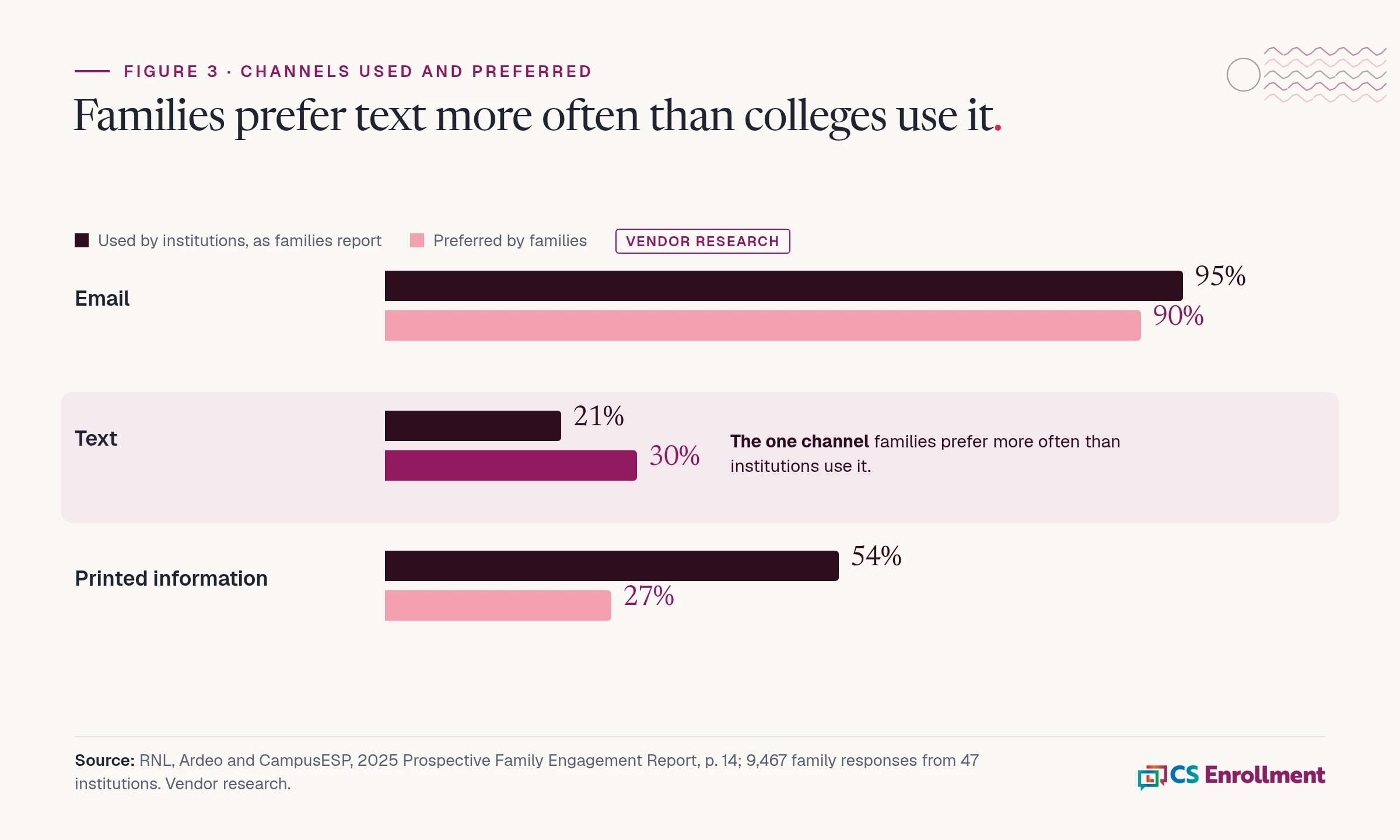
Email still matters to families. The 2025 Prospective Family Engagement Report (RNL, Ardeo and CampusESP) asked families which channels colleges use with them and which they prefer, across 9,467 family responses from 47 institutions (vendor research). Email led both lists: 95% of families said colleges use it, and 90% named it a preferred channel.
The same report shows a gap on text. 30% of families preferred text messages, but only 21% said colleges use them. Printed information ran the other way: 54% said colleges use it, and 27% preferred it. Students are within reach on their phones: Pew Research Center found that 95% of US teens ages 13 to 17 have or have access to a smartphone, in a fall 2024 survey of 1,391 teens. For colleges adding texting, the consent and opt out rules are covered in our post on the FCC's new opt out order.
Where CS Enrollment fits
CS Enrollment runs search on high reputation sending infrastructure that it owns and monitors, so a college's primary domain stays out of the cold list risk described above. Alongside email, CS Enrollment Pathways reaches students through branded, verified text messaging that shows the school's name.
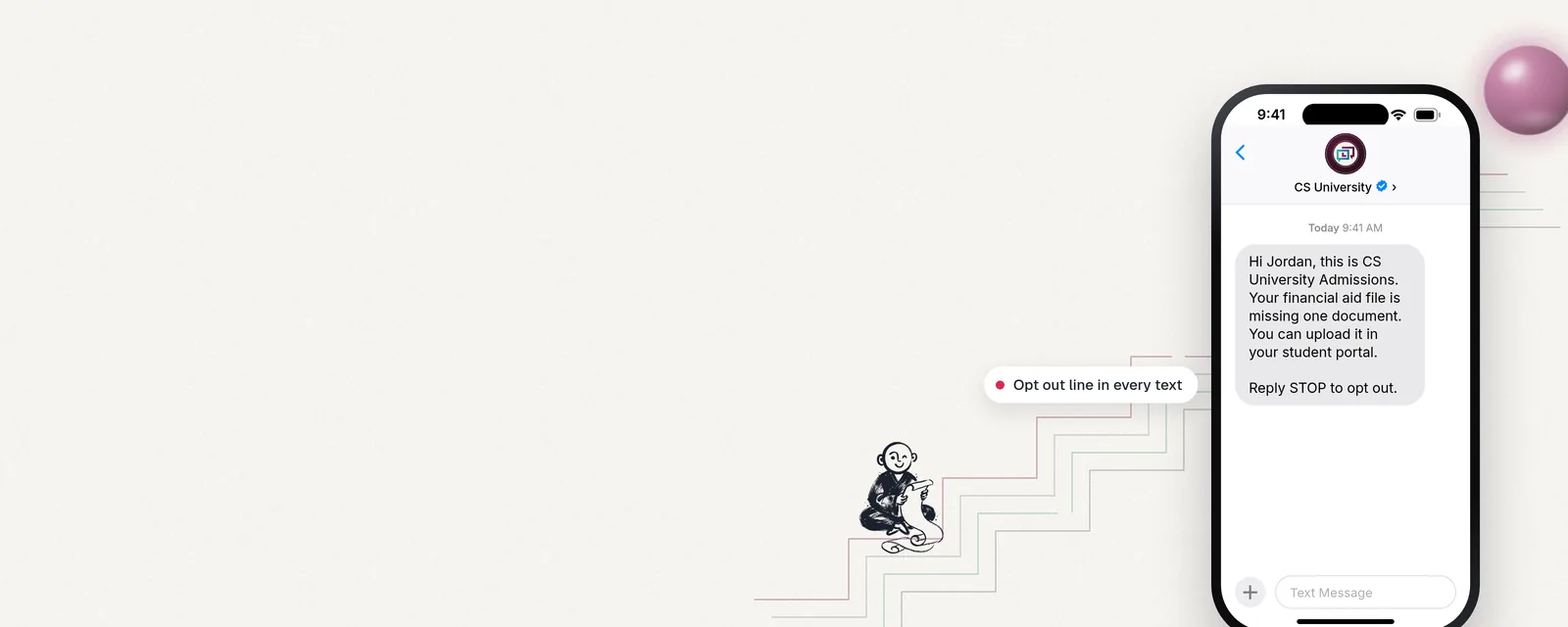
To see how a search message looks when it arrives on a student's phone, request the sample walkthrough.
Frequently asked questions
Why do college admissions emails go to spam? Mailbox providers such as Gmail and Yahoo filter mail that is not authenticated, draws spam complaints above 0.3%, arrives in sudden volume spikes or goes to people who never signed up. Search lists of purchased names often trigger several of these at once.
Does using a subdomain for search email protect our main domain? Partly. Separating mail by type is what Google and Yahoo recommend, because each sending domain and IP builds its own reputation. But Google counts subdomain mail toward the primary domain's 5,000 a day bulk threshold, so a subdomain is not a way around the rules. Authentication, list hygiene and low complaint rates still apply.
Sources
- Google, Gmail Help, Email sender guidelines.
- Google, Gmail Help, Email sender guidelines FAQ.
- Yahoo Sender Hub, Sender Requirements and Recommendations.
- Microsoft Community Hub, Microsoft Defender for Office 365 Blog, Strengthening Email Ecosystem: Outlook's New Requirements for High Volume Senders.
- Michael Koppenheffer, EAB, Why your messages are getting flagged as spam, and how to avoid it.
- CollegeVine, Traditional marketing efforts aren't cutting it for the modern day student. Survey of 3,009 high school students with CollegeVine accounts. Vendor research.
- 2025 Prospective Family Engagement Report. (RNL, Ardeo and CampusESP), p. 14. 9,467 family responses from 47 institutions (p. 37). Vendor research. Full report on ERIC, ED675828.
- Michelle Faverio and Olivia Sidoti, Pew Research Center, Teens, Social Media and Technology 2024. Online survey of 1,391 US teens ages 13 to 17, Sept 18 to Oct 10, 2024, through Ipsos KnowledgePanel. Read Oct 22, 2026.
- Google, Postmaster Tools.