The short answer: AI tools now shape where students look for colleges, but the visits they send are a small and easily mislabeled slice of website traffic. Measure AI's influence by asking students how they found you and checking what AI says about you, not by referral counts alone.
Marketers spent the past two weeks arguing about a ChatGPT traffic drop that turned out to be a tracking bug. In the same stretch, three analyses sized AI traffic against Google. Read together, they say the same thing to an admissions office: the referral report is the wrong place to judge AI search.
What happened to ChatGPT traffic in October?
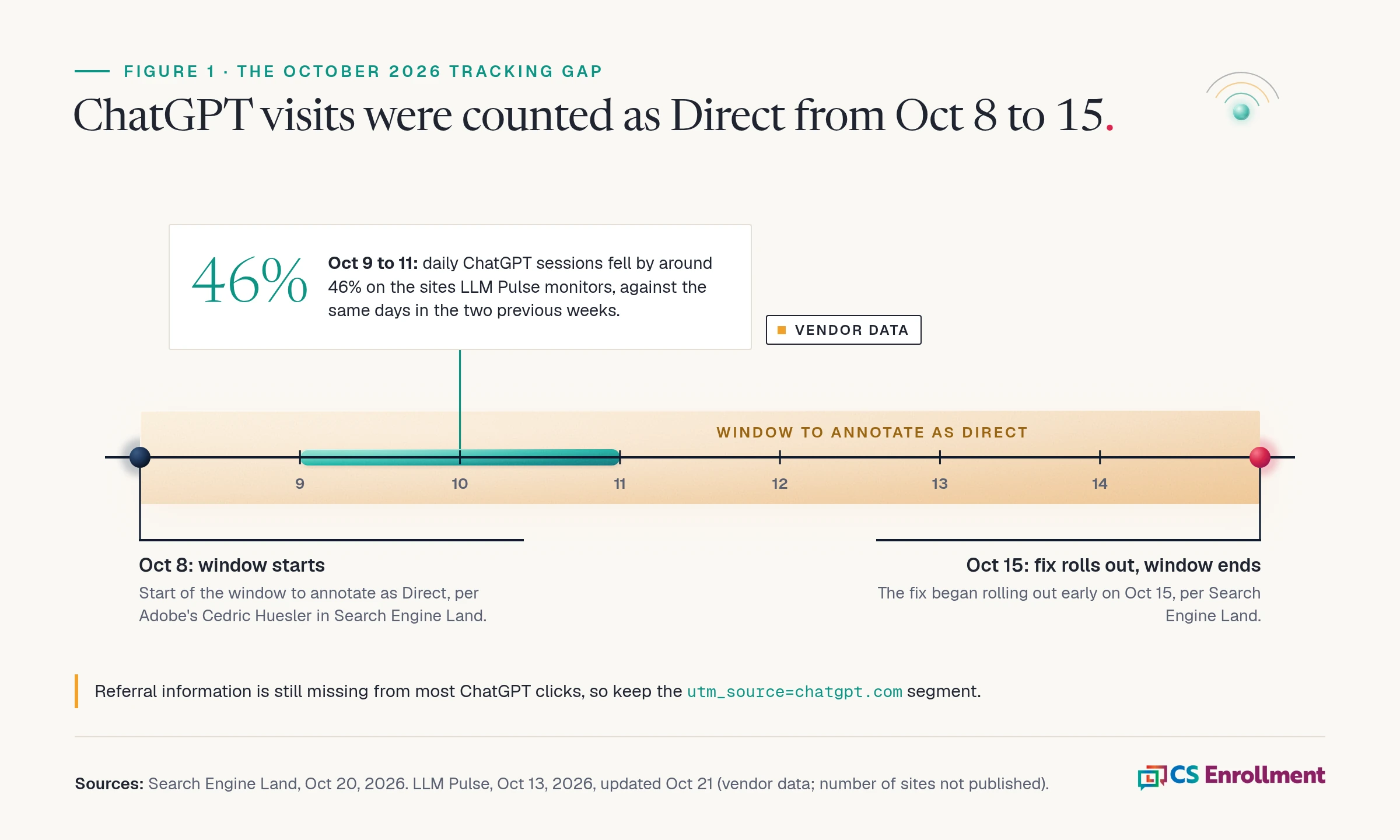
For about a week, many visits from ChatGPT were counted as Direct traffic. Search Engine Land reported on Oct 20 that ChatGPT links had stopped carrying the utm_source=chatgpt.com tag. It reported that OpenAI "confirmed that the missing UTM parameters were a known bug," and that "the rollout began early on October 15." Adobe's Cedric Huesler, quoted in the same report, recommends annotating Oct 8 to 15 in analytics so the gap is not read as a real decline.
LLM Pulse, a vendor that tracks AI visibility, measured the dip on the sites it monitors. Daily ChatGPT sessions fell "by around 46%" from Oct 9 to 11, compared with the same days in the two previous weeks. That is one vendor's sample, and it does not publish the number of sites.
The fix did not solve everything. Search Engine Land also notes: "Referral information is still missing from most ChatGPT clicks." That leaves the utm_source=chatgpt.com tag as the main signal analytics has.
How much traffic does AI actually send?
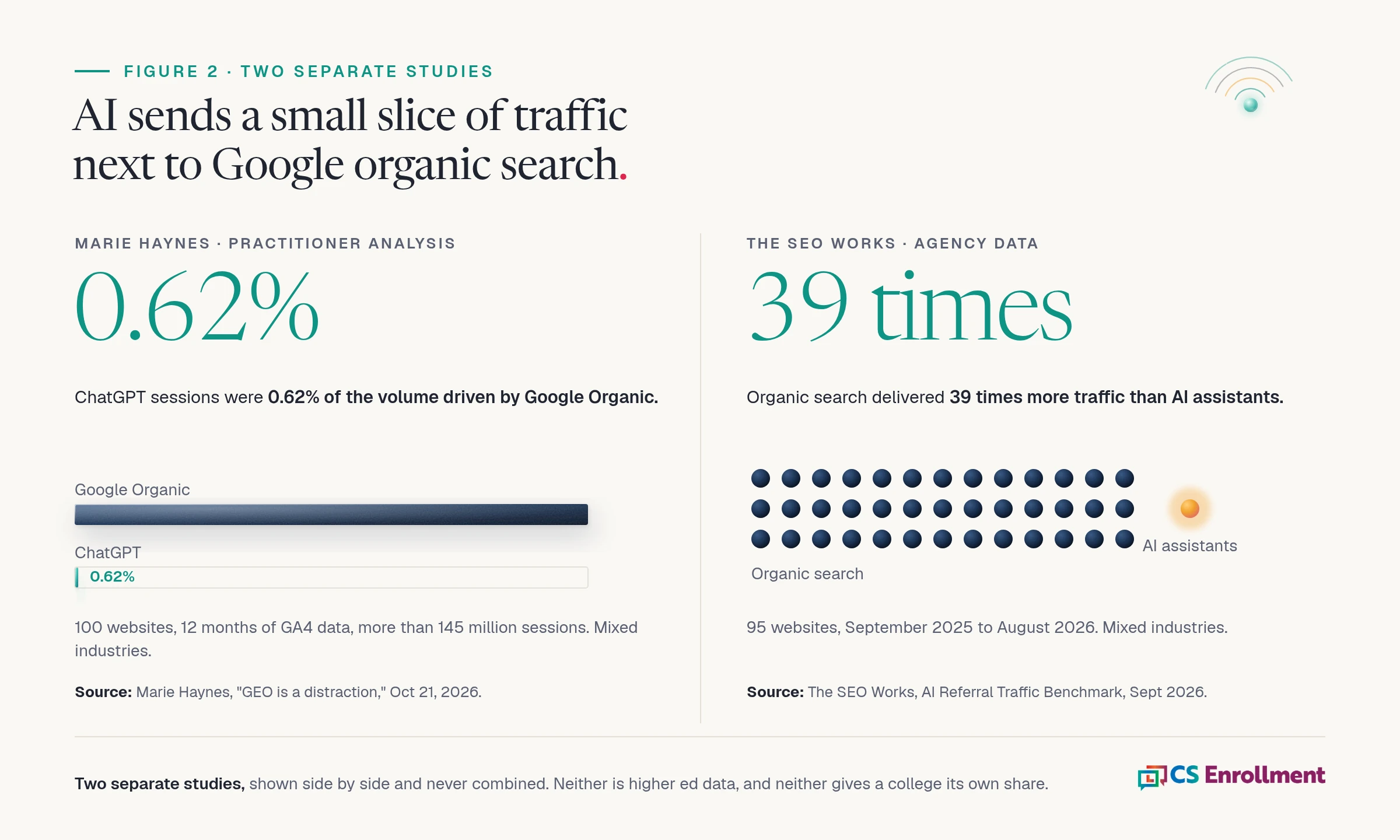
Less than the debate suggests. Marie Haynes, an SEO practitioner, analyzed 12 months of GA4 data from 100 websites with more than 145 million sessions. Sessions from ChatGPT came to "just 0.62% of the volume driven by Google Organic."
The SEO Works, a UK agency, studied 95 websites from September 2025 to August 2026. It found that "organic search delivered 39 times more traffic than AI assistants."
Both are practitioner or agency data from mixed industries, not higher ed. Neither tells a college what its own share is. Both point the same way: AI referrals are a small line in the report.
Is AI traffic hiding in Direct?
Not in a way analytics can see yet. Kevin Indig, who writes the Growth Memo newsletter, examined the GA4 data of 12 sites, a sample he says skews toward B2B. "Direct sessions with identifiable AI traces are only 0.003% of total direct traffic," he found. In a separate analysis of four brands and 632 tests, he could not establish a reliable link between AI visibility and later branded search or Direct traffic.
These are small samples, and Indig says so. The fair reading is that analytics cannot see AI's influence well, not that the influence is absent. His own conclusion is that self reported attribution, combined with leading indicators, is the better way to measure it.
Does AI matter for enrollment, then?
Yes, before the visit happens. EAB surveyed 5,095 high school students in October and November 2025. It found that 46% "now use AI tools such as ChatGPT during their college search, up sharply from 26 percent in spring 2025." In the same survey, 18% removed a college from consideration based on information surfaced through AI generated search results. EAB is vendor research. Our post on how students use AI to search for colleges covers those findings in more detail.
Retail shows the same gap between influence and clicks. PYMNTS Intelligence surveyed 2,191 US consumers in August 2026. It found 23.2% name AI as their main starting point for retail research, while just 2.5% named a direct link from the AI tool as the main reason they bought where they did. That is consumer retail data, not college search. The pattern still applies: the research happens in one place, and the decision lands in another.
Our take: what should an admissions office do this month?
Referral counts are the wrong scoreboard for AI search. A student who asks ChatGPT about a college and later types its web address shows up as Direct. A tagging bug can hide a week of real visits. The student, though, knows how they found you.
1. Ask students how they found you. Add "How did you first hear about us?" to the inquiry form and the first touch survey, with an AI tool option and a follow up asking which one. It is the same logic behind survey led student search: asking beats guessing.
2. Check what AI says about you. Ask ChatGPT, Perplexity and Google the ten questions a prospective student would ask about your college: cost after aid, deadlines, programs and outcomes. Fix what is wrong on your own pages first, since that is the record you control.
3. Build an AI referrer segment. In GA4, group visits from chatgpt.com, perplexity.ai, gemini.google.com and copilot.microsoft.com. Keep utm_source=chatgpt.com in the definition, because most ChatGPT clicks still arrive without referral data. Annotate Oct 8 to 15, 2026.
4. Judge AI by influence, not volume. Track self reported source on inquiries and applications, and watch branded search over time. Treat referral volume as a floor, not a total.
Survey led outreach through CS Enrollment Pathways asks students directly how they found a college and what they are weighing, so the answer comes from the student, not a referrer string.
To see what a student sees on their own phone, request the sample walkthrough.
Frequently asked questions
Why did ChatGPT referral traffic drop in October 2026? A tracking bug. Search Engine Land reported that ChatGPT links stopped carrying the utm_source=chatgpt.com tag, so many visits were counted as Direct. OpenAI confirmed a known bug, and the fix began rolling out on Oct 15. Annotate Oct 8 to 15, 2026 in GA4.
How do I track AI traffic to a college website? Build a GA4 segment for AI referrers such as chatgpt.com, perplexity.ai, gemini.google.com and copilot.microsoft.com, and keep the utm_source=chatgpt.com tag in it. Then add a self reported source question to the inquiry form, because referral data misses much of AI's influence.
Does AI search send much traffic to websites? Not yet. Marie Haynes found ChatGPT sessions were 0.62% of Google organic volume across 100 websites, and The SEO Works found organic search delivered 39 times more traffic than AI assistants across 95 websites. Neither study covers higher ed alone.
Sources
- Anu Adegbola, ChatGPT drop in UTM tracking was a bug. Source for the bug, the fix rollout on Oct 15, the Oct 8 to 15 window and the missing referral information.
- Esteve Castells, ChatGPT Referral Traffic Fell by Almost Half on October 9, 2026. Vendor data from the sites LLM Pulse monitors; the number of sites is not published.
- Marie Haynes, GEO is a distraction. Practitioner analysis of 100 websites, mixed industries.
- The SEO Works, AI Referral Traffic Benchmark. Agency data from 95 websites, September 2025 to August 2026.
- Kevin Indig, Does AI drive more direct traffic?
- EAB, Nearly Half of High School Students Now Use AI in College Search. Vendor research.
- EAB, How Students View and Use AI in College Search. Vendor research.
- PYMNTS Intelligence, From Prompt to Purchase: Who Wins the AI Shopper? Survey of 2,191 US consumers, August 2026. Consumer retail data.