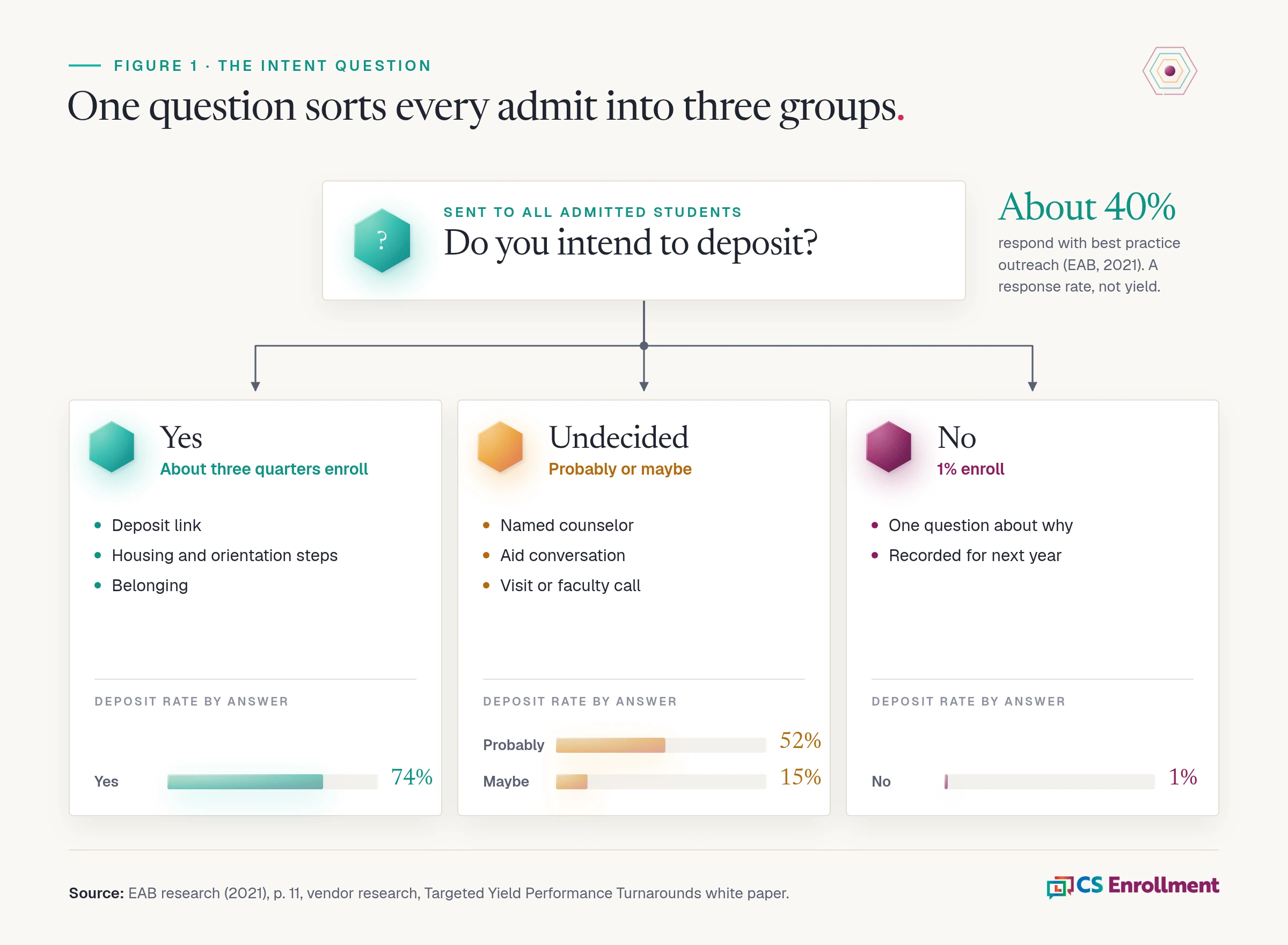
The short answer: Small colleges raise yield by finding out early which admitted students are undecided and why, then putting personal outreach on that group. Asking admits whether they intend to deposit is one of the strongest predictors there is: in EAB's research, about three quarters of students who answer "yes" enroll, against just 1% of those who answer "no."
Why is yield getting harder for small colleges?
Students apply to more colleges, so each admit holds more offers. The Common App reports 7.06 applications per first year applicant in 2025 to 2026, up from 6.79 the year before. Each of those extra applications is another college competing for the same deposit.
Discounting keeps climbing. NACUBO's preliminary study puts the average tuition discount rate for first time, full time undergraduates at private nonprofit colleges at 57.1%, up from 54.5% the year before, based on 258 institutions, as reported by Inside Higher Ed.
More aid late in the cycle is not a reliable fix. In a Niche pulse survey of 134 enrollment leaders in July 2026, 48% of colleges that relied on increased discounting hit their deposit targets, against 67% of colleges that did not. That is vendor research and a correlation, not proof that discounting caused the misses. It does suggest that aid alone does not decide yield.
What a small office controls is how much it knows about each admit and how quickly it acts. The rest of this plan is built on that.
What should you ask admitted students?
Start with one direct question: "Do you intend to deposit?" EAB's 2021 Targeted Yield Performance Turnarounds white paper calls asking students about their plans one of the most effective ways to predict yield, and also the simplest. In that EAB research (2021), which is vendor research, around three quarters of students who answered "yes" enrolled, and just 1% of those who answered "no" did. EAB reports that best practice outreach consistently produces response rates in the neighborhood of 40%.
EAB offered four answers: yes, probably, maybe and no. That middle ground matters. It shows which students are still deciding so a team can put its most intensive outreach where it can still change the outcome.
Add two or three follow ups, and keep them short:
- What is holding you back? Offer simple choices: cost, distance, program, family, or something else.
- Who else helps you decide? A parent, a guardian, a counselor, or no one.
- What would help you decide? A call about aid, a visit, or a conversation with a faculty member in their program.
Our post on survey led student search explains why a question draws more replies than an announcement. The same logic applies after the admit.
What do you do with each answer?
Sort every response into three groups the same week it arrives.
The yes group gets logistics and belonging: the deposit link, housing steps, orientation dates and a reason to feel part of the class. Keep it efficient, since these students have mostly decided.
The undecided group gets a named counselor and an aid conversation. This is where a four person office should spend most of its hours. If cost is the barrier, a counselor walks through the award line by line. If distance or program fit is the barrier, the counselor sets up a visit or a faculty call.
The no group gets one respectful question about why, and then space. Their answers are data for next year's recruiting and aid strategy.
Encoura's yield action plan makes the same point as vendor guidance: with limited time, staff and budget, segment admitted students and put more effort on the students where intentional outreach changes the result, rather than sending the same general campaign to everyone.
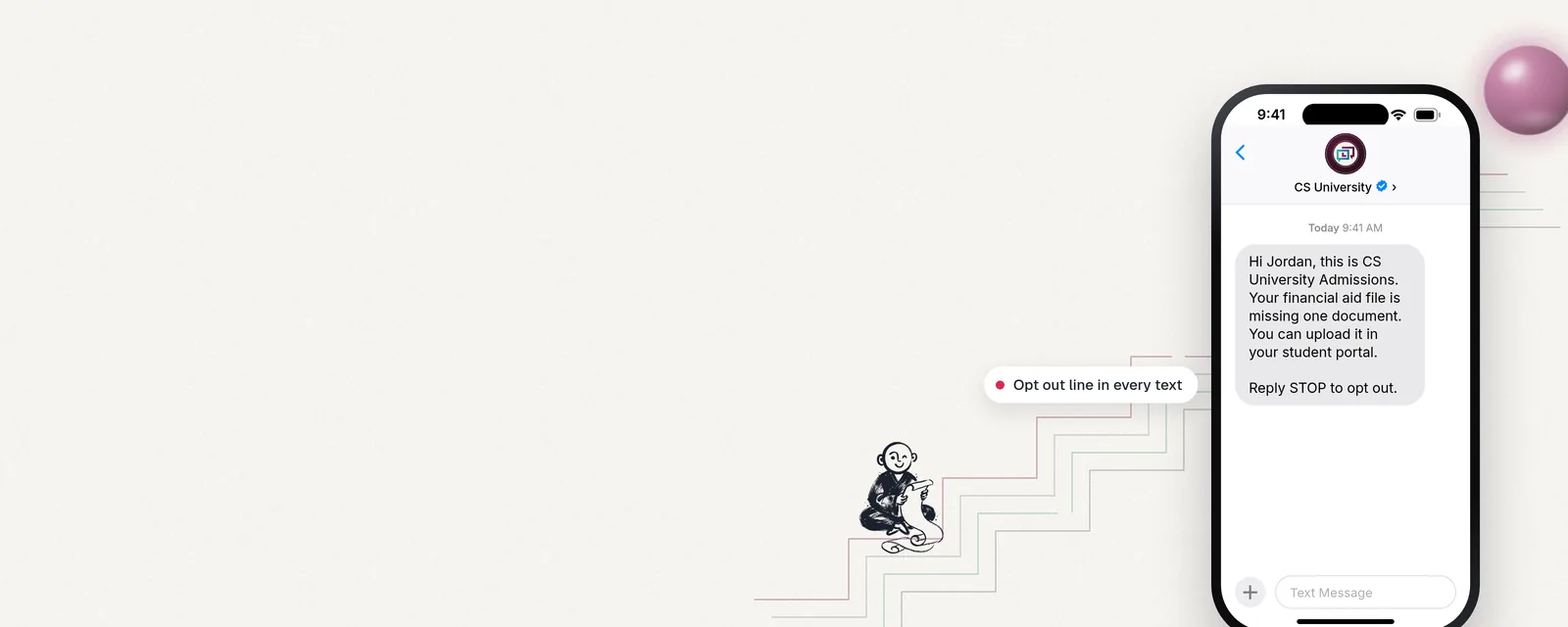
CS Enrollment builds the intent question into yield campaigns as a short survey. Through CS Enrollment Pathways, it arrives as a branded, verified message with the college's name on it, so the undecided group surfaces in days, not weeks.
How do you bring families in?
Families help decide, and many prefer a channel colleges underuse. In the 2025 Prospective Family Engagement Report from RNL, Ardeo and CampusESP, 30% of families preferred text messages, while 21% of institutions used them. That is vendor research. The same chart shows email as the most used and most preferred channel, so text adds to email rather than replacing it.
Plan one family touch per stage. At the admit, send a note to the family with the same next steps the student received. When the aid offer arrives, invite the family to the aid conversation. Before May 1, send the family the deposit deadline and the name of the student's counselor. Use the follow up question about who helps the student decide to know which families to include.
Does personalization actually move students?
It can, when it is accurate. Capture Higher Ed, a vendor, surveyed nearly 6,000 students and reports that when a college personalized a message correctly, 94% of students did something about it. That figure is self reported by students, not a measured change in enrollment.
The practical lesson is to personalize on what the student told you. A message that names the barrier they reported and the counselor who will help is more useful than one that only uses a first name. A broken merge field does the opposite.
When should each step happen?
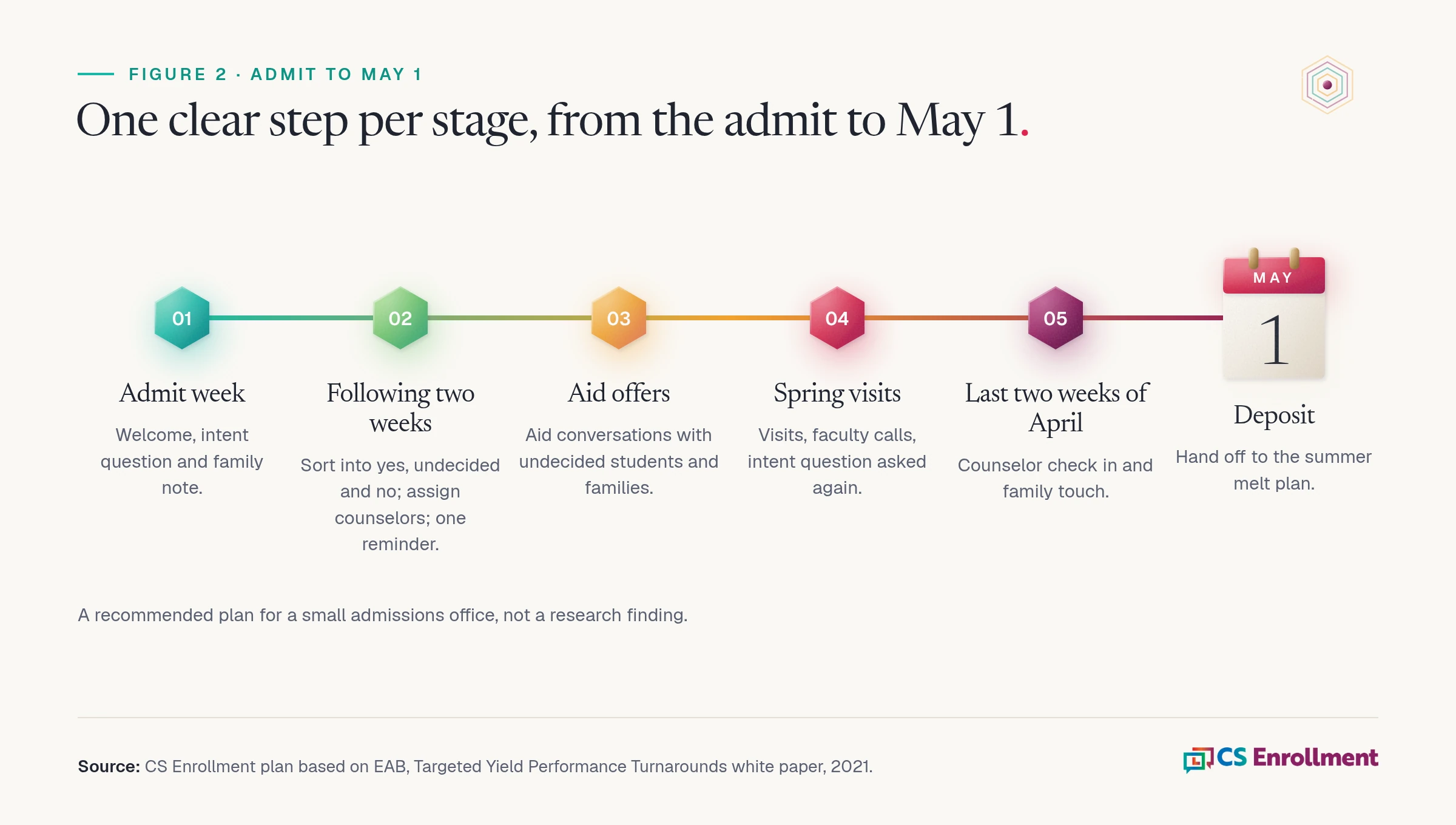
A simple calendar from admit to May 1 keeps a small team on schedule.
1. Admit week. Send the welcome and the intent question together. Send the family note.
2. The following two weeks. Sort responses into the three groups. Assign a counselor to each undecided student. Send one reminder to students who have not answered.
3. When aid offers go out. Hold aid conversations with the undecided group first, with families invited.
4. The spring visit season. Invite undecided students to visits and faculty calls. Ask the intent question again of anyone who answered probably or maybe.
5. The last two weeks of April. A personal check in from the counselor with every student still undecided, and one family touch.
6. At deposit. Hand each student to the summer plan in our post on how to reduce summer melt, because a deposit is not yet an enrolled student.
None of this works if the messages never arrive. Our post on search email deliverability covers why admissions email lands in spam and how to fix it.
How should you measure it?
Track yield by segment: in state and out of state, by program, by aid band and by first generation status. Then track yield by answer group, so the team can see how many undecided students it converted and which barrier it resolved for each.
Track the response rate to the intent question as its own number. A low response rate means the question is not reaching students, which is a delivery or sender problem before it is a yield problem.
Benchmark against your own last cycle, not a national average. A small college's yield depends on its applicant mix, its region and its aid policy, so the most honest comparison is this year's admits against last year's.
Frequently asked questions
What should you ask admitted students to predict yield? Ask whether they intend to deposit. In EAB's research, about three quarters of students who said "yes" enrolled and 1% of those who said "no" did, which makes the question one of the simplest yield predictors available.
What do you do with each answer to the intent question? Sort students into three groups. The yes group gets logistics and belonging, the undecided group gets a named counselor and an aid conversation, and the no group gets one respectful question about why.
When should each yield step happen? Send the intent question in admit week, sort and assign counselors over the next two weeks, hold aid conversations when offers go out, and check in personally with every undecided student in the last two weeks of April.
Why is yield getting harder for small colleges? Admitted students hold more offers, with the Common App reporting 7.06 applications per first year applicant in 2025 to 2026, and discounting keeps rising. More aid is not a reliable fix: in a Niche pulse survey, 48% of colleges that relied on increased discounting hit deposit targets, against 67% that did not, a correlation from vendor research.
To see how an intent question and its follow ups look on a student's phone, request the sample walkthrough.
Sources
- EAB, Targeted Yield Performance Turnarounds: learning from EAB's Enroll360 product suite on how to rapidly improve admitted student engagement.
- Common App, End of Season Report, 2025 to 2026: First Year Application Trends.
- Josh Moody, Tuition Discounting Continues to Climb.
- Johanna Alonso, 61 Percent of Colleges Have Met Their Enrollment Goals for Fall 2026.
- Encoura, 5 Steps to Drive Your Yield Strategy. Encoura action plan (vendor guidance).
- RNL, Ardeo and CampusESP, 2025 Prospective Family Engagement Report. 14 (vendor research).
- Michelle Perry, Capture Higher Ed, What Makes College Communications Sound AI Generated? 6,000 High School Seniors Told Us.