
Updated Oct 25, 2026.
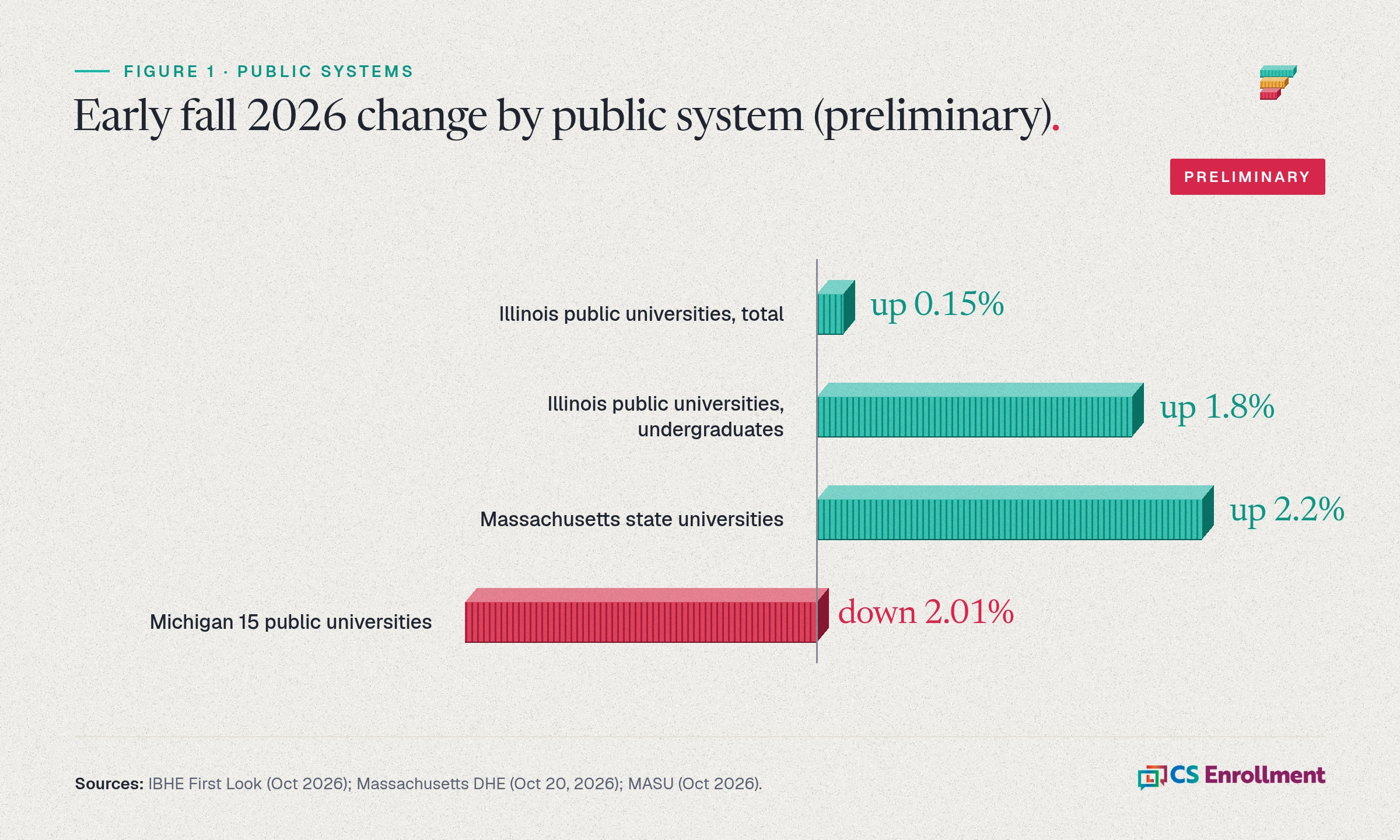
The short answer: Early fall 2026 counts are mixed: Illinois public universities grew 0.15% to 190,114 and Massachusetts state universities grew 2.2%, their first increase since 2013, while Michigan's 15 public universities fell 2.01%. All three are preliminary state counts, and there is no national fall 2026 number until the National Student Clearinghouse Research Center's Preliminary Fall Enrollment Trends report, which the Clearinghouse publishes each November.
What do the first fall 2026 counts show?
Three states have published preliminary numbers for their public universities. Every count below is preliminary and may change when final data comes out.
Preliminary fall 2026 counts, as published by each state
- Illinois, 12 public universities. Change from fall 2025: up 0.15% (287 students). Headline count: 190,114 total. What drove it: undergraduates up 1.8%; graduate and professional down 3.9%. Source: IBHE First Look, Oct 2026.
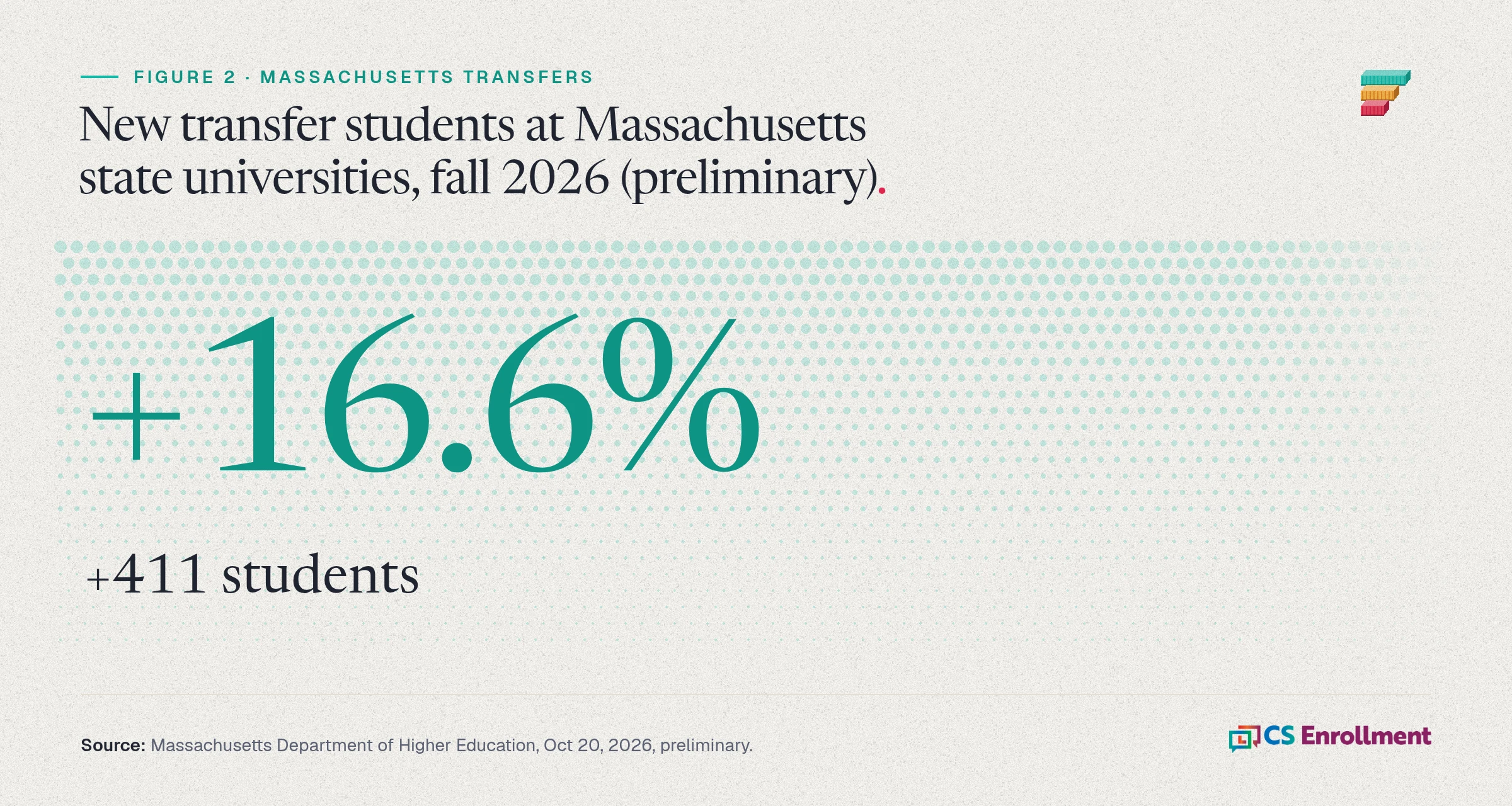
- Massachusetts, 9 state universities. Change from fall 2025: up 2.2% (699 students). Headline count: 32,345. What drove it: new transfer students up 16.6%. Source: Massachusetts DHE, Oct 20, 2026.
- Michigan, 15 public universities. Change from fall 2025: down 2.01% (5,223 students). Headline count: 254,107, from 259,330. What drove it: first time freshmen down 1.21%; the smallest university down 14.44%. Source: MASU, Oct 2026.
Illinois: how did a state facing a projected 32% drop in high school graduates post growth?
Illinois public universities enrolled 190,114 students this fall, up 0.15%, or 287 students, according to the Illinois Board of Higher Education (IBHE). The Governor's office called it the highest level in 11 years. IBHE notes that all fall 2026 figures are preliminary counts collected shortly after each university's census date.
Undergraduates drove the gain. Undergraduate enrollment rose 1.8%, or 2,464 students, to 136,795. First time, full time freshmen rose 2.2% to 27,502, and seven of the 12 universities grew undergraduate enrollment. Graduate and professional enrollment fell 3.9% to 53,319, pulled down by a 19.9% drop in international graduate and professional students.
The Governor's office credits state aid. Its release says 44% of in state undergraduates paid $0 in out of pocket tuition and fees at Illinois public universities in FY25.
The context is striking. WICHE projects Illinois will have 32% fewer high school graduates in 2041 than in 2023. The national graduate peak was 2025, and the decline is a slope that runs through 2041, so one fall neither confirms nor refutes it.
Massachusetts: where did the new transfer students come from?
Enrollment at the nine Massachusetts state universities grew 2.2%, or 699 students, to 32,345. The Governor's office called it the first increase at the state universities since 2013. New transfer students at the state universities rose 16.6%, or 411 students.
The Department of Higher Education's board deck says early reports from the institutions credit "an influx of transfer students from community colleges and recently closed independent institutions." Across the public system, undergraduate enrollment reached nearly 176,000, up 2.2%, and community colleges grew an estimated 3.9%, as of the board's Oct 20 deck. The department calls these preliminary estimates and expects final data in early 2027.
Small private colleges should read the transfer line twice. When a college closes, its students go somewhere, and in Massachusetts many went to public universities.
Michigan: which universities lost the most students?
Michigan's 15 public universities enrolled 254,107 students this fall, down from 259,330, a drop of 5,223 students or 2.01%, according to the Michigan Association of State Universities (MASU). First time freshmen fell 1.21%. Lake Superior State, the smallest of the 15, fell 14.44%.
MASU's chief executive, Dan Hurley, pointed to "the continued demographic challenge of a declining number of high school graduates," as quoted by Bridge Michigan.
Our take: what does this mean for a small college?
In two of the three states, public systems grew, and their own releases point to price in Illinois and transfers in Massachusetts. In Michigan, the smallest public university fell the most in percentage terms. For a small college, the lesson is competitive more than demographic. Your fall 2027 inquiry pool is being priced and courted by public systems right now.
Four moves for this month:
1. Do not wait for November. Pull your own fall 2027 inquiry and application counts against the same date last year, stage by stage. If one stage is behind, there are still months to act on it.
2. Know your public competitors' price story. Families are hearing "free" and "$0" from public systems. Answer with your real net price early, not in April. Our post on how to increase college yield covers how to work with admits once offers are out.
3. Recruit transfers on purpose. Build community college partnerships, and reach students at colleges in your region that are closing or shrinking. The Massachusetts numbers show how quickly those students move.
4. Find out who is in market before you spend. Our post on survey led student search explains the approach. CS Enrollment Pathways starts with a short survey sent as branded, verified messages, so a small office learns which prospects, transfers and admits are actually considering it, and what price or program question is holding them back, while there is still time to answer. When public systems are courting the same students, knowing who is in market matters more than mailing more names.
Is the demographic cliff still coming?
Yes, as a projection of high school graduates. WICHE projects that U.S. high school graduates peaked in 2025 and will decline 13% through 2041. Early fall counts measure enrollment, which also depends on how many graduates go to college, transfers, adult students, international students and price. One fall of growth in Illinois does not change the projection. Our post on what the demographic cliff means for small colleges covers the regional picture.
What should enrollment leaders watch next?
- The national picture. The National Student Clearinghouse Research Center publishes its Preliminary Fall Enrollment Trends report each November, and it has scheduled a webinar on this year's findings for Nov 11, 2026. Until then, no national fall 2026 number exists.
- More state releases. Other systems publish as their census counts are finished.
- Final Massachusetts data, which the Department of Higher Education expects in early 2027.
- Your own funnel, every two weeks, against the same date in your last three cycles.
Frequently asked questions
Is college enrollment up or down in fall 2026? It is mixed so far. Preliminary state counts show Illinois public universities up 0.15%, Massachusetts state universities up 2.2% and Michigan's 15 public universities down 2.01%. There is no national fall 2026 number yet.
When will national fall 2026 enrollment numbers come out? The National Student Clearinghouse Research Center publishes its Preliminary Fall Enrollment Trends report each November, and it has scheduled a webinar on this year's findings for Nov 11, 2026. Final fall numbers follow in January.
Why did Massachusetts state university enrollment grow? Enrollment grew 2.2%, or 699 students, with new transfer students up 16.6%. Institutions credit "an influx of transfer students from community colleges and recently closed independent institutions."
Does Illinois' growth mean the demographic cliff is not happening? No. WICHE projects Illinois will have 32% fewer high school graduates in 2041 than in 2023, and U.S. graduates peaked in 2025 with a 13% decline projected through 2041. One fall of enrollment growth does not change a projection of graduates.
To see how a short survey looks on a student's phone, request the sample walkthrough.
Sources
- Illinois Board of Higher Education, IBHE First Look: Fall Enrollment 2026 to 27, Illinois Public Universities, Preliminary Report.
- Office of the Governor of Illinois, Gov. Pritzker announces Illinois public universities achieved highest enrollment level in over a decade.
- Massachusetts Department of Higher Education, Board of Higher Education enrollment trend deck, fall 2026 preliminary.
- Massachusetts Department of Higher Education, Enrollment data center, current enrollment.
- Office of the Governor of Massachusetts, Governor's release on fall 2026 enrollment growth.
- Michigan Association of State Universities, Preliminary Enrollment Report, Fall 2026.
- Bridge Michigan, University enrollment drops 2% in Michigan, first drop in three years.
- WICHE, Knocking at the College Door key findings: geography.
- WICHE, Knocking at the College Door key findings: graduates.
- National Student Clearinghouse Research Center, Preliminary Fall Enrollment Trends.
- National Student Clearinghouse, A First Look at Fall Enrollment: What the Early Data Show.