The short answer: The enrollment marketing strategies that work best for a small private college convert the students it already has: answer every inquiry personally, bring families in early, and protect yield and melt before buying more names. Then it narrows the top of the funnel to the students, programs and regions it can actually win, and measures each stage instead of total volume.
Why is enrollment marketing different at a small private college?
A small private college depends on tuition, runs its office with a few people and rarely gets a bigger budget. In a Niche pulse survey of 134 enrollment leaders in July 2026, reported by Inside Higher Ed, 50% of leaders at colleges under 2,000 students expected to hit their fall 2026 goals, against 61% overall. Budgets are tight too: in EAB's survey of 121 higher ed marketing leaders (August and September 2025, vendor research), 69% said marketing budgets stayed flat or fell from the 2024 to 25 year to 2025 to 26. A small college can't outspend anyone, so it has to out convert.
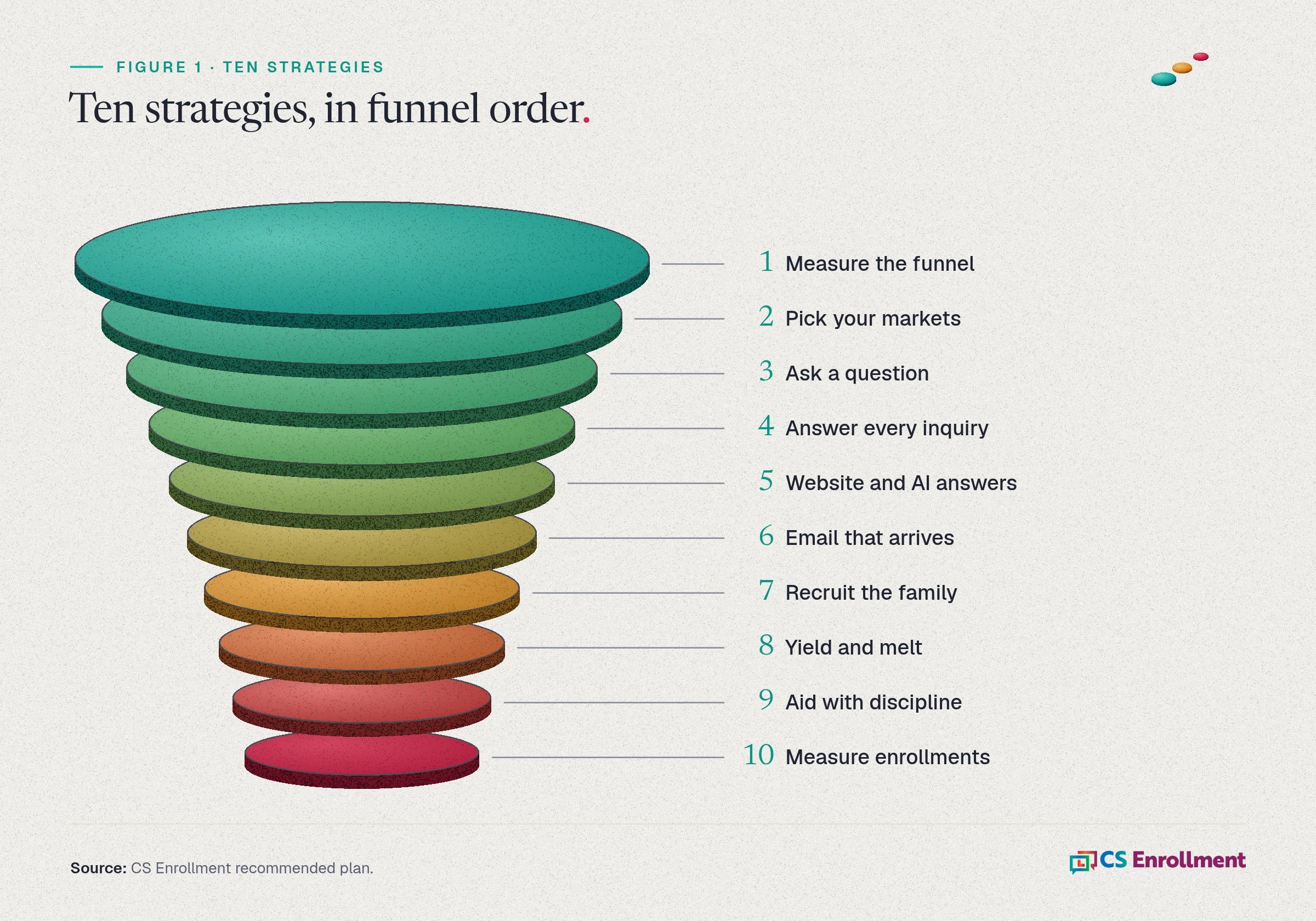
Ten strategies follow, in funnel order, each with a link to the post that goes deeper.
Strategy 1: Measure your funnel before you change anything
Build one row per stage, from prospect to enrolled, with counts for this cycle and the last three at the same date. The stage that loses the most students gets your staff time first. In Niche's 2026 survey of 142 enrollment and admissions leaders at four year colleges (vendor research, self reported), 65% reported challenges hitting freshman goals in one or both of the last two cycles. Our guide to enrollment funnel stages has the definitions and formulas.
Strategy 2: Pick the markets you can win
WICHE projects that U.S. high school graduates peaked in 2025 and will decline 13% through 2041. That is a projection of graduates, not enrollment, and it lands unevenly by region; see what the demographic cliff means for small colleges.
Look past first year students. In preliminary fall 2026 data, new transfers to Massachusetts state universities rose 16.6%, or 411 students, and early reports from the institutions credit "an influx of transfer students from community colleges and recently closed independent institutions." Our fall 2026 enrollment early counts post has the state numbers. Adults count too: the National Student Clearinghouse Research Center counted 37.6 million working age people under 65 with some college and no credential, as of the start of the 2023 to 24 academic year. Choose the groups you can serve well and say no to the rest.
Strategy 3: Ask a question instead of sending a brochure
Students are buried in mail. In CollegeVine's 2024 survey of 3,009 students with CollegeVine accounts (vendor research), the median student received 1,040 college emails in 12 months, and 68% agreed "The college emails I've received feel like spam." Colleges keep sending anyway: in RNL's fall 2024 poll, 83% of four year private colleges said they keep contacting students who never responded to search (vendor research, 50 four year private colleges).
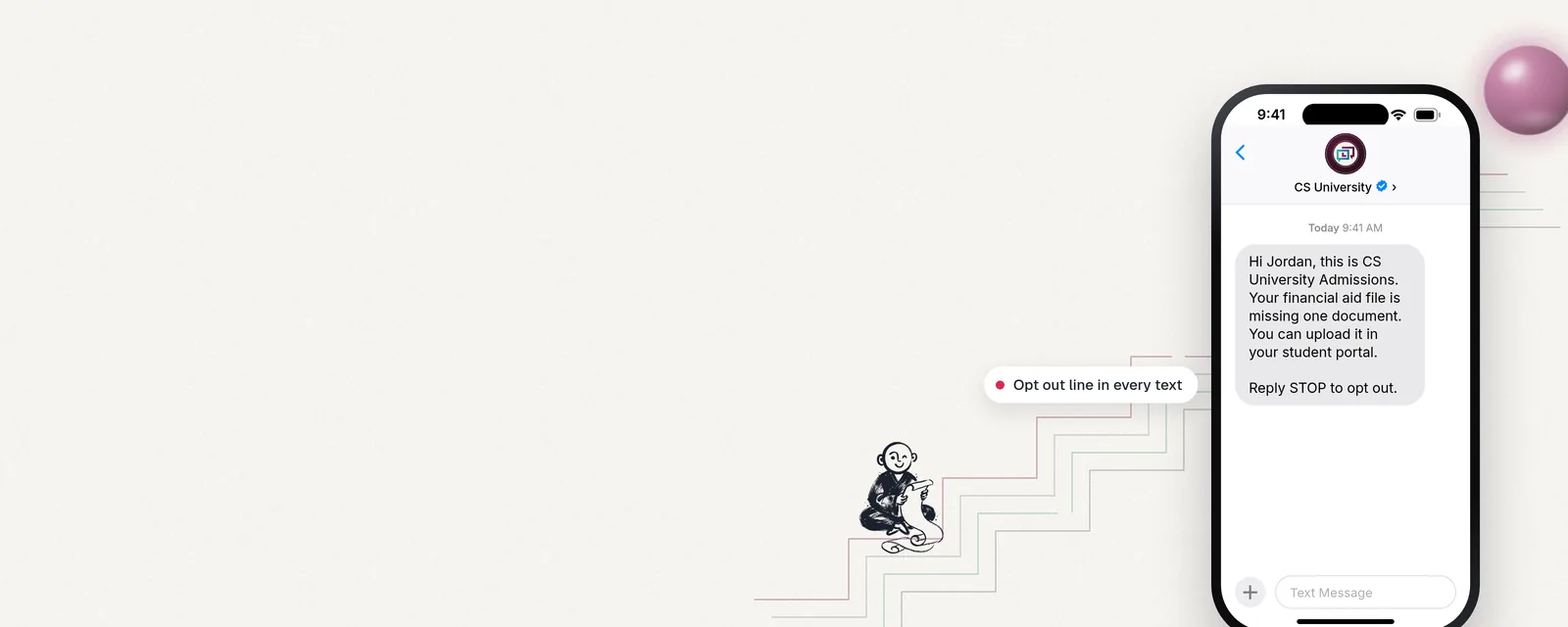
Open with a short question about the student's plans, so a name becomes an inquiry by answering. Our post on survey led student search explains why it works. CS Enrollment Pathways opens with a short survey sent as branded, verified messages, so a student answers a real question about their plans instead of getting another brochure, and a small office learns who is in market, which program they want and how to reach their family. The same survey approach works at the admit stage to find undecided students while there is time to act.
Strategy 4: Answer every inquiry fast and personally
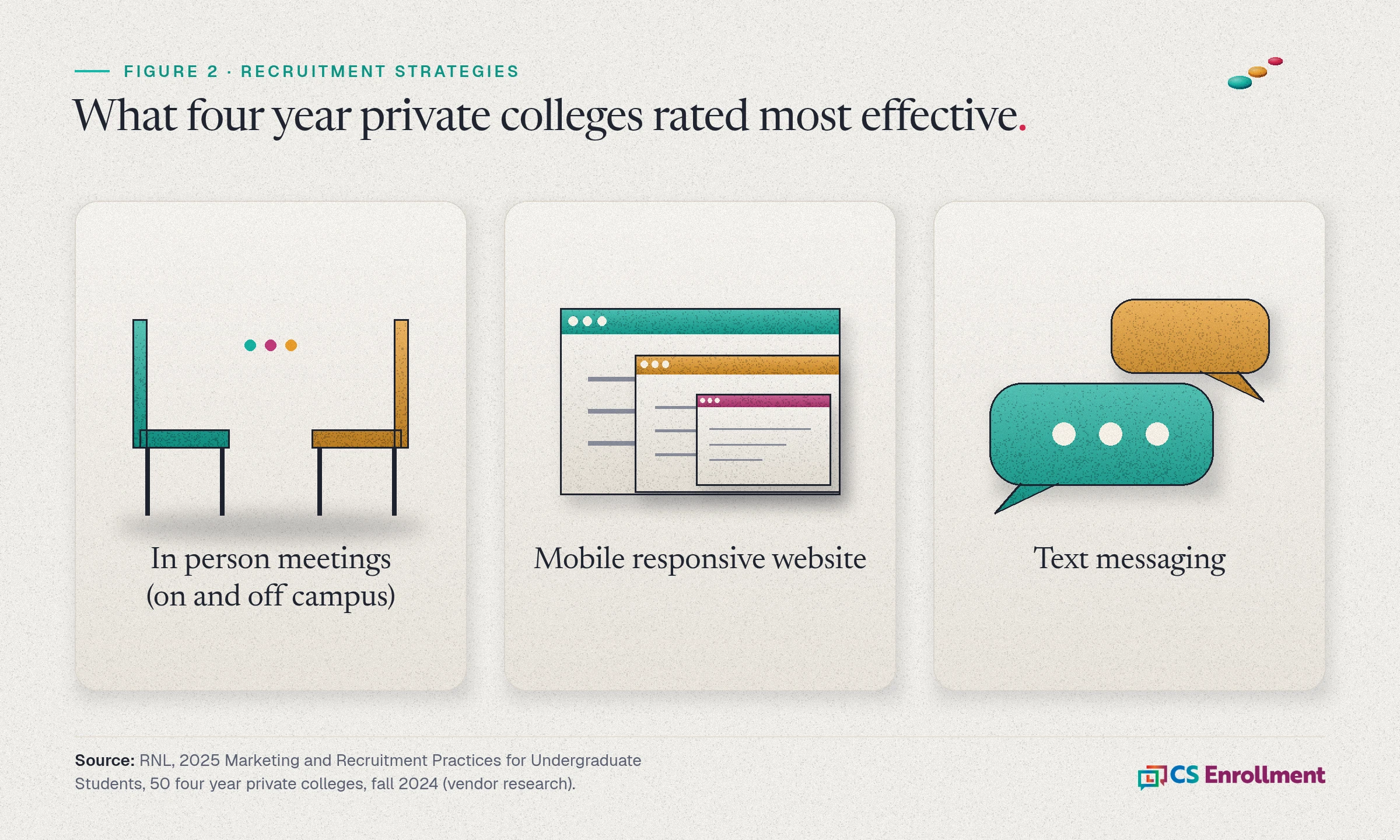
In RNL's fall 2024 poll of 50 four year private colleges (vendor research), private colleges rated in person meetings, a mobile responsive website and text messaging as their three most effective recruitment strategies. Personalized videos sent directly to students were used by 49% of the private respondents, and 96% of those using them rated them effective.
There is no verified statistic for how fast is fast enough, so set your own standard: a reply from a person within one business day, tracked weekly.
Strategy 5: Make your website and AI answers do recruiting work
Capture Higher Ed reports that when students have a question about a specific college, 57% go straight to the college's website first (vendor research). EAB found 46% of students used AI tools such as ChatGPT in their college search, in a survey of 5,095 high school students in October and November 2025 (vendor research). Write plain program pages with cost, outcomes and a next step, use question headings, and publish sourced facts an AI tool can quote. See how students find colleges through AI answers and what AI search traffic means for your college website.
Strategy 6: Make sure your email actually arrives
Gmail has required bulk senders to authenticate their mail and offer easy unsubscribes since Feb 1, 2024, and Outlook began enforcing similar rules for high volume senders on May 5, 2025. Our guide to search email deliverability walks through the checks.
Strategy 7: Recruit the family, not only the student
EAB's 2026 parent survey of more than 2,500 parents (vendor research) found 74% are highly involved in their student's search, but 69% feel colleges don't give them the information they need. In Niche's 2026 survey, 76% of enrollment leaders said parent engagement is very important to filling the class (vendor research). Families also name channels colleges underuse: in RNL, Ardeo and CampusESP's 2025 report (9,467 family responses, vendor research), 30% of families preferred text messages while 21% of institutions used them. Add a family message at the admit stage, and before you text families, review the FCC opt out rule.
Strategy 8: Treat yield and melt as marketing problems
NACAC, using IPEDS data, reports average yield of 33% at private four year colleges in fall 2022. Ask admits whether they plan to enroll: in EAB research from 2021 (vendor research), about three quarters of students who answered "yes" enrolled, against about 1% of those who answered "no." EdResearch for Action estimates that nationally about 10% to 20% of students who intend to go to college do not enroll that fall. Our posts on how to increase college yield and how to reduce summer melt lay out both plans.
Strategy 9: Use aid with discipline
NACUBO's preliminary average discount rate for first time, full time undergraduates at private nonprofits is 57.1% for 2025 to 26, as reported by Inside Higher Ed. In the Niche pulse survey, 48% of colleges that relied on increased discounting hit deposit targets, against 67% of colleges that did not. That is vendor research and a correlation, not proof, but it suggests more aid alone does not close the gap. Start net price conversations earlier, at inquiry and admit, rather than in April.
Strategy 10: Measure enrollments, not clicks, and keep the list clean
Track cost per enrolled student by source and review it every two weeks in season. Fake applicants inflate the top of the funnel, so check for them; see how colleges spot ghost students. Don't let more applications pass for progress: of the four year colleges whose applications grew from 2023 to 2024, 78% saw yield fall, yet 58% still enrolled more students (Jennifer Wick, IPEDS analysis of 1,149 institutions).
Where should a small office start this month?
- Build the funnel report by stage, against the last three cycles.
- Send inquiries and admits a question based first message.
- Add one family touch at the admit stage.
Frequently asked questions
What are the best enrollment marketing strategies for a small private college? Convert the funnel you already have first: personal replies to inquiries, early family outreach, and yield and melt plans. Then narrow the top of the funnel to markets you can win.
How can a small college increase enrollment with a small staff? Put staff time on the stage that loses the most students. In RNL's fall 2024 poll (vendor research), four year private colleges rated in person meetings, a mobile responsive website and text messaging most effective.
Should small colleges buy more student names? Ask before you tell. In CollegeVine's 2024 survey (vendor research), the median student received 1,040 college emails in a year and 68% said they feel like spam.
How important are parents in college recruitment? Very. EAB's 2026 parent survey (vendor research) found 74% of parents are highly involved in the search.
Does more tuition discounting increase enrollment? Not reliably. In a Niche pulse survey, colleges that relied on more discounting hit deposit targets less often (48% against 67%), a correlation in vendor research.
How should a small college measure enrollment marketing? By cost per enrolled student by source and by conversion at each stage, not by application volume alone.
To see how a short survey looks on a student's phone, request the sample walkthrough.
Sources
- Johanna Alonso, 61 Percent of Colleges Have Met Their Enrollment Goals for Fall 2026.
- EAB, 2026 Higher Ed Marketing Outlook: How 120+ Marketing Leaders Are Advancing Digital Strategy for Visibility and Enrollment Growth. 10 and 21 (vendor research).
- Niche, The State of Higher Education 2026. 3, 5 and 8 (vendor research).
- WICHE, Knocking at the College Door key findings: graduates.
- Massachusetts Department of Higher Education, Board of Higher Education enrollment trend deck, fall 2026 preliminary.
- National Student Clearinghouse Research Center, Some College, No Credential.
- CollegeVine, Traditional marketing efforts aren't cutting it for the modern day student. Survey of 3,009 high school students with CollegeVine accounts (vendor research).
- RNL, 2025 Marketing and Recruitment Practices for Undergraduate Students.
- Michelle Perry, Responsible AI in College Admissions: How Gen Z Actually Wants Your Team to Use It.
- EAB, Nearly Half of High School Students Now Use AI in College Search.
- EAB, How Students View and Use AI in College Search: Insights from a Survey of 5,000+ High School Students. 5 (vendor research).
- Google, Email sender guidelines. Gmail Help.
- Microsoft, Strengthening Email Ecosystem: Outlook's New Requirements for High Volume Senders.
- EAB, Findings from EAB's 2026 Parent Survey.
- RNL, Ardeo and CampusESP, 2025 Prospective Family Engagement Report. 14 (vendor research).
- National Association for College Admission Counseling, Trends in Yield Rates at Four Year Colleges.
- EAB, Targeted Yield Performance Turnarounds. 11 (vendor research).
- Lindsay Page, Katharine Meyer, Aizat Nurshatayeva and Ellen Bryer, Helping Students Make It to College, a research brief on design principles for reducing summer melt.
- Josh Moody, Tuition Discounting Continues to Climb.
- Jennifer Wick, Evaluating the Return on Application Growth.