Updated Oct 27, 2026. We will update this post when first results are out.
The short answer: The federal earnings test cuts off federal student loans for programs whose graduates earn too little, and most private nonprofit four year colleges have no students in a program projected to fail it. The work for a small college is to check each program now and, if one is exposed, plan how admissions will deliver the required warning to prospective students.
This post is not legal advice. Confirm the details for your programs with your financial aid and compliance staff.
What is the earnings test?
For an undergraduate program, graduates' median earnings four years after completion must exceed the median earnings of 25 to 34 year olds in the same state who have only a high school diploma, as the PEER Center summarizes it. Graduate programs are compared with bachelor's degree holders aged 25 to 34 (the lowest of three comparison groups).
Under the Department of Education's final rule, a program that fails the "earnings premium measure" in two out of any three consecutive award years for which it is calculated loses eligibility for federal Direct Loans. The test comes from the 2025 federal budget law, the One Big Beautiful Bill Act, and the final rule published July 1, 2026. Most of the rule takes effect July 1, 2027; its Direct Loan program changes took effect Aug 31, 2026.
The Institute for Higher Education Policy (IHEP) says the department will calculate the first test in early 2027, and programs that fail in both 2027 and 2028 will lose Direct Loan access starting in the 2028 to 29 academic year.
Which programs are most at risk?
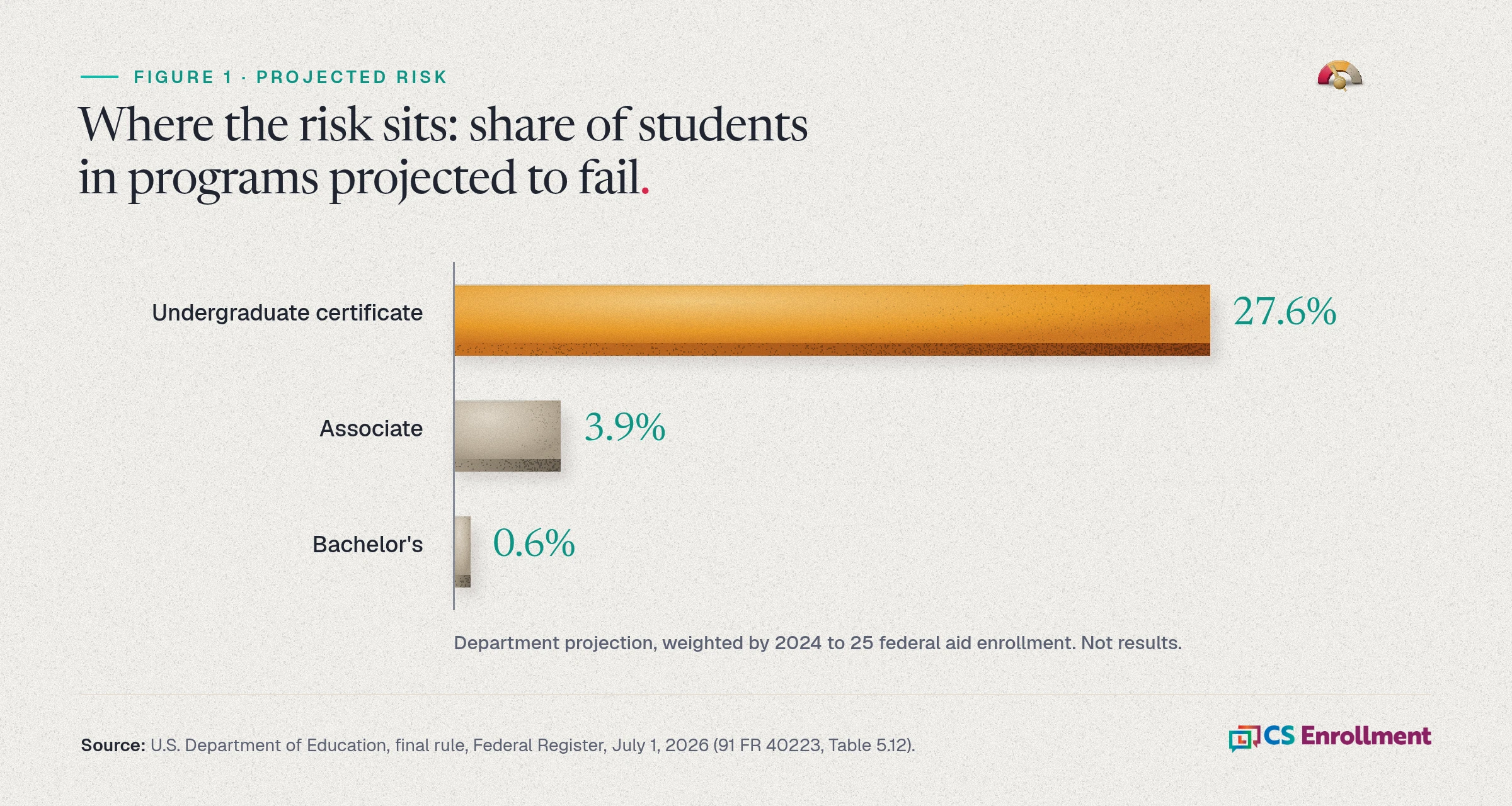
The department projects that 27.6% of undergraduate certificate students are in programs that would fail, compared with 3.9% of associate degree students and 0.6% of bachelor's degree students. It is a projection weighted by 2024 to 25 federal aid enrollment, not a result.
The rule's analysis names the fields most affected: humanities and liberal arts, education and fine arts at the undergraduate level, and computer and IT, health programs such as mental and social health services, religious studies, and humanities and liberal arts at the graduate level.
Validated Insights, a marketing and analytics firm, found that 29% of undergraduate certificate programs (among programs with enough data to test) fail, as reported by Higher Ed Dive. It also found failure rates of 1.2% for bachelor's programs, 4% for master's programs overall and 38% for clinical mental health counseling master's programs. These are vendor program shares, not comparable with the department's student shares.
Will it hit a small private college?
For most, no. The PEER Center at American University, using data the department released during rulemaking, estimates that programs projected to fail enroll 2.5% of federally aided students. It found that 84% of private nonprofit four year institutions have none of their students in failing programs. At nonprofit institutions, 2.3% of federally aided students are in failing programs, against 13.7% at for profit institutions.
Undergraduate certificates account for 10% of federal aid enrollment but 63% of federally aided enrollment in programs projected to fail, according to PEER. A mostly bachelor's catalog is likely fine; look hardest at certificates, graduate counseling and some arts and religion programs.
How do you check your own programs this month?
1. Pull your program list by credential level and CIP code.
2. Look each program up in the PEER Center's earnings explorer, linked from its report.
3. Ask institutional research and financial aid what the department's data shows. IHEP notes institutions can review their completer lists, so check them.
4. Flag any program near the line, not only the projected failures.
For program mix, see our guide to enrollment marketing strategies for small colleges.
What changes for admissions if a program gets a failing notice?
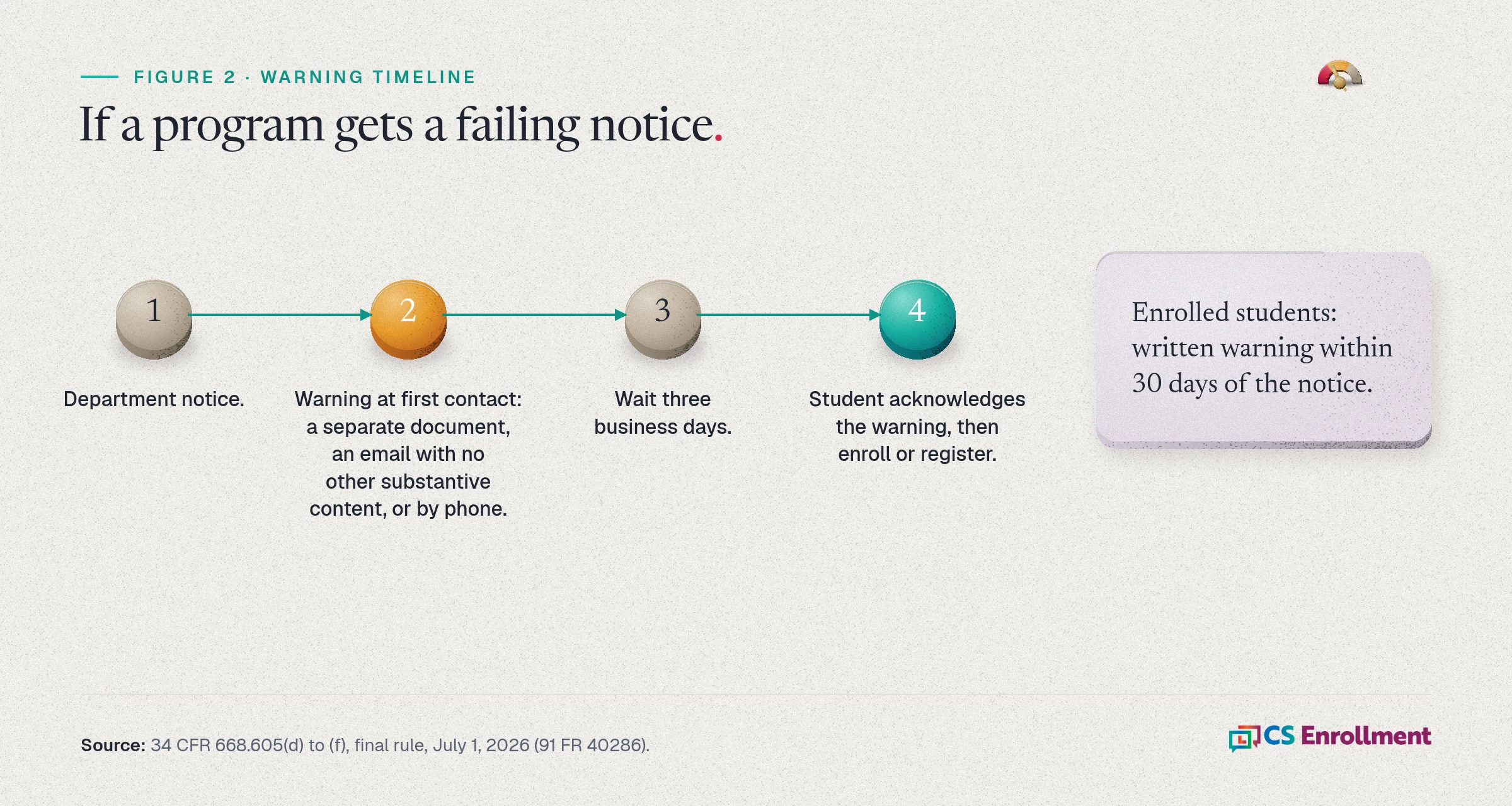
The warning must go to "each prospective student or to each third party acting on behalf of the prospective student at the first contact about the program." The rule allows three ways to deliver it: by hand as a separate document; by email, provided "the warning is the only substantive content in the email," with another method if the email bounces; or orally if the contact is by phone. Then the institution "may not enroll, register, or enter into a financial commitment with the prospective student with respect to the program earlier than three business days after the institution delivers the warning." A prospective student seeking federal aid must also acknowledge the warning before signing an enrollment agreement, registering or making a financial commitment. Enrolled students get the warning in writing within 30 days of the department's notice.
Our take for an admissions team:
- Know who is asking about an exposed program before first contact.
- Have an honest alternative ready, such as a related program that passes.
- Build the three business days into deposit and registration deadlines for that program.
- Make sure that email arrives, since a bounce means another delivery method. See our guide to search email deliverability.
What should every small college say about outcomes now?
Even with nothing exposed, put program level earnings, job outcomes, cost and time to finish on each program page, with dates and sources. The test makes "what do graduates earn" a public question. IHEP notes the department's new Student Tuition and Transparency System will publish program level data on costs, debt and earnings. Families asking about value want the answer early, not in the yield packet; our post on how to increase college yield covers the admit stage.
Our take, in short
Run the check by program, not by institution. If a program is exposed, the first warning is an admissions message, so plan the workflow and the honest alternative before any notice arrives. Either way, publish outcomes where students look.
Our post on survey led student search explains the approach. CS Enrollment Pathways opens with a short survey sent as branded, verified messages, so a student says which program they want and what they are weighing (cost, a career, time to finish) before the first long conversation. With an exposed program, admissions then knows who is asking in time to deliver any required warning and offer a related program honestly.
Frequently asked questions
What is the federal earnings test for colleges? It compares graduates' median earnings with those of 25 to 34 year olds in the same state with only a high school diploma. A program that fails in two out of any three consecutive years loses Direct Loan eligibility.
When does the earnings test take effect? Most of the final rule takes effect July 1, 2027; its Direct Loan program changes took effect Aug 31, 2026. IHEP says the first test will be calculated in early 2027, with loan loss starting in 2028 to 29 for programs that fail in 2027 and 2028.
Which programs are most likely to fail the earnings test? Undergraduate certificates. The department projects 27.6% of certificate students are in programs that would fail, against 0.6% of bachelor's students.
Will the earnings test affect private nonprofit colleges? Mostly not. The PEER Center estimates 84% of private nonprofit four year institutions have no students in failing programs.
What do colleges have to tell prospective students about a failing program? The college must deliver a warning at "the first contact about the program," then wait "three business days" before enrolling the student in that program.
How can a small college check its programs? Look up each program in the PEER Center's explorer and confirm the data with institutional research and financial aid.
To see how a short survey looks on a student's phone, request the sample walkthrough.
Sources
- U.S. Department of Education, Accountability in Higher Education and Access Through Demand-Driven Workforce Pell: Student Tuition and Transparency System (STATS) and Earnings Accountability.
- U.S. Department of Education, Final rule, PDF.
- Jordan Matsudaira, Kristen Allen and Clare McCann, The Limited Impact of New Federal Earnings-Based Accountability Rules.
- Institute for Higher Education Policy, How ED's Final Accountability and Transparency Rule Will Help Students, and Where It Falls Short.
- Jessica Blake, New Earnings Test Will Have Limited but Concentrated Impact.
- Ben Unglesbee, Undergraduate certificates are most at risk of failing new earnings test.
- Validated Insights, New Validated Insights Whitepaper: 2,880 College Programs Fail the Federal Earnings Test Today, and Most Have a Fix.