The short answer: A college shows up in ChatGPT and other AI answers when AI crawlers can read its site, its key facts sit on plain, current pages, and outside profiles such as Wikipedia, Niche and U.S. News say the same thing. No file or markup guarantees a mention, so test the questions students ask every month and fix what the answers get wrong.
Why does this matter for a small college?
Students now ask AI tools about colleges, and the answers shape their lists. In EAB's survey of 5,095 high school students in October and November 2025 (vendor research), 46% used an AI tool such as ChatGPT in their college search, and 18% removed a college from consideration based on what AI surfaced. The college's own site still matters: Capture Higher Ed reports that 57% of students with a question about a specific college go straight to its website first, and 67% say they check anything important a second time (vendor research, nearly 6,000 high school seniors, fall 2026). For the full student picture, see how students find colleges through AI answers.
A small college can't control what ChatGPT says. It can control what ChatGPT can read. Here is the order of work.
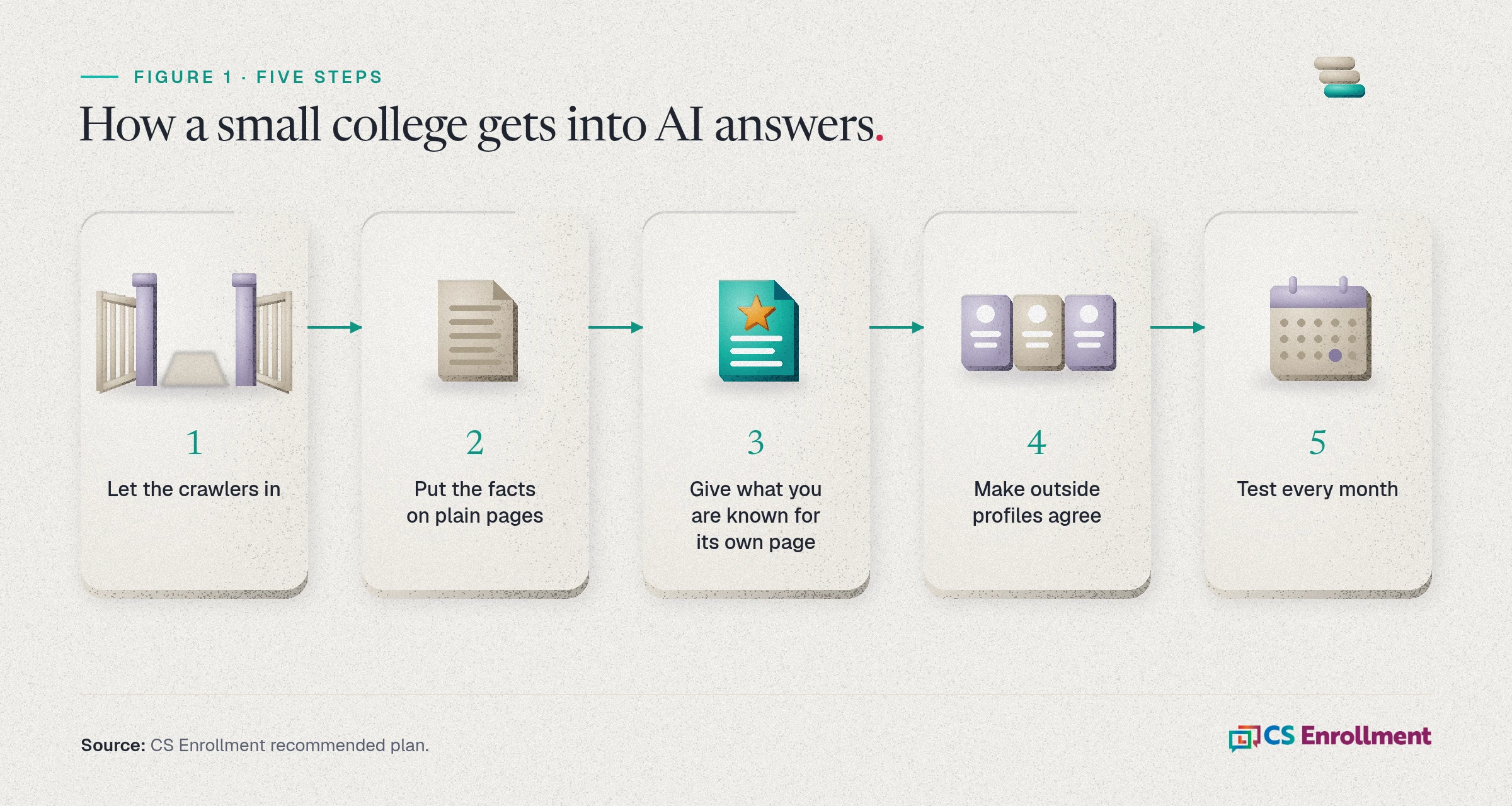
Step 1: Can AI crawlers read your site?
Start with access, because nothing else matters if the tools can't read your pages.
Google says plainly: "There are no additional requirements to appear in AI Overviews or AI Mode, nor other special optimizations necessary." To appear as a supporting link, a page must be indexed and eligible to be shown in Google Search with a snippet. Google's own checklist includes "Ensuring that crawling is allowed in robots.txt, and by any CDN or hosting infrastructure." Google's search crawler is Googlebot.
OpenAI runs a separate search crawler, OAI-SearchBot. Sites that block it "will not be shown in ChatGPT search answers, though can still appear as navigational links." OpenAI says a robots.txt change can take about 24 hours to take effect. Its training crawler, GPTBot, is a separate setting, so a college can allow search while making its own choice about training.
The move: ask your web team to check robots.txt and any bot blocking setting at your hosting provider or content delivery network for both search crawlers. Then make sure key facts appear as plain text on the page, not only inside scripts. In Gradial's study of 51 colleges and universities (vendor research, June 2026; Gradial sells AI search services), JavaScript rendering issues were flagged at all 51.
Step 2: Which facts should be on your own pages?
Put the facts students ask about where a crawler and a person can both find them: cost and net price, aid and scholarships with real dollar amounts, deadlines, programs, outcomes, location and size. Give each fact its own line or a small table, date it, and put it on a page with a question heading.
Gradial found financial aid was the most common gap: students ask AI tools specific aid questions, and the answers often cite outside sites such as CollegeVine or personal finance blogs instead of the college's own aid page. Clean up old pages too. Inside Higher Ed reported EAB's Michael Koppenheffer's warning that AI tools can pull from old webpages students would probably never find on their own. Retire or update pages with old tuition and old deadlines.
Step 3: What is your college actually known for?
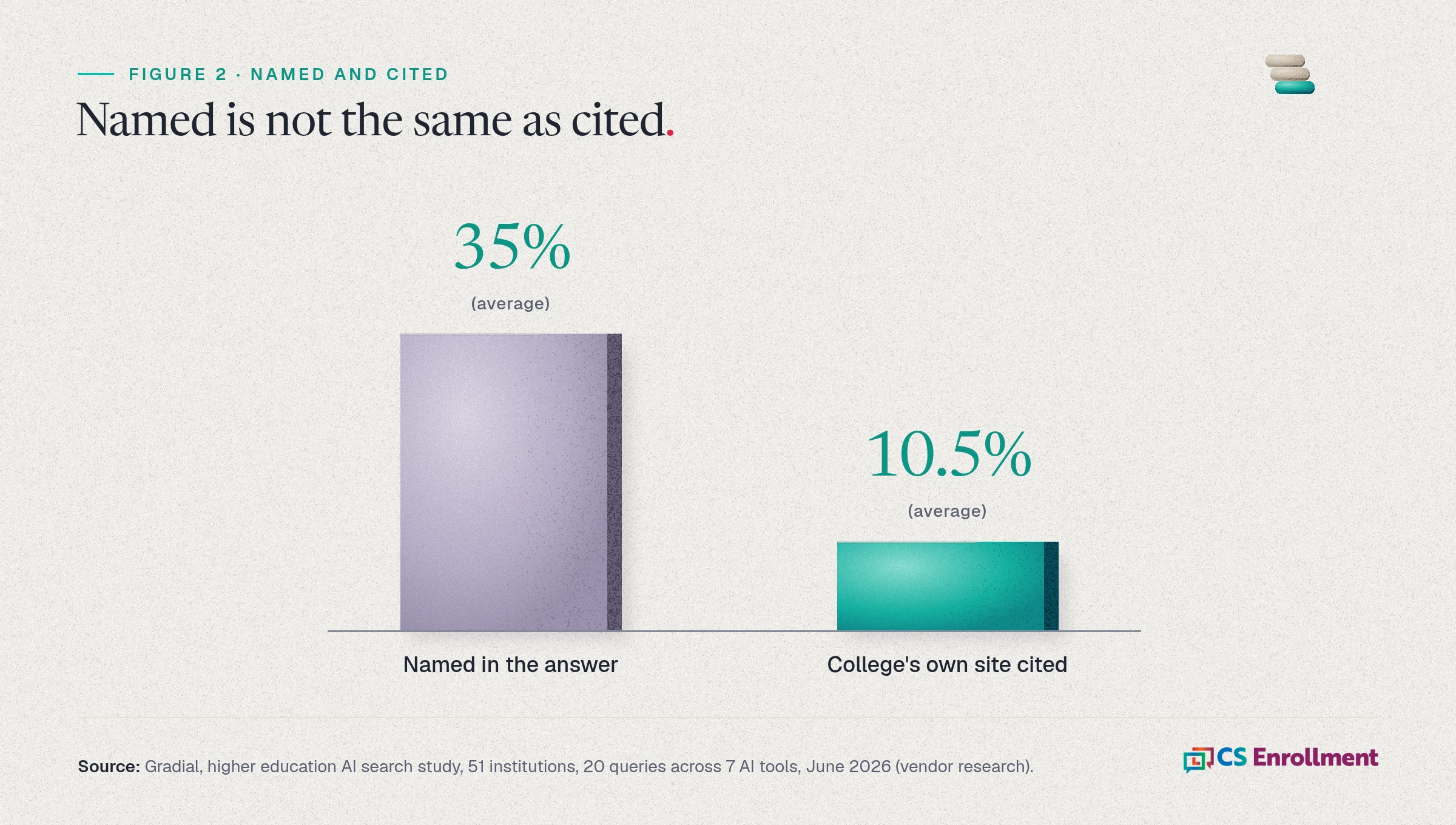
This is the small college step. Being named and being cited are different things. In Gradial's study, which tracked 20 queries across 7 AI tools for each of 51 institutions, the average college was named in 35% of answers, but its own site was cited in only 10.5%. The colleges that earned citations had specific pages about a distinct program, policy or place, and Gradial notes some small schools did this well.
Pick one or two things that are true and distinct about your college, and give each a page that answers one question directly. AI tools cite specific answers, not brochures. Our guide to enrollment marketing strategies for small colleges covers choosing what to lead with.
Step 4: Do your outside profiles agree with your site?
AI tools lean on outside profiles. Across Gradial's 51 reports, the most cited sources were Niche (more than 120 references), Wikipedia (118), CollegeVine (91), U.S. News & World Report (62) and Reddit (52).
The move: claim and correct your profiles on Niche, College Board's BigFuture, CollegeVine and the Common App. Check your Wikipedia article for stale facts, and follow Wikipedia's conflict of interest rules: suggest changes on the article's talk page instead of editing it yourself. Make sure your IPEDS and College Scorecard data match your site. On Reddit, watch what students say and answer honestly when you are asked, but never post as a fake student.
Does structured data help?
It helps search engines read a page, but it is not the switch. Google says a site does not need new AI text files or special markup to appear in these features, and "There's also no special schema.org structured data that you need to add." Google also says structured data should match the visible text on the page.
Add Organization or CollegeOrUniversity markup, and FAQ markup on pages with real questions, because it is good practice. No public guidance from Google or OpenAI says an llms.txt file gets a college into ChatGPT.
Step 5: How do you check what AI says about your college?
Run a monthly test that takes about 30 minutes. Write 10 to 20 questions a student would ask, such as "best small colleges for nursing in Ohio", "how much does [your college] cost after aid" and "is [your college] good for transfer students". Run them in ChatGPT, Perplexity, Gemini and Google's AI Mode. Log the date, the tool, whether you are named, which source is cited and what is wrong.
Expect the results to move. Gradial found the same query gave materially different results across tools. Count mentions and citations, not clicks; our post on AI search traffic and your college website explains why clicks are a poor measure right now.
Where does direct outreach fit?
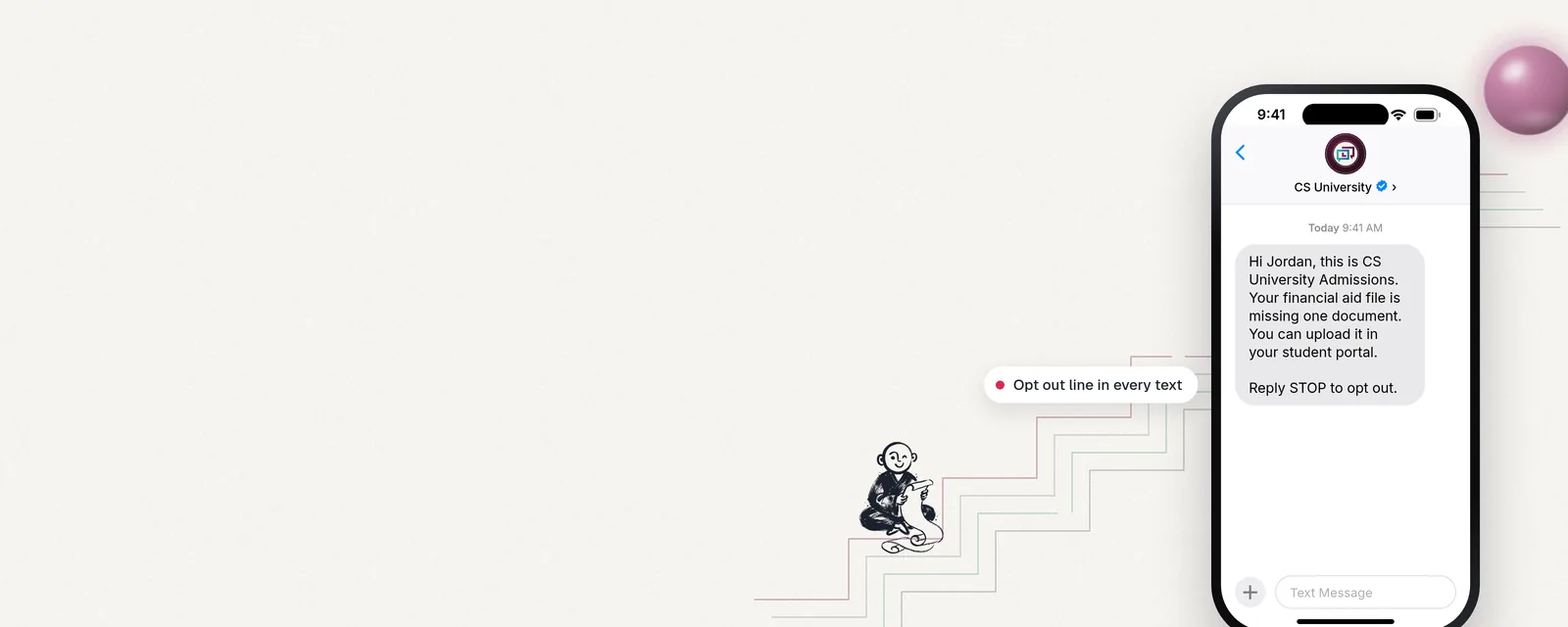
When a student does the research inside an AI tool, your best chance to be heard in your own words is the moment you reach that student directly. Our post on survey led student search explains why a question works better than a brochure. CS Enrollment Pathways opens that moment with a short survey sent as branded, verified messages, so the student tells you what they are weighing (cost, a program, distance). Those answers are also the questions your fact pages should answer next.
What should a small office do this month?
- Check crawler access in robots.txt and at your hosting provider.
- Publish or fix the cost and aid page.
- Correct your top outside profiles.
- Run the first monthly test and save the log.
Frequently asked questions
How do I get my college mentioned in ChatGPT? Let search crawlers read your site, put key facts on plain, current pages, make outside profiles match, and test student questions monthly. No single tactic guarantees a mention.
Do I need special schema or an llms.txt file to appear in AI Overviews? No. Google says "There are no additional requirements to appear in AI Overviews or AI Mode, nor other special optimizations necessary," and that no special schema.org markup is required.
Why does ChatGPT cite Niche or Reddit instead of our website? AI tools lean on outside profiles. In Gradial's study of 51 institutions (vendor research), Niche, Wikipedia, CollegeVine, U.S. News and Reddit were the most cited sources.
How often should we check what AI tools say about our college? Monthly. Results vary by tool and by day, so keep a log and look for patterns.
Does blocking AI crawlers keep us out of ChatGPT? Blocking OpenAI's search crawler keeps your site out of ChatGPT search answers, though it can still appear as a navigational link. The training crawler is a separate setting.
Do students trust AI answers about colleges? Not fully. Capture Higher Ed reports that 67% of students check anything important a second time (vendor research). See how students find colleges through AI answers.
To see how a short survey looks on a student's phone, request the sample walkthrough.
Sources
- EAB, Nearly Half of High School Students Now Use AI in College Search.
- EAB, How Students View and Use AI in College Search: Insights from a Survey of 5,000+ High School Students. 5 (vendor research).
- Michelle Perry, Responsible AI in College Admissions: How Gen Z Actually Wants Your Team to Use It.
- Google, AI features and your website.
- OpenAI, Overview of OpenAI Crawlers.
- Justin Hartford, We Researched AI Search Results for Over 50 Colleges and Universities. Here's What the Data Shows.
- Johanna Alonso, As Students Turn to ChatGPT for College Searches, AI Visibility Becomes Priority.