The short answer: Adult learners choose the college that makes it easiest to start while working: clear cost after employer aid, a schedule that fits, and fast, human answers. Recruit them through employers and through direct, early conversation, not the traditional senior year funnel.
A small college has a real advantage here. Adults want a person who answers, a plan that fits their week and a bill they can predict. Those are things a small team can deliver well.
Who are adult learners, and how many are there?
Adult learners are usually students 25 and older, often working, often with family responsibilities, and often returning after time away. Many have already earned some credit.
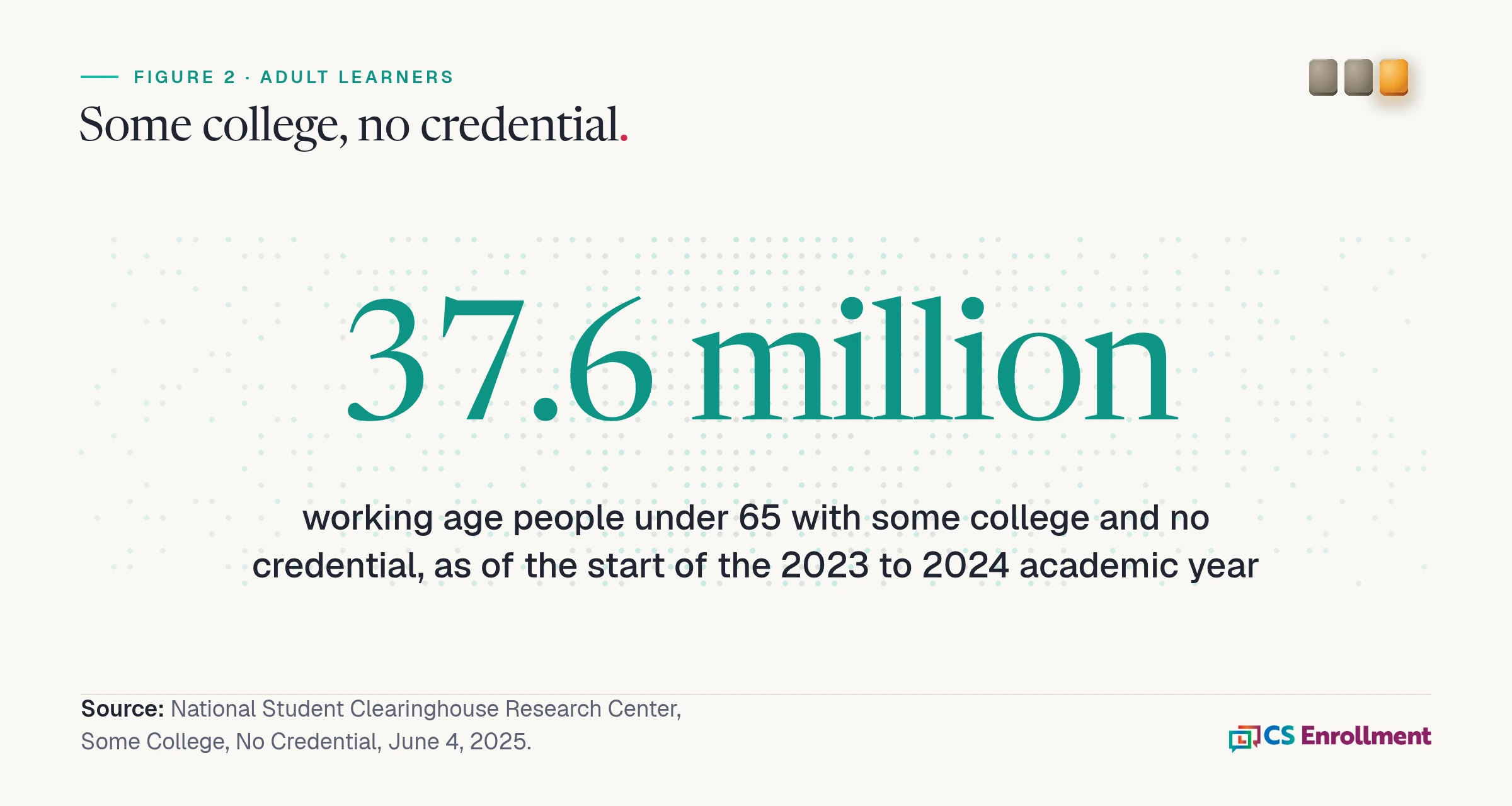
The National Student Clearinghouse Research Center counted 37.6 million working age people under 65 with some college and no credential as of the start of the 2023 to 2024 academic year. That is the clearest single measure of the returning student pool.
Aspen Institute's UpSkill America puts it this way: more than 40 million adults 25 and older have some college credit and no credential, and another 60 million have only a high school diploma (the 60 million is from Census ACS 2024 data). Aspen uses a different definition from the Clearinghouse, so the two figures should not be compared directly.
Why does the traditional funnel miss them?
The usual admissions calendar is built for high school seniors: search in the spring, applications in the fall, deposits by May. Adults rarely follow it.
- They start in any term. A job change or a promotion path can set the timeline, not a deadline.
- More people weigh in. A spouse, a manager or an HR benefits office may shape the decision.
- Cost comes first. Many adults want to know what they will owe before they care about anything else.
- Long forms lose them. Someone filling out an inquiry on a lunch break will not finish a twelve field form.
If your reporting only tracks the fall cycle, adult inquiries can disappear inside it. Our guide to enrollment funnel stages shows how to measure each step so you can see where adults drop out.
How do you work with employers that pay tuition?
Employers already pay for workers through tuition assistance, apprenticeship and cohort programs, Aspen's guide notes, but partnerships often stall on the college's own operations, and that friction falls hardest on working learners. The guide traces the problem to a college's "operational systems, coordination," and everyday practices, which often were not built to support these partnerships. The guide includes a self assessment across five domains: foundational actions and mindsets, business and financial practices, academic practices for working learners, data, and student support.
Aspen's Room for Growth 2026 analysis, based on an UpSkill America survey of employers across industries, looks at how companies approach upskilling.
Practical steps for a small college:
- Name one contact for employers. HR teams should not have to find the right office.
- Match billing to tuition assistance rules. If an employer pays after grades post, offer a payment plan that waits for it.
- Make a one page program sheet for HR. Cost, schedule, format, time to finish and who to call.
- Start with employers you already know. Local hospitals, school districts and manufacturers often have staff who started a degree and stopped.
What do adults need to hear first?
Put these at the top of every adult program page and every first conversation:
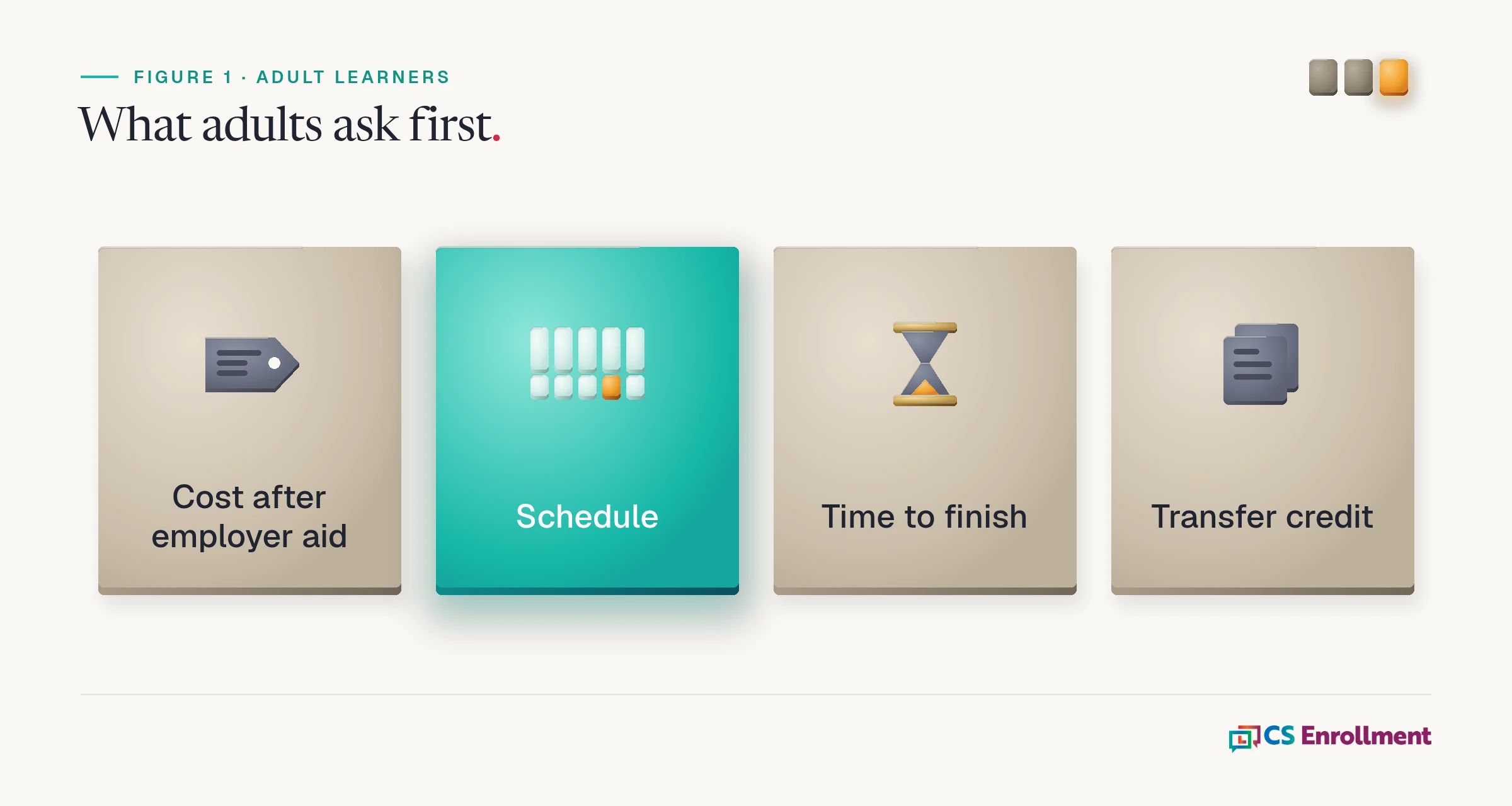
- Cost after employer aid. What they will owe after tuition assistance and any grants, in one line.
- Time to finish. A realistic number of terms for a student working full time.
- Credit for prior learning and transfer. What counts, and how fast they will know.
- Schedule. Evenings, weekends, online, or a mix.
Price clarity usually does more than a bigger award. We cover why in our post on the tuition discount rate.
How fast should you respond?
Fast enough that the adult is still thinking about it. Aim for a same day reply, from a real person, that opens with one short question about their goals rather than a list of requirements.
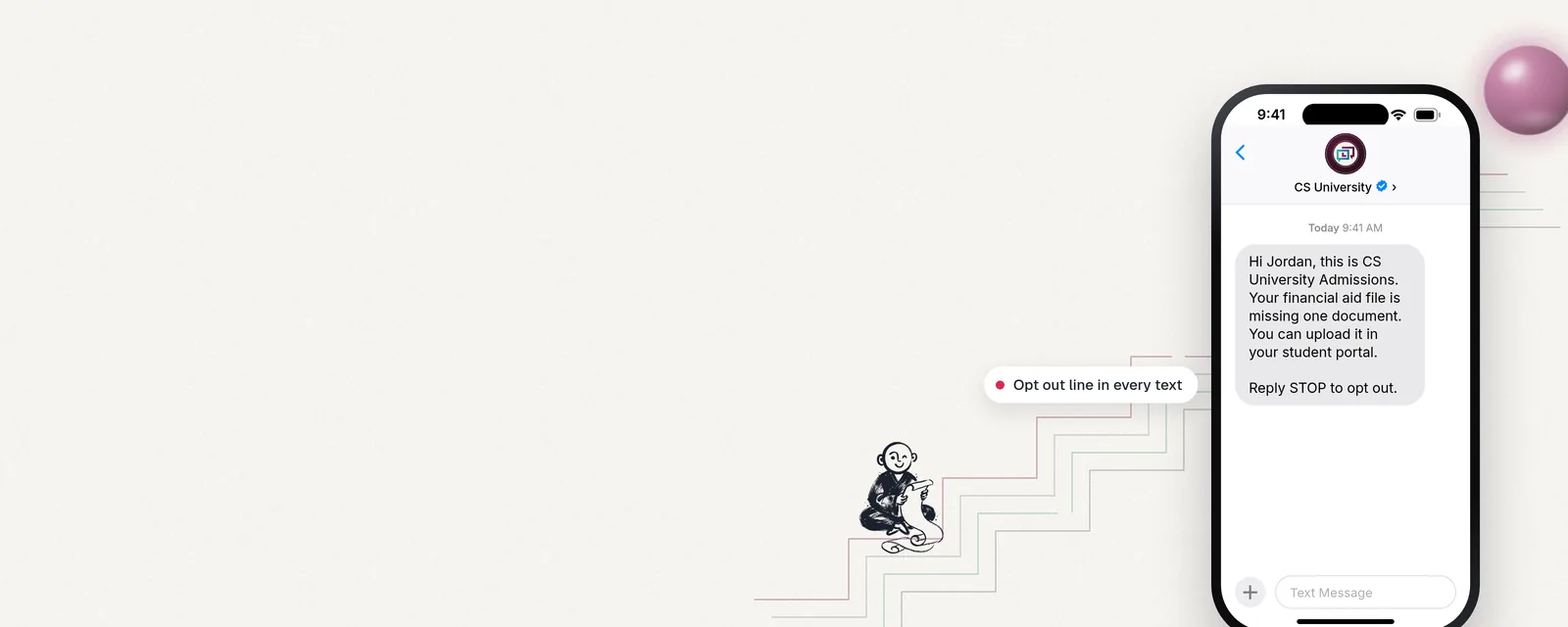
Adults decide between shifts and school pickups, so the first reply has to be quick and easy to answer. CS Enrollment Pathways opens with a short survey sent as branded, verified text messaging, so an adult can say what program, schedule and employer benefit they have before the first call. The same idea, asking first and pitching second, drives survey led student search.
Is this a long game?
Yes. Speaking at an American Council on Education event, as reported by Higher Ed Dive, Patrick Lane of WICHE said a college cannot become one that serves adults overnight, and that "this is a yearslong process."
That matches what small colleges see in practice. Employer relationships take a few cycles to build, and word of mouth among working adults grows slowly. Start now, measure each term, and treat adult recruitment as part of your answer to the demographic cliff. More ideas for small teams are in our post on enrollment marketing strategies for small colleges.
FAQ
What counts as an adult learner? Most colleges use age 25 and older, but the better test is life circumstances: working, supporting a family or returning after time away.
Where do colleges find adult students? Local employers, former students who stopped out, community partners and people already in your inquiry list who never applied.
How do employer tuition benefits work with financial aid? It varies by employer and by student. Have your financial aid office explain how the two fit for each student; this post is not tax or legal advice.
What should an adult learner landing page include? Cost after employer aid, time to finish, schedule options, transfer and prior learning credit, and a short form or a direct way to reach a person.
See what a short first conversation looks like
To see how a short survey looks on a student's phone, request the sample walkthrough.
Sources
- National Student Clearinghouse Research Center, Some College, No Credential: A 2025 Snapshot for the Nation and the States.
- Ben Unglesbee, 'You can't create 18-year-olds': What can colleges do amid demographic upheaval?
- Aspen Institute UpSkill America, Employer-Friendly Practices: A Guide for Higher Education.
- U.S. Census Bureau, Educational Attainment, American Community Survey 1 year estimates, Table S1501.
- Haley Glover, Aspen Institute UpSkill America, Room for Growth: A Survey of Upskilling Approaches, 2026 Analysis.