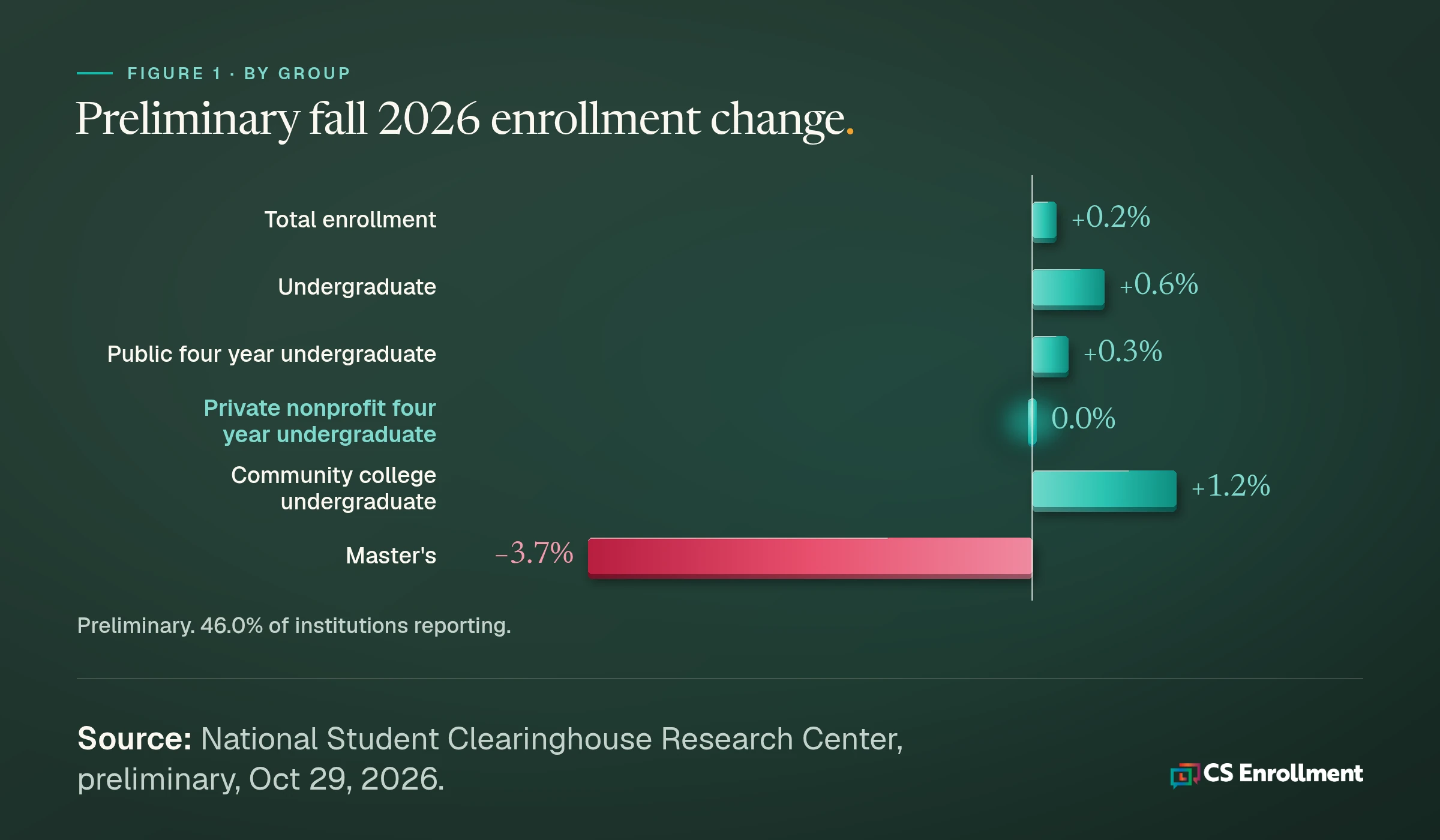
The short answer: Total college enrollment this fall is holding steady, up 0.2%, according to preliminary data from the National Student Clearinghouse Research Center. Undergraduate enrollment is up 0.6%, and private nonprofit four year colleges are flat at 0.0%.
These are early numbers. They reflect 7.92 million enrollments reported by 46.0% of institutions as of Sept 24, 2026, and they may change when the final report comes out in January 2027.
What did the Clearinghouse report?
The Clearinghouse published its Preliminary Fall Enrollment Trends report on Oct 29, 2026. The main findings:
- Total enrollment: holding steady compared with last fall, up 0.2%.
- Undergraduates: up 0.6%, with little change at public four year colleges (up 0.3%) and private nonprofit four year colleges (0.0%).
- A slowdown: undergraduate growth slowed to 0.6% this fall after a 2.4% increase in fall 2025.
Because the data covers less than half of institutions, small shifts could still move up or down. The direction is the useful signal: undergraduate growth has slowed sharply since fall 2025, and the private nonprofit four year sector, where most small private colleges sit, is level. A college whose own fall numbers beat or trail that flat line now has a clear national reference point for its board.
That last point is the one to watch. Last year's growth gave many colleges some room. This year the national market barely moved, and private nonprofit four year colleges, as a group, did not grow at all.
For the state counts that came out before this report, see our post on fall 2026 early enrollment counts.
Where is growth, and where isn't it?
Community colleges. They are the only sector showing growth, with undergraduate enrollment up 1.2%.
Graduate programs. Graduate enrollment is down 1.6%, driven mainly by a 3.7% drop in master's enrollment. Doctoral enrollment is roughly stable, down 0.5%.
Programs. Computer and Information Science enrollment fell 12.4% at four year undergraduate institutions, while Health majors grew 6.2% at the same level.
For a small private college with graduate programs, the master's decline matters as much as the undergraduate number. A college counting on graduate growth to offset a soft first year class may need a second plan.
Why fewer 18 year olds matters to small privates
The report also found undergraduate enrollment declining slightly among 18 year olds (down 0.7%) and among students ages 21 to 24 (down 0.8%).
Eighteen year olds are the core first year market for most small private colleges. A small drop there, on top of a flat sector, means the traditional pool is not growing. Our post on the demographic cliff explains why that pressure is likely to continue.
Our take: what to do this year
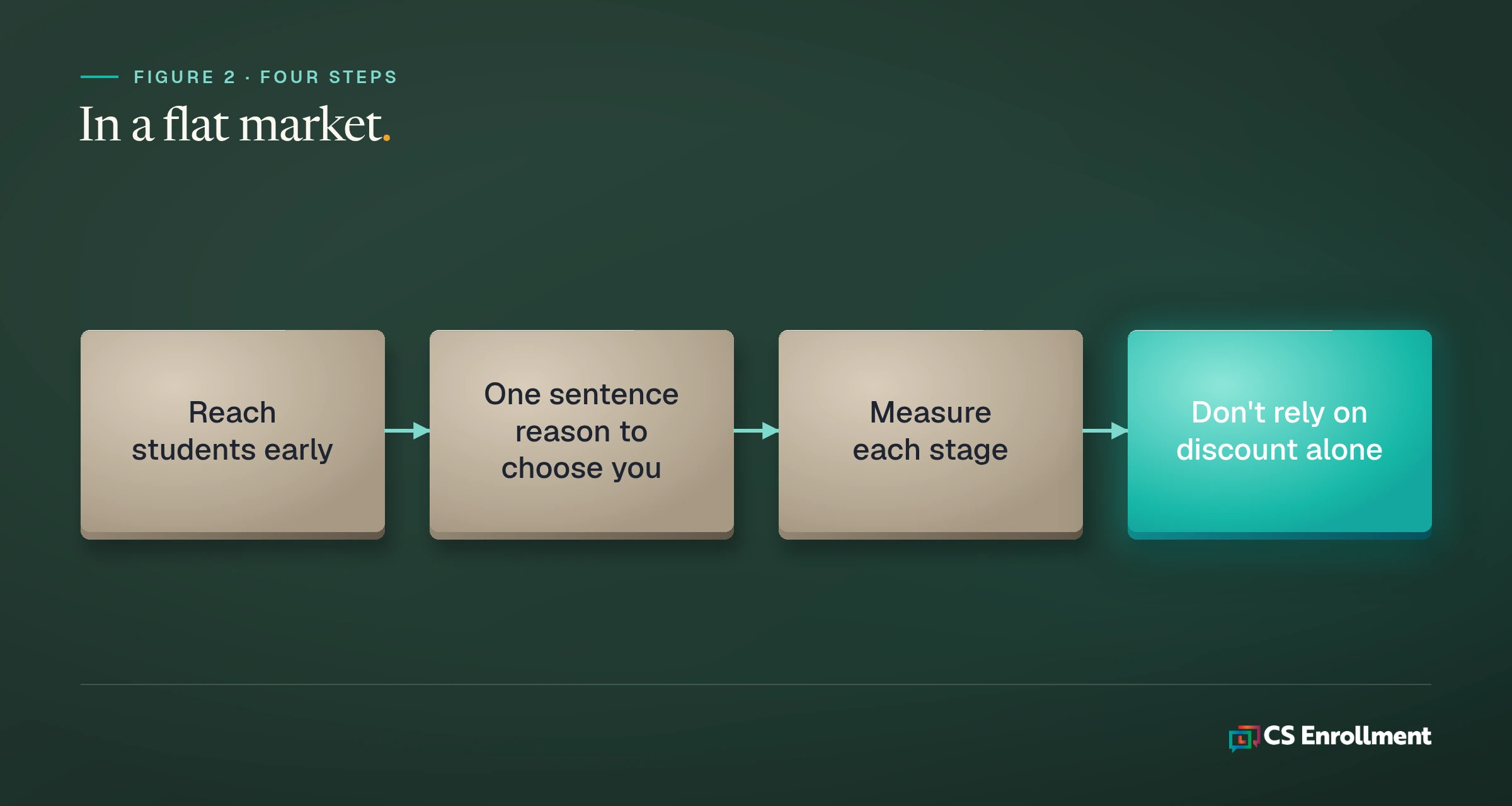
A flat market changes the math. When the total pool is not growing, a small private college gains a student mainly by winning that student from another option. That favors the college that reaches students early and gives them a clear reason to choose it.
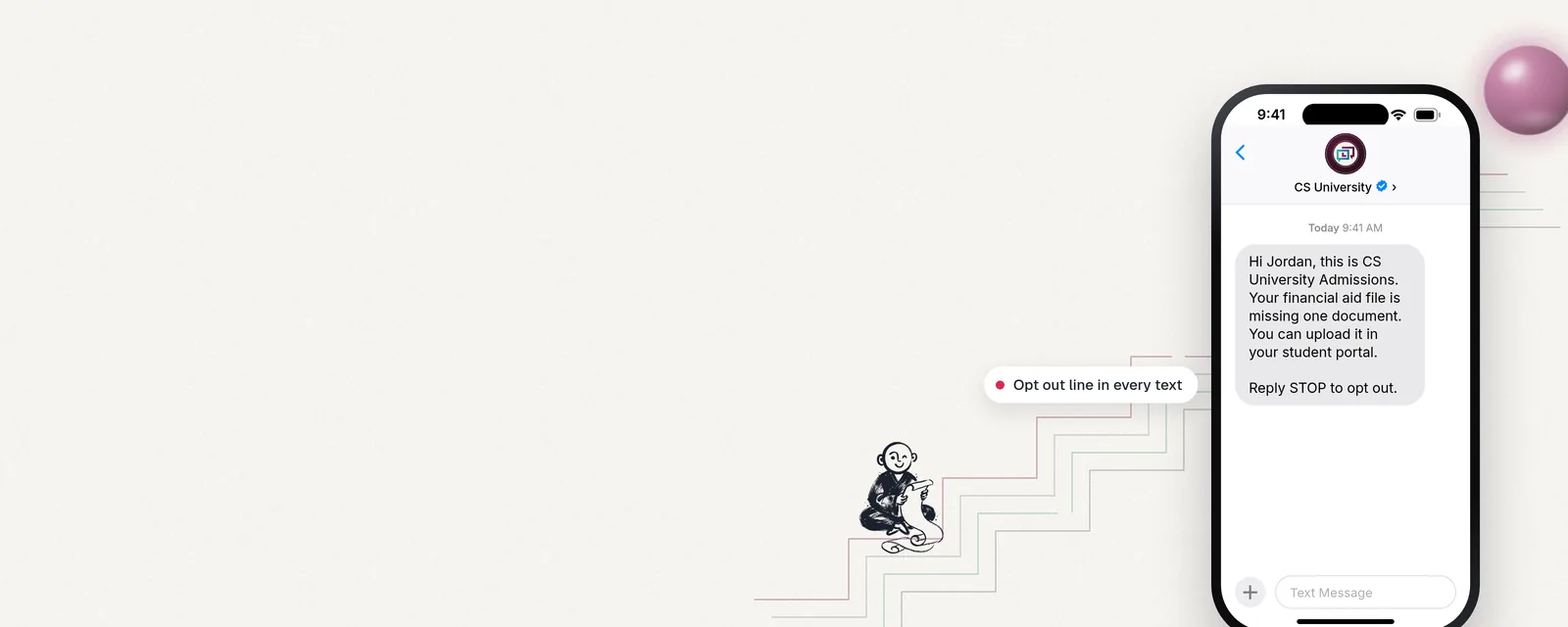
Reach students before they have a short list. Once a student has narrowed to three colleges, it is hard to get onto the list. CS Enrollment Pathways reaches students early with a short survey sent as branded, verified text messaging, so a college learns what each student wants before the short list forms.
Say why a student should choose you in one sentence. In a flat market, a vague message loses to a specific one. If your team cannot agree on the sentence, students will not hear it either.
Measure each stage. Track inquiries, applications, admits and deposits separately, so you can see where students fall away and fix that stage first. Our guide to enrollment funnel stages walks through it.
Don't try to buy yield with discount alone. A bigger award is a price cut, not a reason to choose you. We explain why in our post on the tuition discount rate.
Our take, in short
Enrollment this fall is flat nationally, and private nonprofit four year colleges did not grow as a group. In that market, the colleges that gain students are the ones that reach them early with a specific reason to enroll. These numbers are preliminary; the Clearinghouse's final fall report is scheduled for January 2027.
FAQ
Is college enrollment up or down in fall 2026? Roughly flat. Preliminary Clearinghouse data shows total enrollment up 0.2% and undergraduate enrollment up 0.6%.
How did private colleges do? Undergraduate enrollment at private nonprofit four year colleges was flat at 0.0% in the preliminary data.
When is the final Clearinghouse report? The Final Fall Enrollment Trends report is scheduled for January 2027 and will update these preliminary findings.
See what a short first conversation looks like
To see how a short survey looks on a student's phone, request the sample walkthrough.
Sources
- National Student Clearinghouse Research Center, Preliminary Fall Enrollment Trends.
- National Student Clearinghouse, Total Higher Ed Enrollment Holds Steady in Preliminary Fall Enrollment Trends Report.