The short answer: Yes, modestly. In College Board's own study of 1,068 natural experiments, students whose names a college licensed were 23% more likely to apply there (about 0.1 percentage points), and it took about 1,000 names, roughly $400, to add one applicant before any outreach costs.
One caution belongs right next to those numbers. College Board sells Student Search Service, and the research comes from College Board's own researchers. The studies are careful, and they are also the best public evidence available, so the fair reading is: name buys work a little, and the value depends almost entirely on what a college does after it buys.
What does the research actually show?
The strongest study is a 2020 College Board paper by Smith, Howell and Hurwitz. It used 1,068 search orders placed between October 2014 and September 2015, where names were chosen at random within each order. That design lets the authors compare similar students who were and were not licensed.
They found licensed students were 23% more likely to apply to the licensing college (0.1 percentage points) and 22% more likely to enroll there (0.02 percentage points). The effects were about twice as large for traditionally underserved students.
A second College Board paper (April 2021) found that students found through Search enrolled in college at a rate 7.8 percentage points higher than similar students across the 2015 to 2018 SAT cohorts, and graduated within four years at a rate 5 percentage points higher (2015 and 2016 cohorts). That study is associational, not causal. Students who opt into Search may differ in ways the comparison does not capture.
What does an added applicant or enrollee cost?
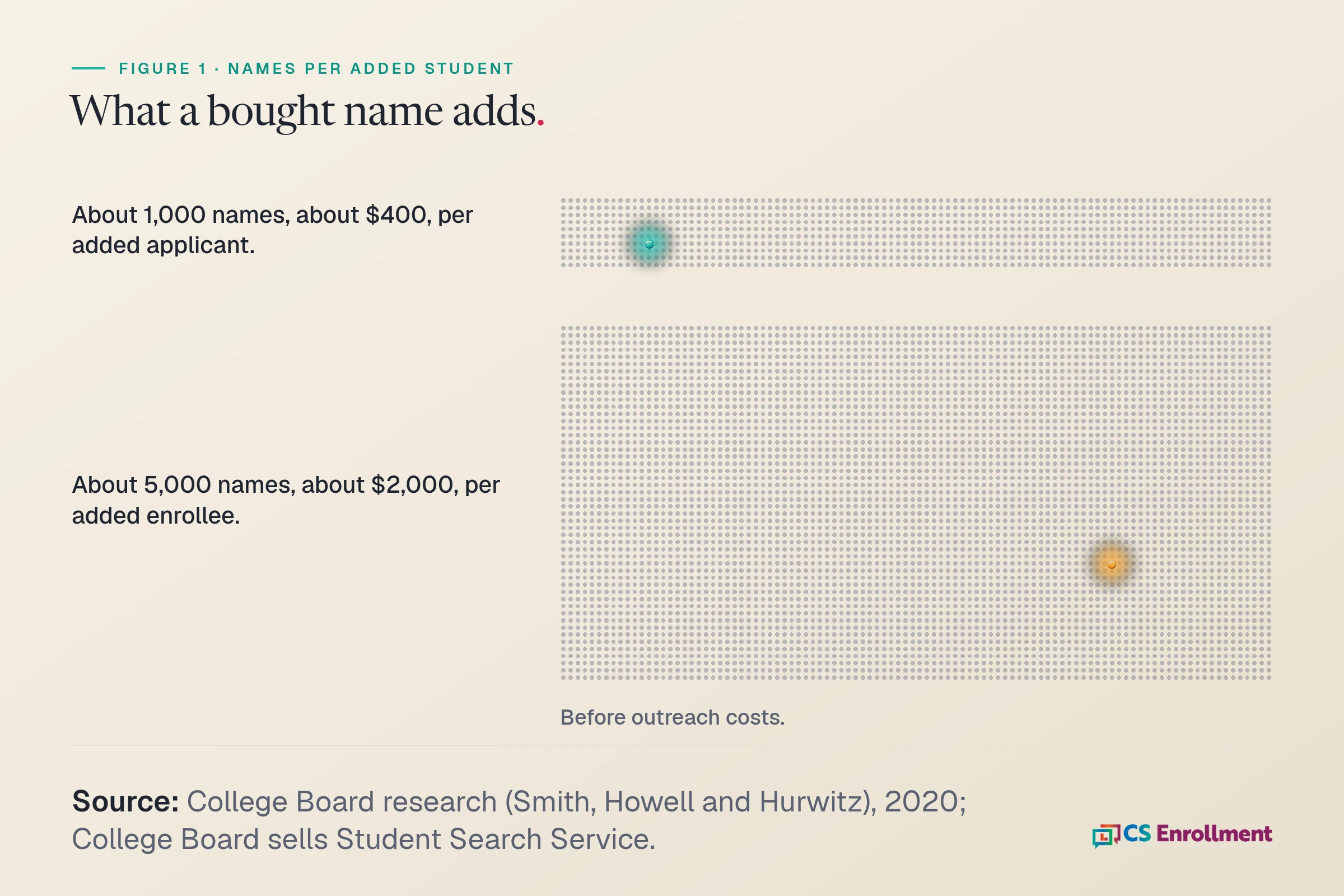
The 2020 paper does the math. Colleges paid a licensing fee of $0.38 to $0.42 per name in the study period. At that price, one added applicant took about 1,000 licenses, about $400, and one added enrollee took about 5,000 licenses, about $2,000. Those figures leave out everything a college spends writing to the students afterward.
There is a second detail worth knowing. In the study, a student's contact information was licensed an average of 28.5 times. Many colleges are buying the same student and writing to them at the same time.
Why do purchased names underperform?
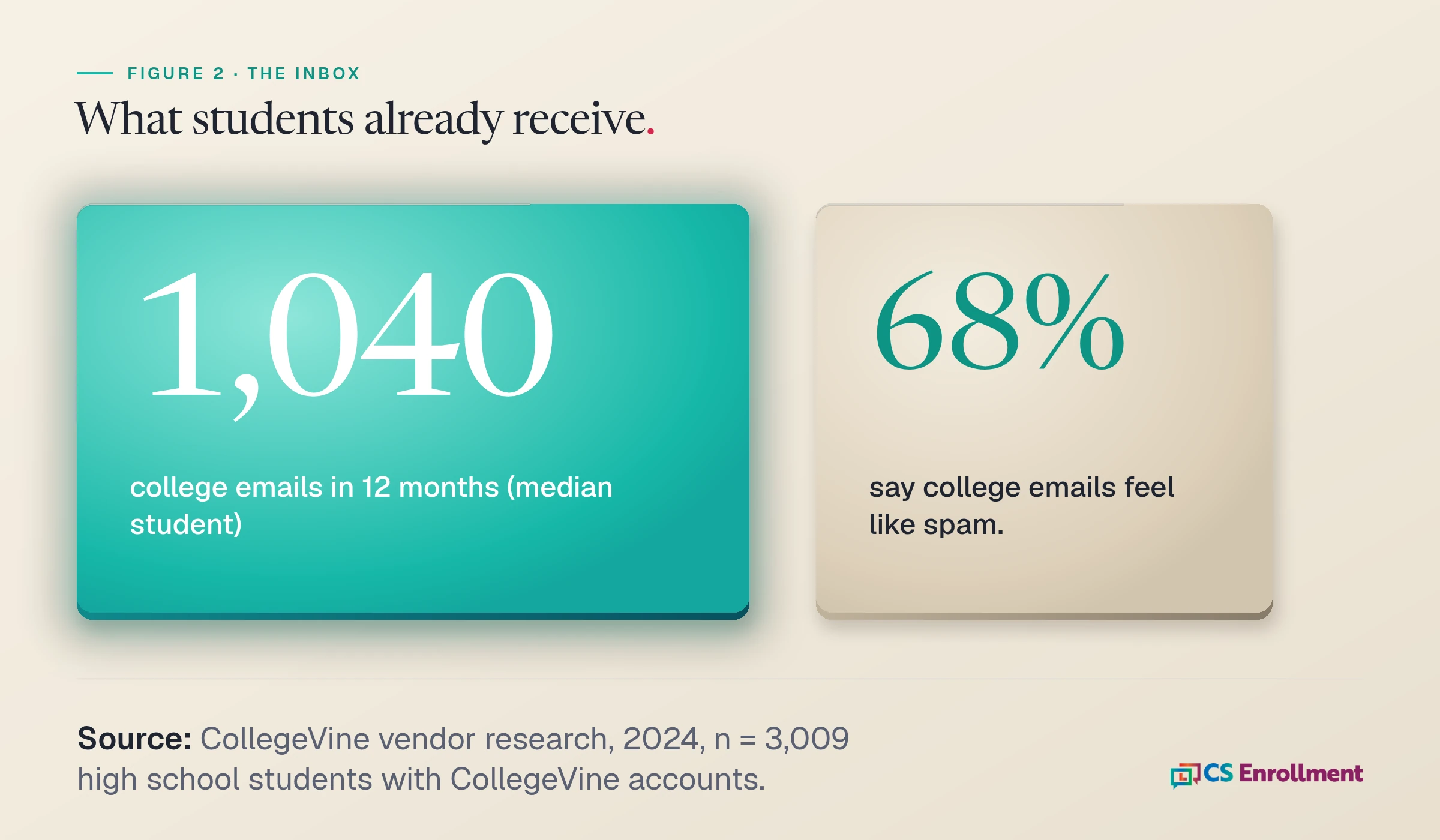
Volume is part of the answer. In CollegeVine's 2024 survey (vendor research, n = 3,009 high school students with CollegeVine accounts), the median student received 1,040 college emails over 12 months, and 68% agreed that the college emails they received feel like spam. For printed mail, 43% said the same.
So the questions for your own team are practical ones. Does your first message look different from the other emails in that inbox? Does it ask the student anything, or only tell? Do you know what share of purchased names ever reply?
How to decide: a checklist
Before the next order, answer these for your own college:
1. Cost per added applicant by source. Divide what you spend on a list and its outreach by the applications it produced, and compare it with other sources. 2. Overlap. How many purchased names are already in your system as inquiries or past buys? 3. Reply rate. What share of purchased students ever answer anything you send? 4. First message. Does it ask the student a question?
Here is a worked example with round numbers. This is an example, not data. A college buys 20,000 names. If they perform like the College Board estimate, that adds about 20 applicants. If 4,000 of those names were already in the college's system, the true buy is smaller than it looks, and the cost per added applicant is higher. Our guide to inquiry to application conversion shows how to measure the next step consistently.
How to get more from fewer names
Buy smaller and more targeted. Choose the geographies and interests your college actually serves, rather than the largest list the budget allows.
Make the first message one a student would answer. A short question about what they want does more than a brochure. Our post on survey led student search explains the method. CS Enrollment Pathways opens with a short survey sent as branded, verified text messaging, so a purchased name becomes a student who has told you what they want.
Follow up quickly with what they asked about. Use the answer to send program specific information, not the general sequence.
Measure replies, not opens. A reply is a student raising a hand. Track it by list and by stage, using the enrollment funnel stages you already report. For the wider plan, see enrollment marketing strategies for small colleges.
FAQ
How much does a student name cost? In College Board's 2020 study period, the licensing fee was $0.38 to $0.42 per name. Current prices vary by product and order.
Do purchased names lead to enrollments? A little. College Board's own research found licensed students were 22% more likely to enroll at the licensing college, about 0.02 percentage points, or roughly one added enrollee per 5,000 names.
Should a small college stop buying names? Not necessarily. Buy fewer, measure cost per added applicant against your other sources, and make sure the first message gives students a reason to reply.
The bottom line
Student search adds applicants, slowly and at a real cost per student. The colleges that get value from it buy fewer names and start a conversation with each one.
See what a short first conversation looks like
To see how a short survey looks on a student's phone, request the sample walkthrough.
Sources
- Jonathan Smith, Jessica Howell and Michael Hurwitz, The Impact of College Outreach on High Schoolers' College Choices. College Board sells Student Search Service.
- College Board, College Outreach and Student Outcomes. College Board sells Student Search Service.
- CollegeVine, Traditional marketing report.