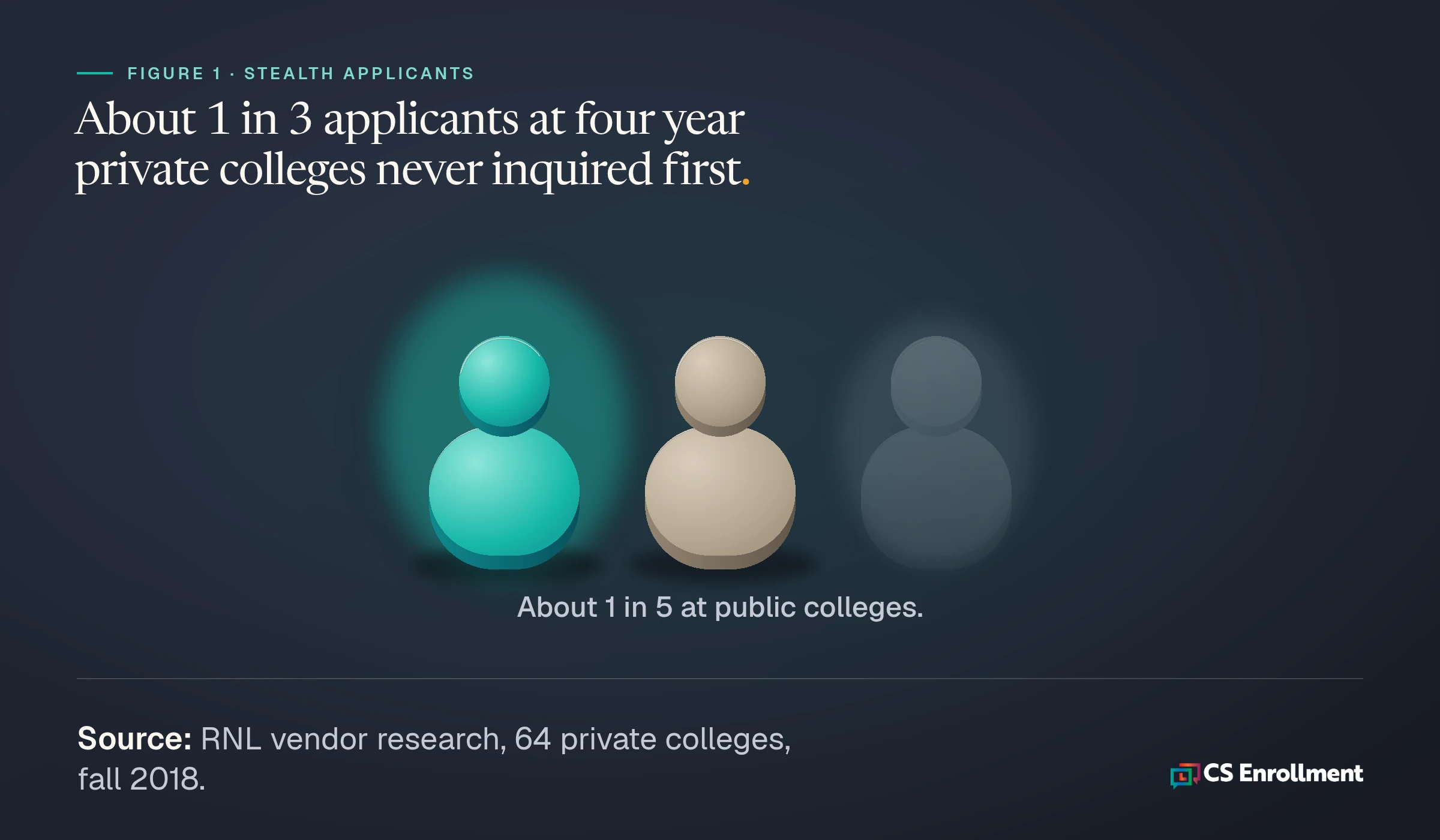
The short answer: A stealth applicant is a student whose first contact with a college is the application itself. In RNL's benchmarks (vendor research, 64 private colleges, fall 2018), stealth applicants made up 33% of applicants at four year private colleges, about 1 in 3, and 22% at public colleges, about 1 in 5.
Stealth applicants are not invisible. They are researching quietly, on your website, in search results and in conversations with family and friends. The work is to answer their questions where they already look and give them an easy, low pressure way to raise a hand before they apply.
What is a stealth applicant?
In a CRM, a stealth applicant shows up as an application with no earlier inquiry record. No form fill, no event signup, no reply to a search email. The student may have read every program page and visited campus with a friend, but nothing tied that interest to a name until the application arrived.
That definition depends on how a college records inquiries. A college that counts more touches as inquiries will see fewer stealth applicants. Write your definition down and keep it the same from year to year, so the share you track means the same thing each cycle.
Why do students apply without inquiring?
Every college's reasons will differ, so treat these as questions to check, not findings:
- Privacy. Does your inquiry form ask for more than a student wants to share with a college they are only curious about?
- Inbox fatigue. Do students expect that filling out a form will start a long run of generic emails?
- Self service research. Can a student answer most of their questions on your site without talking to anyone?
- New research tools. Are students asking AI tools about your college instead of asking you?
That last question is getting more attention. In an EAB survey of 5,095 high school students in October and November 2025, 46% said they used AI tools such as ChatGPT in their college search, up from 26% in spring 2025 (vendor research). Our post on how students find colleges in AI answers covers what that means for your site.
What do stealth applicants cost you?
They change your funnel math. In the same RNL benchmarks, the median inquiry to application rate at four year private colleges was 14% counting stealth applicants and 10% without them. A college that ignores the difference can misread how well its inquiry follow up works. Our guide to the inquiry to application conversion rate shows how to calculate both versions.
They also cost you chances to help. A student who never inquires never gets an answer to the question that was holding them back, and never hears the one detail that might have made your college the first choice. Some students like them likely never applied at all. You see the stealth applicants who made it to an application; you do not see the ones who quietly chose somewhere else. For where this sits among the other stages, see enrollment funnel stages.
How to reach them earlier: a checklist
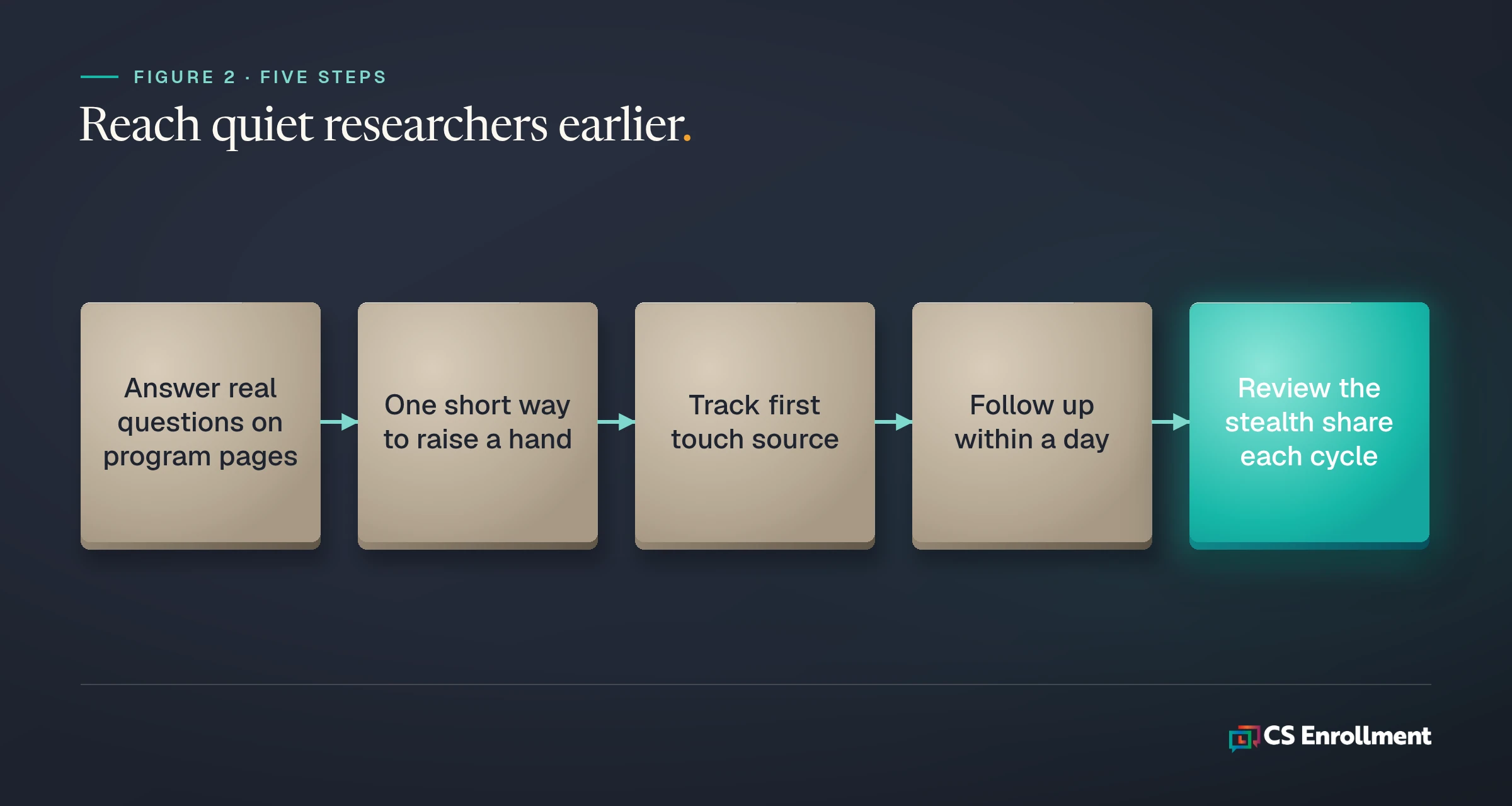
1. Answer real questions on program pages. Cost after aid, schedule, outcomes and how to start. If a counselor answers it every week, it belongs on the page. 2. Offer one short, low commitment way to raise a hand. One or two questions, not a long form. Make clear what happens next and how often you will write. 3. Track first touch source on every application. Ask applicants how they first heard of you, and record it, so stealth applicants become a pattern you can study. 4. Follow up within a day once a student raises a hand. Answer what they asked about, not the general sequence. 5. Review the stealth share each cycle. Compare it with the same point last year, using the same definition.
Here is a worked example with round numbers. This is an example, not data. A college receives 900 applications, and 300 have no prior inquiry record. After adding a two question hand raise to its program pages, it compares the stealth share at the same point next cycle. If more of those students now show up as inquiries first, the college had the chance to answer their questions before they applied.
How a first message turns a quiet researcher into an inquiry
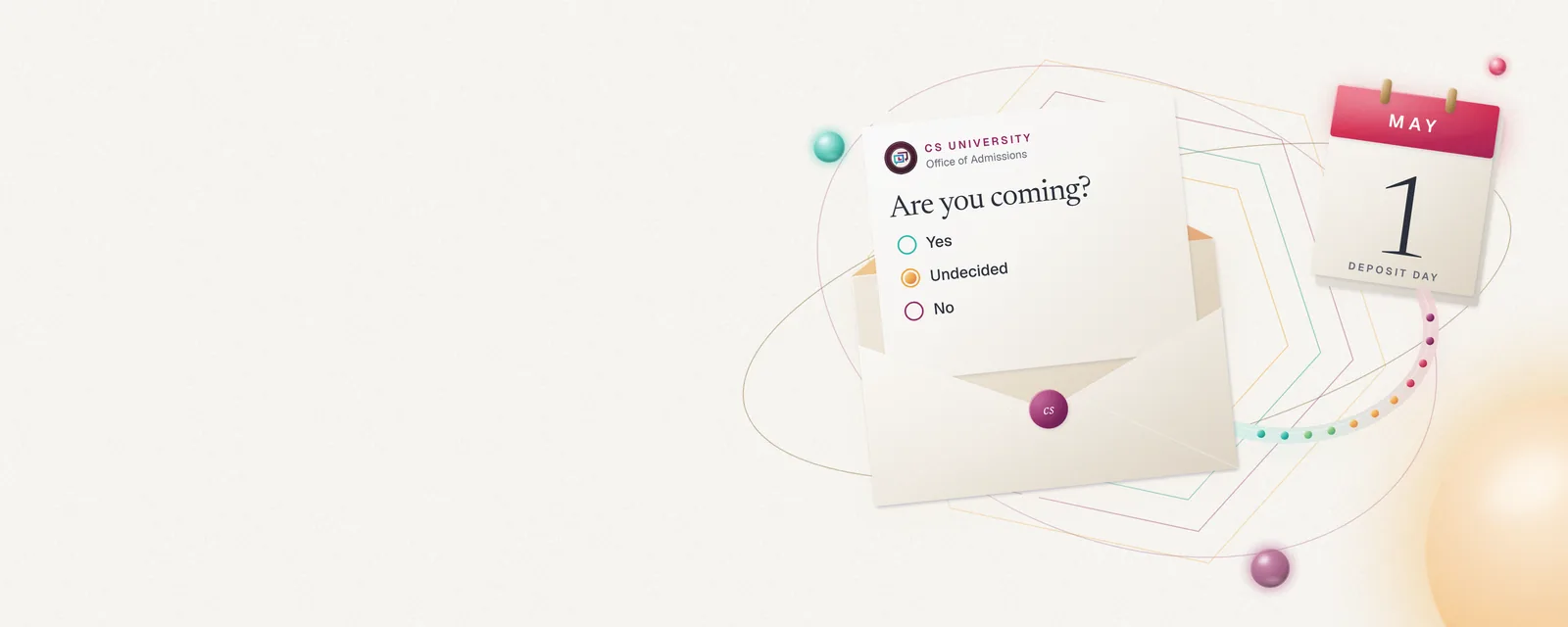
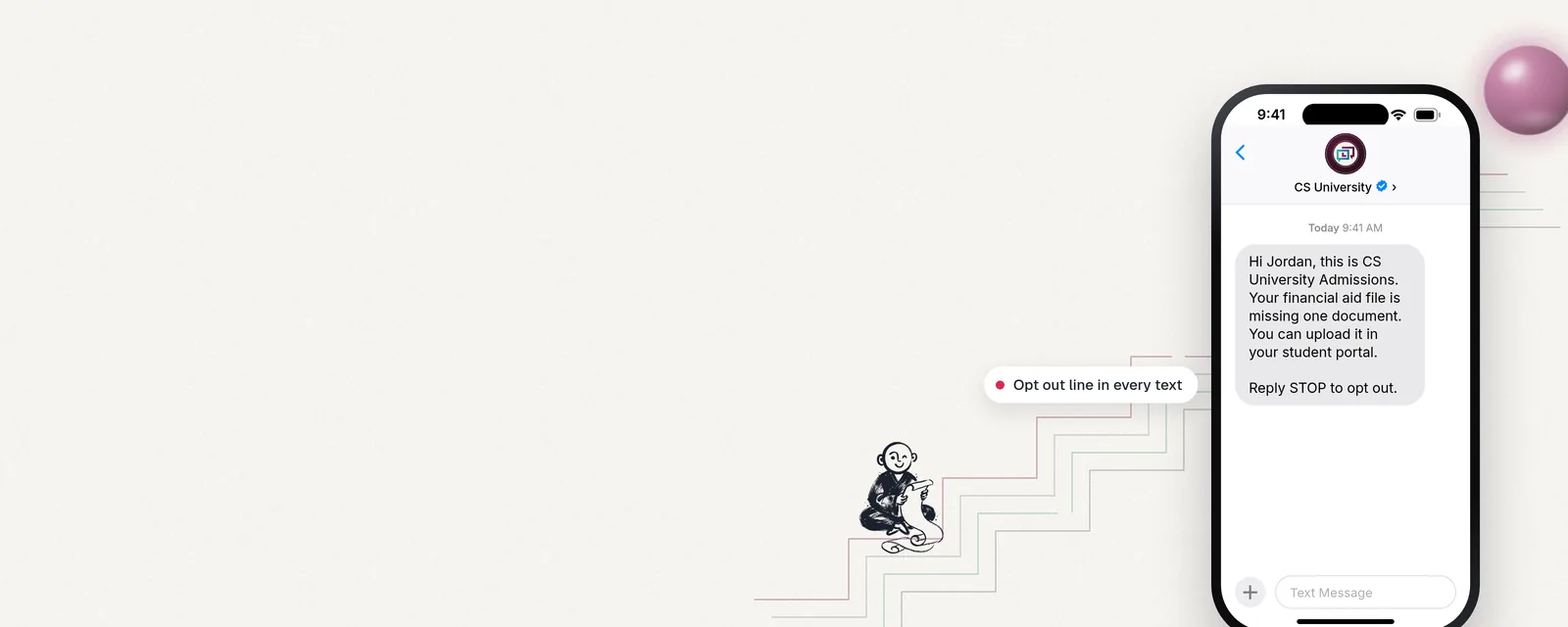
A quiet researcher will answer a short, specific question when it costs them little and gets them something useful. That is the idea behind survey led student search: ask before you tell. CS Enrollment Pathways opens with a short survey sent as branded, verified text messaging, so a student gets an easy way to tell you what they want before they apply.
If you buy names, the same principle applies to the first message those students receive. Our post on whether student search is worth it covers how to get more from fewer names.
FAQ
What is a stealth applicant? A student whose first contact with a college is the application itself, with no earlier inquiry on record.
What share of applicants are stealth applicants? In RNL's fall 2018 benchmarks (vendor research, 64 private colleges), about 1 in 3 applicants at four year private colleges and about 1 in 5 at public colleges.
Are stealth applicants less likely to enroll? It varies by college. Measure your own: compare admit and deposit rates for applicants with and without a prior inquiry, using the same definitions each year.
The bottom line
Stealth applicants are students you could have helped sooner. Answer their questions where they already look, and give them one easy way to say hello before they apply.
See what a short first conversation looks like
To see how a short survey looks on a student's phone, request the sample walkthrough.