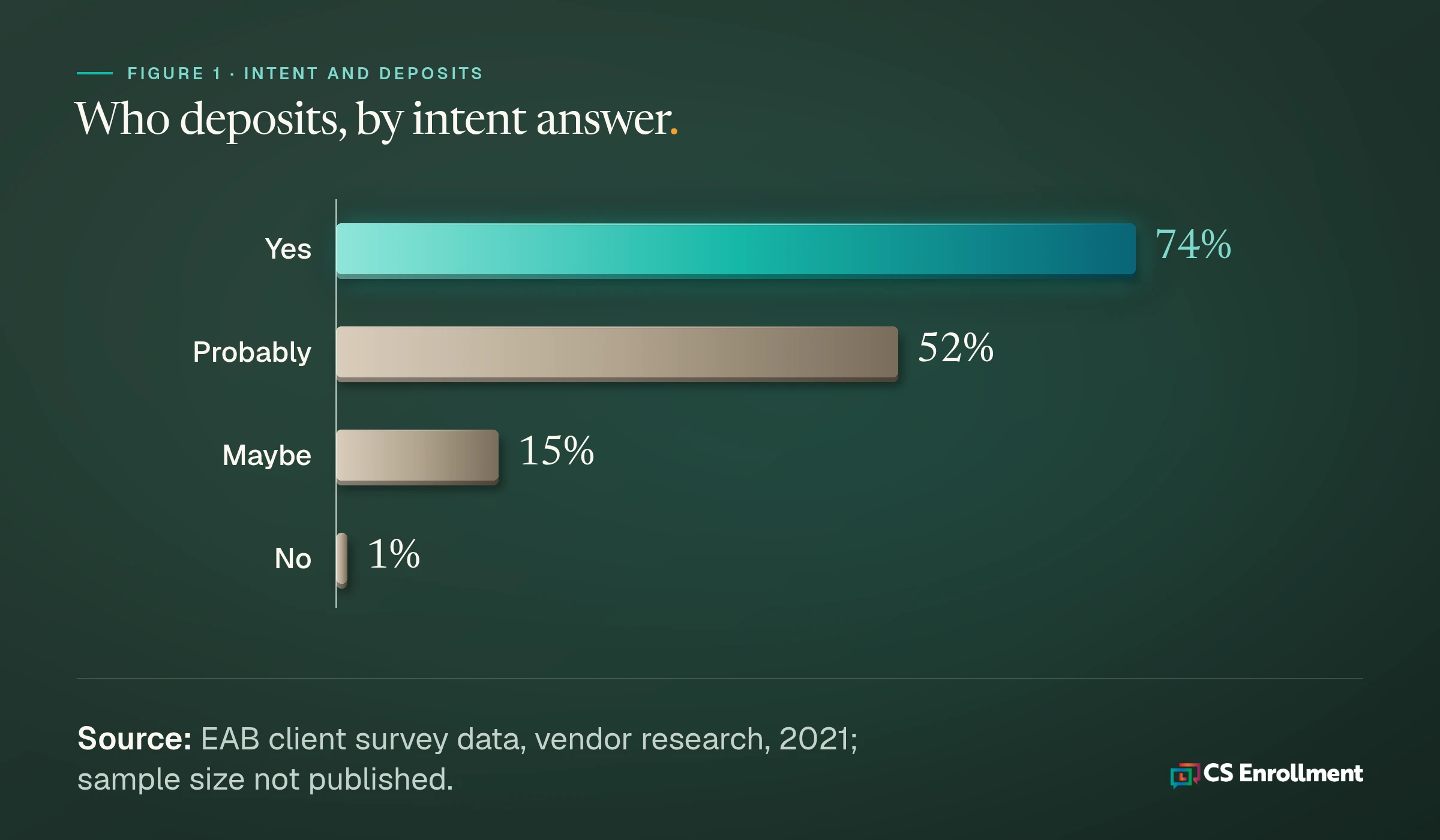
The single best admitted student survey question is a direct intent question, such as "Do you intend to deposit?", with four answers: Yes, Probably, Maybe and No. In EAB client survey data (vendor research, 2021; sample size not published), 74% of students who answered "yes" went on to deposit, along with 52% of "probably", 15% of "maybe" and 1% of "no".
That one answer tells a small enrollment team where to spend its time. The rest of the survey should be short, sent early, and built so every answer leads to a next step within a day.
Why survey admitted students at all?
Most admitted students go somewhere else. NACAC reports an average yield rate of 30.2% in fall 2022 at four year nonprofit colleges, down from 32.1% in fall 2019. Yield was 33% at private colleges and 25% at public colleges.
At a college of 2,000 students, counselors cannot give every admit the same attention. A survey sorts the class by what students say they will do, so outreach goes to the students it can still move. Our guide on how to increase college yield covers the wider yield plan, and enrollment funnel stages shows where this step sits.
Which questions predict enrollment?
The list below is practice guidance, not data. Keep it to five to seven questions, and put intent first.
1. "Do you intend to deposit?" (Yes, Probably, Maybe, No). This is the sorting question. Keep the four answers exactly the same every year so you can compare cycles. 2. "What is the biggest question or worry you still have?" One open text box. The answer tells a counselor what to say on the first call. 3. "Have you filed the FAFSA, and have you seen your aid offer?" Cost is often the deciding factor. A student who has not filed needs a different message from a student comparing offers. If you are thinking ahead to the summer, our post on how to reduce summer melt picks up from here. 4. "Are other colleges still in the running?" (optional). A yes or no is enough. You do not need names, and asking for them can feel intrusive. 5. "What is the best way and time to reach you?" Then use it. 6. "Would a visit, a call with a counselor or a talk with a current student help you decide?" This turns the survey into a booking step.
Each question earns its place by changing what the team does next. If an answer would not change your follow up, cut the question.
How many questions, and when should you send them?
Short beats long. Five quick questions take a student about a minute on a phone; a long form asks for far more patience than a newly admitted student owes you.
Send the first survey soon after the admission decision, while interest is high. Send a shorter repeat of the intent question a few weeks before your deposit deadline, so you can see who has moved. Response matters as much as question design: EAB reports that strong outreach "consistently produces response rates in the neighborhood of 40%" (EAB client survey data, vendor research, 2021).
What should you do with each answer?
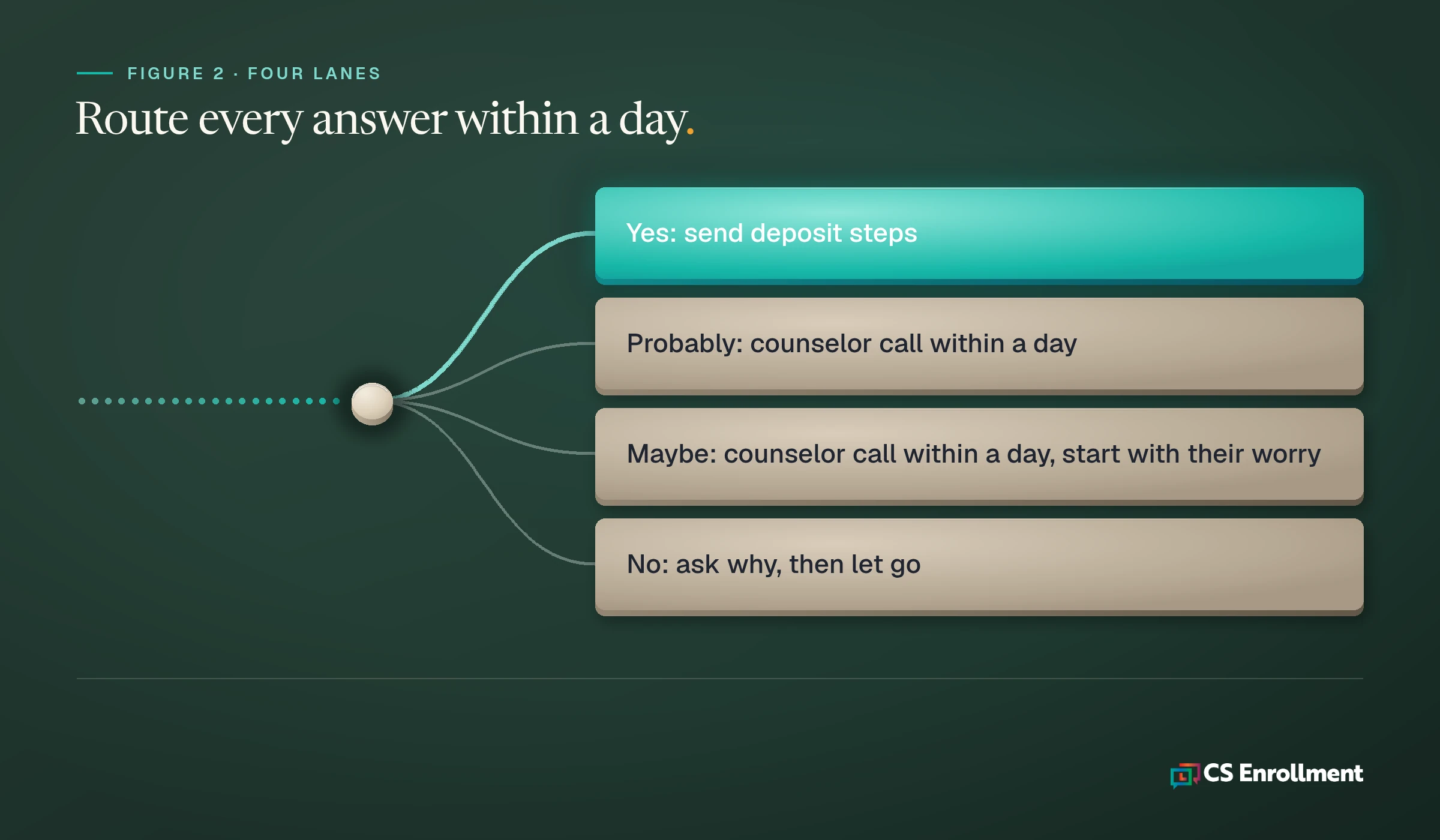
Route every response the day it arrives. EAB notes that teams using this approach can "focus their most intensive outreach on just a quarter of respondents" (EAB client survey data, vendor research, 2021).
- Yes: send the deposit steps, the housing and orientation dates, and one named contact.
- Probably or Maybe: a counselor follows up within a day, starting with the worry the student named.
- No: ask one polite question about why, record the answer, and then let the student go.
Here is a worked example with round numbers. This is an example, not data. A college admits 1,000 students and 400 answer the survey. Of those, 120 say Yes, 100 say Probably, 110 say Maybe and 70 say No. The team sends deposit steps to the 120, schedules counselor calls for the 210 in the middle, and logs reasons from the 70. Counselor time goes to the students whose decision is still open.
Ask in a channel students actually answer
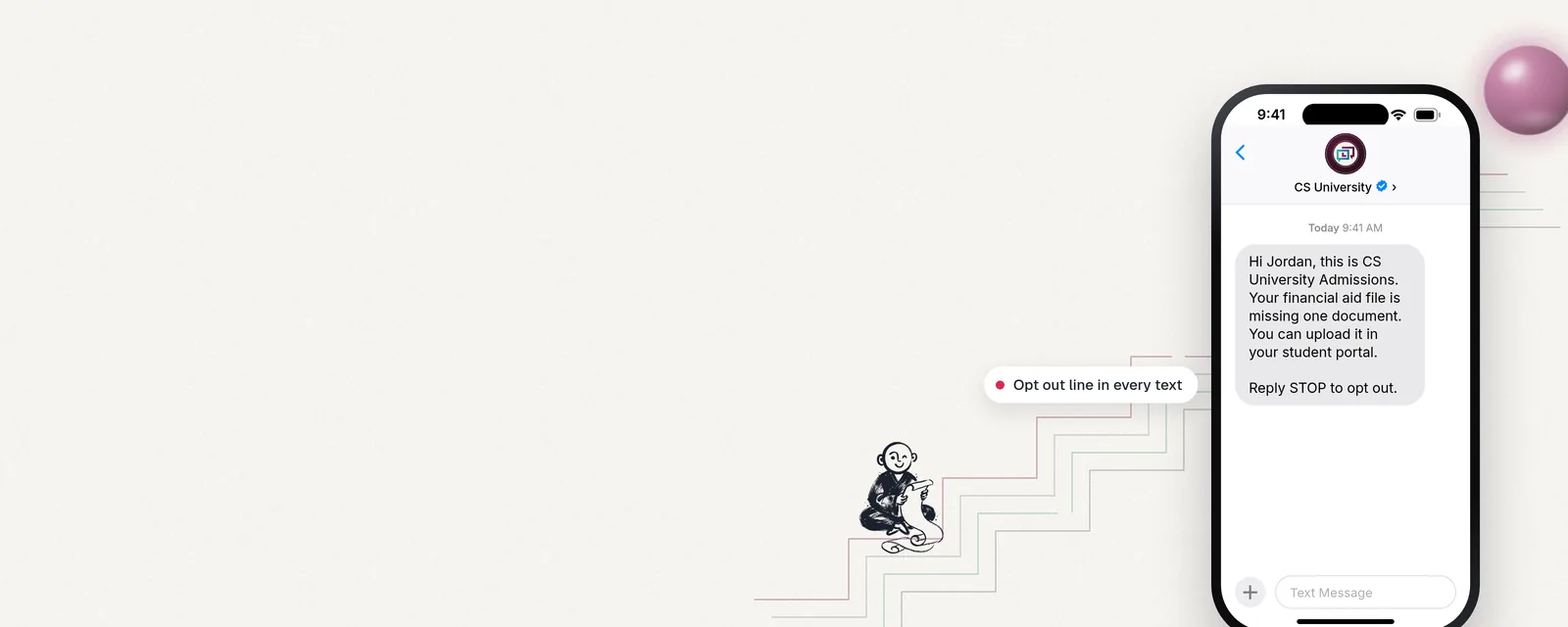
A good question only works if students see it. Email surveys compete with every other college in the inbox. That is why we built CS Enrollment Pathways around a short survey sent as branded, verified text messaging: an admitted student can answer the intent question in seconds, and counselors see right away who needs a call. It follows the same idea as survey led student search: ask first, then answer what the student told you.
FAQ
What questions should be on an admitted student survey? Start with a direct intent question with four answers, then ask about the biggest remaining worry, aid status, other schools in the running, the best way to reach them and whether a visit or call would help.
How many questions should a yield survey have? Keep it to five to seven, short enough to finish on a phone in about a minute.
When should colleges survey admitted students? Soon after the admission decision, then again with the intent question before the deposit deadline.
The bottom line
Ask one clear intent question, keep the rest short, and act on every answer within a day.
See a short survey in action
To see how a short admitted student survey looks on a student's phone, request the sample walkthrough.