
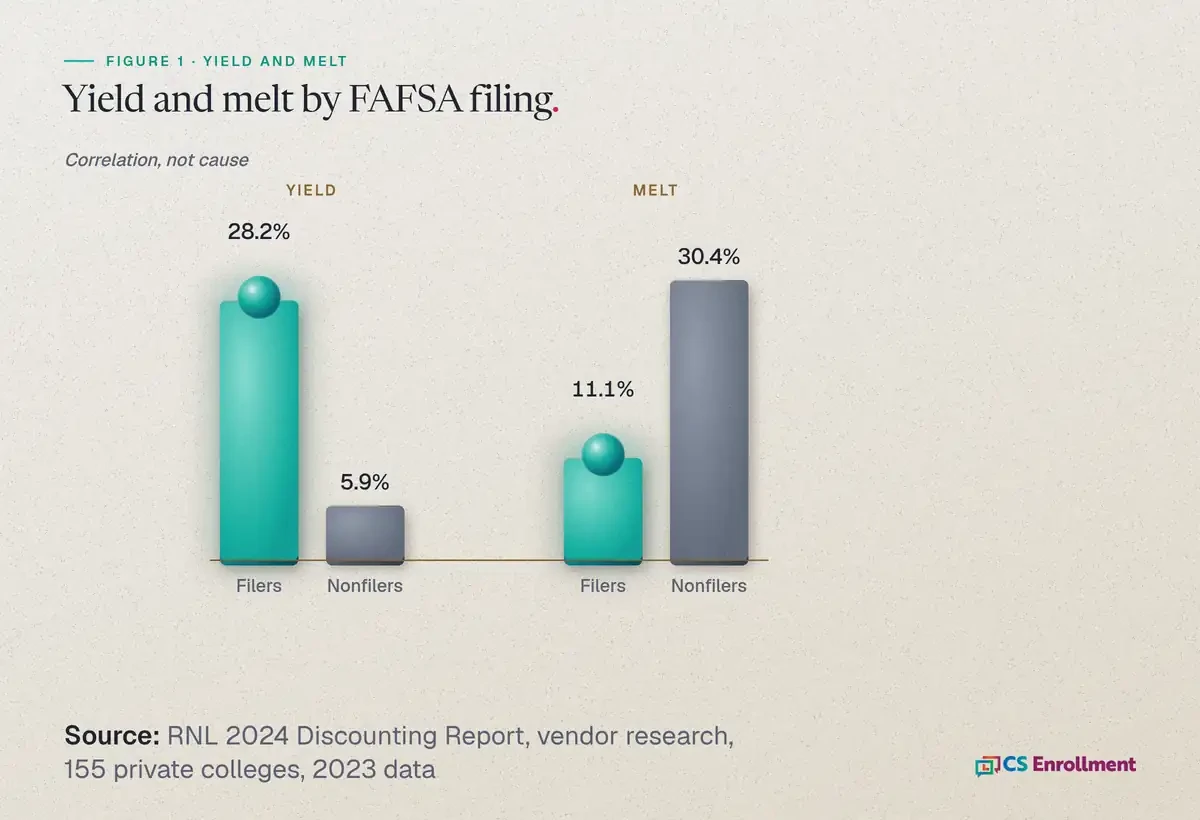
In RNL's 2024 Discounting Report (vendor research, 155 private colleges, 2023 data), first year admits who filed a FAFSA yielded at 28.2%, against 5.9% for those who did not. Students who did not file were "nearly three times more likely to deposit but not enroll," with a 30.4% melt rate against 11.1% for filers.
Those numbers describe a correlation, not a proven cause. They still give an admissions office something useful: a list of admits at risk that it can see weeks before deposit day.
Does filing the FAFSA cause higher yield?
Not entirely. Filing the form is also a sign that a student is serious about enrolling somewhere. A student who has already chosen another college may never list yours, and a student with no plan to enroll anywhere may skip the form altogether.
So the gap between 28.2% and 5.9% is not all something the FAFSA itself creates. Some of it is intent showing up early. That is still worth acting on. A nonfiler is an admit at risk, and the signal arrives months before the deposit deadline, when there is time to help.
The practical read is simple. Treat a missing FAFSA the way you would treat a missed visit or an unopened aid offer: as a reason to reach out to that student. For the wider set of yield steps, see how to increase college yield.
Are fewer admitted students filing the FAFSA?
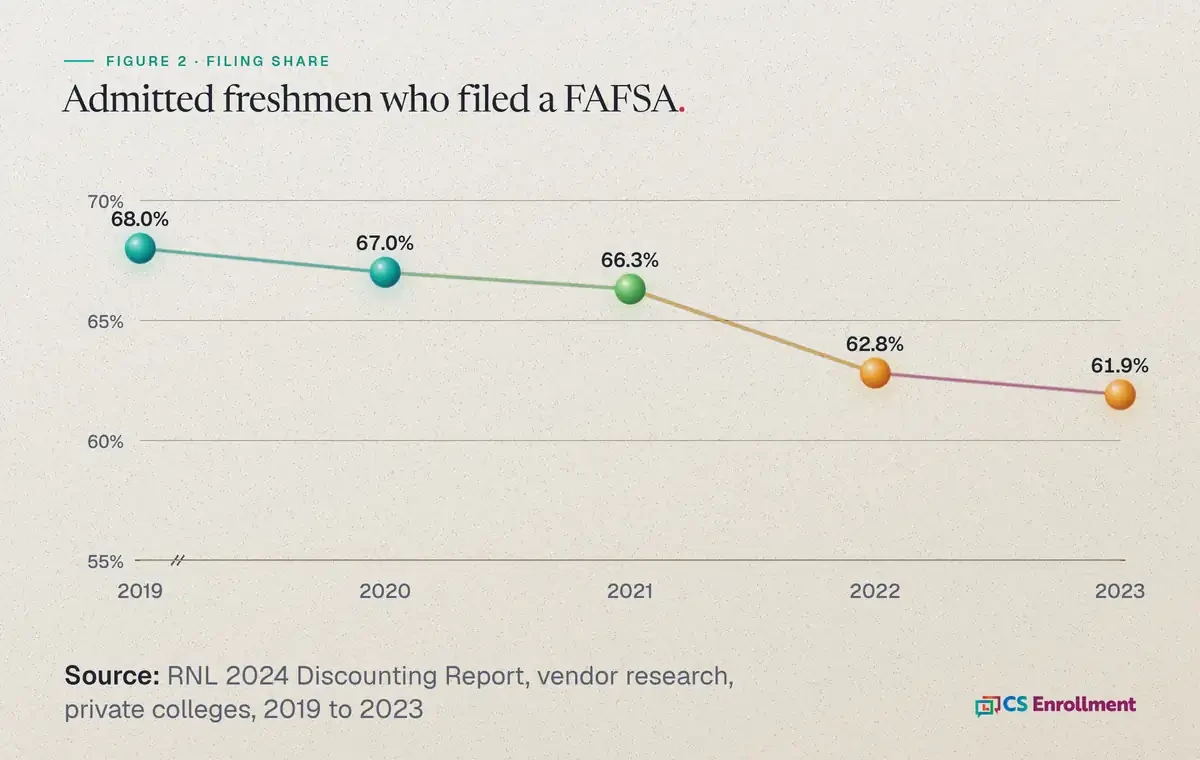
At private colleges, yes, through 2023. RNL reports that the share of admitted freshmen who filed a FAFSA fell from 68.0% in 2019 to 61.9% in 2023, with "only six in 10 first-year students filing one" (vendor research).
The national picture has since turned. The National College Attainment Network (NCAN), which tracks weekly Federal Student Aid data, estimates that the high school class of 2026 reached 64.6% FAFSA completion through September 25, 2026. NCAN calls that "an all-time high for the Tracker." The number of completed FAFSAs grew 7.5% year over year, more than 185,000 additional applications.
The two figures measure different groups, so they do not line up neatly. They do point the same way. More students are finishing the form nationally, which means a low filing rate among your own admits is mostly a follow up gap, not a form problem.
What changed with the FAFSA?
The form now opens earlier and takes less time. Federal Student Aid opened the 2027 to 2028 FAFSA on September 23, 2026, which NCAN calls "the earliest opening on record." NCAN, citing some observers, says average completion time is now 15 minutes or less.
That 2027 to 2028 form is the one students starting college in fall 2027 need. Families can start at the Federal Student Aid FAFSA page.
A weekly FAFSA check for admitted students
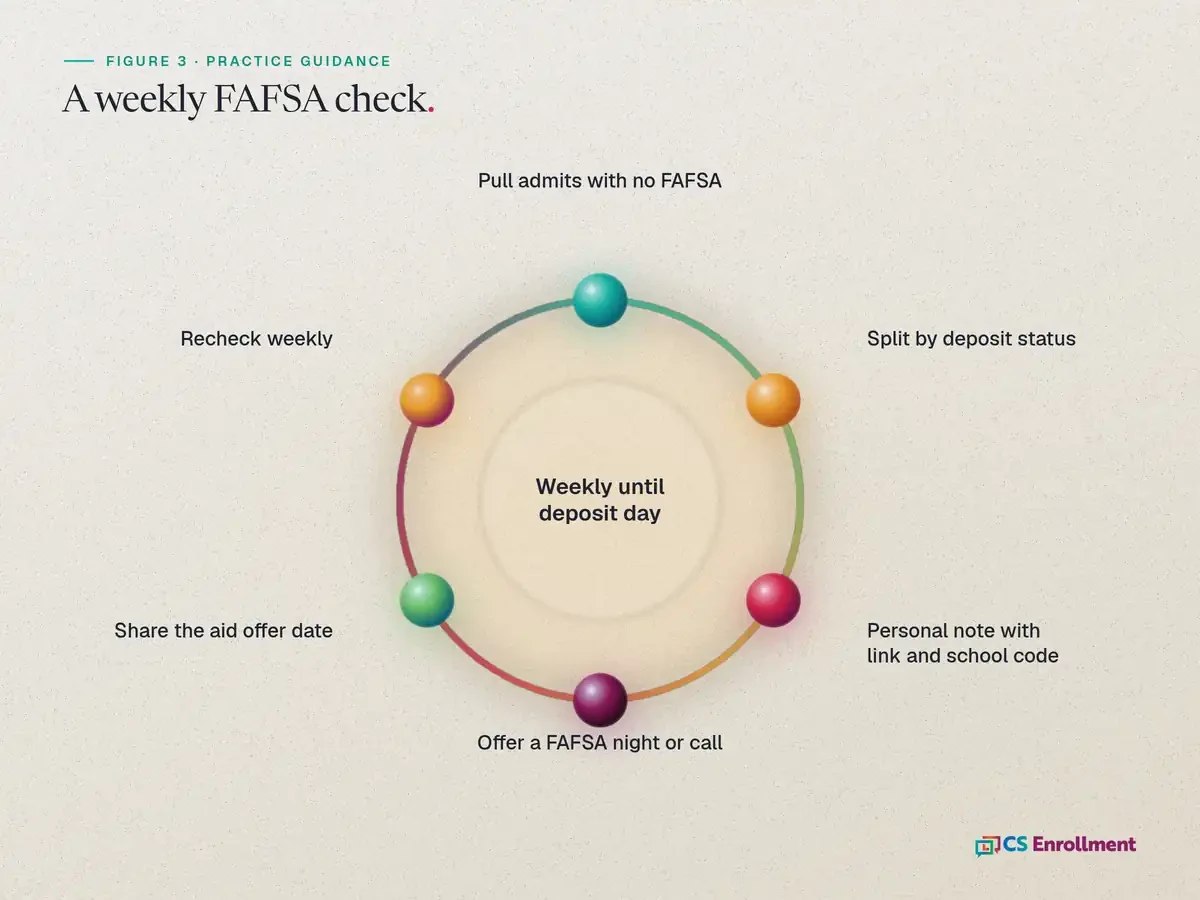
This is practice guidance, not data. Run it with the financial aid office each week from the first admit wave until deposit day.
1. Pull admits with no FAFSA on file. Once a student lists your school on the FAFSA, your aid office receives the student's record. Compare that list with your admit list. 2. Split the list by deposit status. Deposited nonfilers need a different message than undecided ones. 3. Send one personal note to each student. Include the FAFSA link, your federal school code and the name of a real person to contact. 4. Offer help in a form families will use. A FAFSA night on campus or online, or a short call with an aid counselor. 5. Tell families when aid offers go out. A clear date gives a reason to file now rather than later. 6. Recheck every week. Remove students who have filed, and adjust the message for those who have not.
Parents often sit at the kitchen table when the form gets done. For the family side of this work, see parent engagement in college admissions.
After the deposit: FAFSA and summer melt
A deposit does not end the risk. In RNL's data, nonfilers who deposited melted at 30.4%, against 11.1% for filers. Keep deposited nonfilers on the weekly list through the summer, and pair the FAFSA reminder with the other steps in our guide to reducing summer melt.
A missing FAFSA also leaves your aid office guessing about need. How that plays into your discount strategy is covered in our post on the tuition discount rate.
Make the reminder easy to answer
A FAFSA reminder only works if the student reads it and can respond. CS Enrollment Pathways sends branded, verified text messaging from the school, so an admit can reply to a simple question such as "Have you filed your FAFSA yet?" Staff can then follow up with the students who say no.
Frequently asked questions
When does the FAFSA open for fall 2027 students? Students starting in fall 2027 file the 2027 to 2028 FAFSA. Federal Student Aid opened it on September 23, 2026, and it is open now.
Can a college see which admits filed? Yes, once the student lists the college on the form, the college's financial aid office receives that student's FAFSA record. Students who leave a college off the form will not appear on its list.
What should we say to a family that won't file? Ask why first. Some families worry about sharing income details or assume they will not qualify for aid. Explain what the school can offer only after it sees the form, and offer a short call with an aid counselor.
How many of your admits have no FAFSA on file today?
If you want to see what a short, branded reminder looks like on a student's phone, request the sample walkthrough.
Sources
- RNL, 2024 Discounting Report. vendor research, 2024, 2023 data for first year students at 155 private RNL client colleges, pages 2, 3, 4, 9, 12 and 13.
- NCAN, NCAN's FAFSA Tracker's 10th Year Launches as US Pushes to Extend FAFSA Record.
- NCAN, FAFSA Tracker. based on weekly Federal Student Aid data.
- Federal Student Aid, Apply for financial aid with the FAFSA form. U.S. Department of Education.
- Federal Student Aid, FAFSA Central updates. FSA Partners, U.S. Department of Education.