
A cheap inquiry does not prove a cheap enrollment. Before an enrollment office divides anything, it has to decide which costs count and which students count. Get either boundary wrong and the number looks precise while measuring the wrong thing.
What is cost per enrolled student?
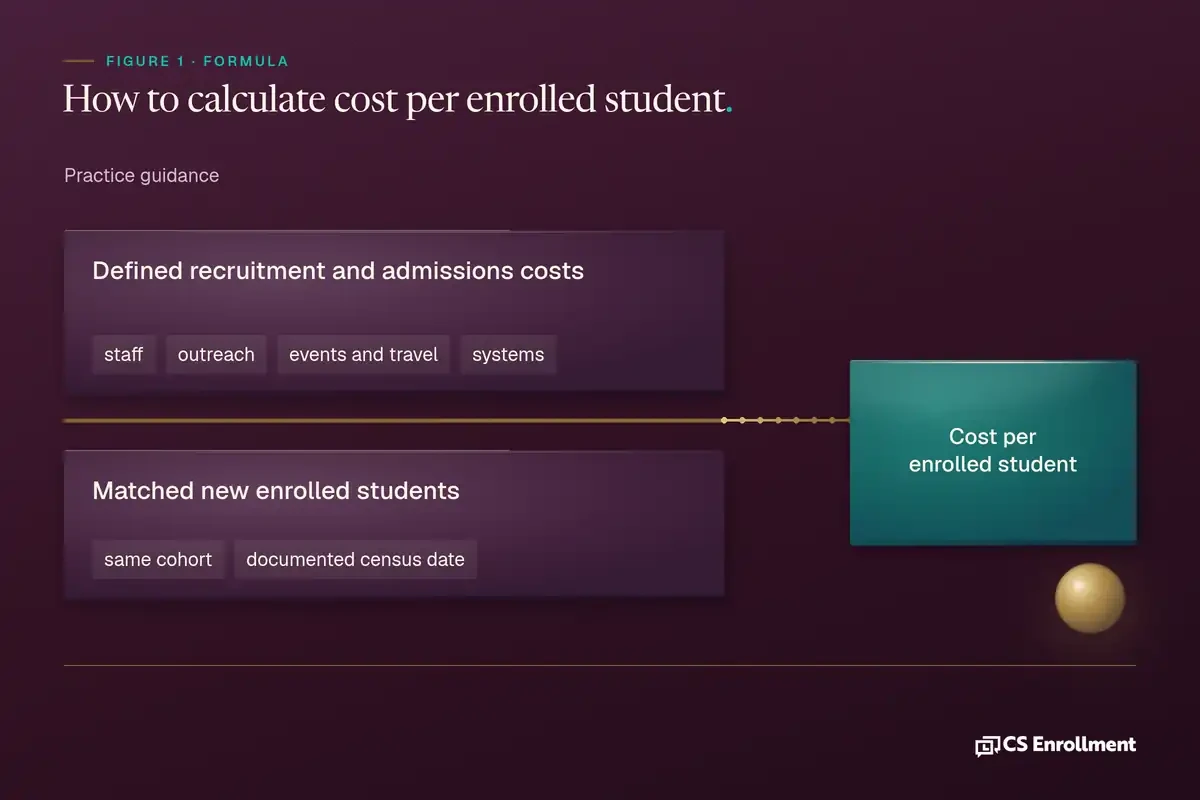
Cost per enrolled student is recruitment and admissions spending for a defined cohort divided by the new students in that cohort who actually enroll. State whether that spending includes staff, systems and shared recruitment costs before comparing the result with another college or channel.
The formula is short:
Cost per enrolled student = defined recruitment and admissions costs / matched new enrolled students
This is method guidance, not an industry finding. The hard part is the two definitions on either side of the slash, and the rest of this post is about those.
Which costs belong in the calculation?
RNL's benchmark worksheet (vendor research) is a useful model because it spells out the boundary. It counts direct recruitment and admissions costs, including costs carried by other offices, and leaves out a few large items that are easy to sweep in by accident.
Include
- Prorated salaries and benefits for recruitment and admissions staff, including part time, temporary and student workers
- A prorated share of supervisors who also do other work
- Recruitment advertising and recruitment marketing
- Events, travel, supplies and recruitment publications
- Web and electronic communications tied to recruitment
- Consultant services and CRM costs
- Recruitment costs paid by offices outside admissions
Leave out of this measure
- Grants and scholarships
- General institutional marketing
- General website maintenance and development
Leaving an item out of this measure does not make it disappear. Scholarships and general marketing still cost the college money; they just belong in other reports. Recruitment specific web work, such as an inquiry form or an admitted student page, stays in. Routine upkeep of the main website does not.
Decide how shared costs get allocated, write the rule down and use it every year. A media only number, covering ad spend and purchased lists, can be useful when it is labeled as exactly that. It cannot be compared with a fully loaded number that carries salaries and systems.
Who belongs in the enrolled student count?
The denominator is new enrolled students. It is not inquiries, applications, deposits or the whole student body. Pick a documented enrollment or census date, name the recruiting cohort, and match the spending to that cohort as closely as you can. If some costs straddle two cycles, say how you split them.
RNL's worksheet shows one way to set this up. It pairs the 2020 to 2021 recruitment budget with all new undergraduates who enrolled between January 1 and October 1, 2021. That count includes first year, transfer, full time, part time, online, campus, international and adult students.
A fall first year only calculation is fine for internal use if its costs are matched to the same students. It is simply not the same population as that benchmark, so the two should not sit side by side without a note. For stage definitions that keep the count clean, see our guide to enrollment funnel stages.
What do published recruitment benchmarks tell us?
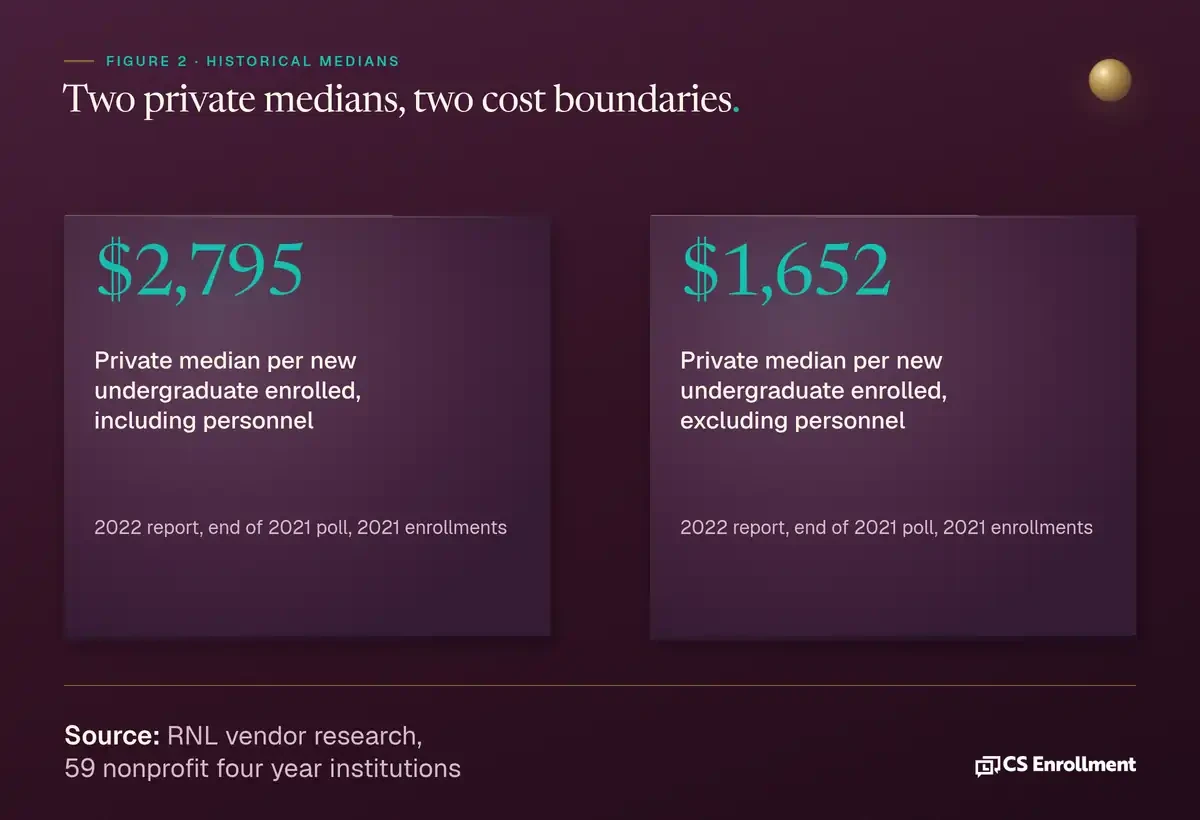
The most detailed public benchmark is old. RNL's 2022 Cost of Recruiting an Undergraduate Student Report (RNL vendor research: 2022 report, poll at the end of 2021, 2021 enrollments, 59 nonprofit four year institutions, self reported) found these medians per new undergraduate enrolled:
- Median cost per new undergraduate enrolled: $2,795 at private institutions and $494 at public institutions.
- Median cost per new undergraduate enrolled, excluding personnel: $1,652 at private institutions and $282 at public institutions.
Read these as historical indicators. They are not current targets, and they are not a promise of what any college should spend in 2026. RNL itself says that, because of the small sample, the results "should read as indicators." Respondents were allowed to estimate their outlays, the data covers a pandemic recruiting year, and the sample is not limited to colleges of 250 to 10,000 students.
Two more cautions. All four figures are medians, and medians do not subtract, so taking one private figure from the other does not give a personnel cost. And the difference between private and public results is not an efficiency ranking; the institutions recruit different students in different ways.
Is cost per enrolled student the same as ROI?
No. Cost per enrolled student has no revenue in it. It tells you what each new student cost to recruit, not whether recruiting them paid off.
As finance practice guidance, recruitment ROI is the incremental net contribution attributable to an activity, less the activity's cost, divided by that cost. Let the finance office define net contribution, the treatment of tuition discounting, instructional costs and the time horizon. Make sure recruitment cost is counted once, not once in the cost line and again inside contribution.
Gross sticker tuition is not contribution. For how discounting changes the revenue side, see our post on the tuition discount rate.
Attribution needs the same care. Students credited to a channel are not automatically extra students that the channel caused; some would have enrolled anyway. Without a credible incremental comparison, such as a holdout group, report cost and attributed enrollment. Do not call the result causal ROI.
What should the admissions and finance teams review together?
Use a blank worksheet both offices agree on before the numbers come in:
1. Cohort and census date. Name the entering term and the date the count is taken. 2. Included and excluded costs. List each line, using the table above as a start. 3. Shared cost allocation. Write down how shared staff, systems and offices are split. 4. New enrolled headcount. Count once, deduplicated across channels, before any rollup. 5. Fully loaded cost per enrolled student. Divide line 2 by line 4. 6. Channel spend and attributed enrollment. Keep these separate and label them as channel figures. 7. Attribution rule. State how a student gets credited to a channel. 8. Prior cycle on the same basis. Recalculate last year with today's rules, and flag any accounting change.
If a channel's enrolled count is zero, report its cost and zero enrollments. Do not divide by zero and print a result.
Compare like cohorts with like cohorts. For budget planning around these numbers, see enrollment marketing strategies for small colleges. Converting more of the students you already reach is one option to test, not a guaranteed saving; our yield guide covers where to start.
Where does a student conversation fit?
CS Enrollment Pathways uses branded, verified text messaging to invite a student reply. Include the cost of that outreach and the staff follow up when you evaluate it, rather than treating a reply as an enrollment. The same rule applies to every channel on the worksheet.
Frequently asked questions
What is a good cost per enrolled student? There is no universal threshold. Published benchmarks come from a historical, self reported sample, and the right level depends on your cohort, market and local economics. Track your own number on the same basis each year.
Should salaries count? Yes, for a fully loaded measure. Recruitment and admissions salaries and benefits are part of what it costs to enroll a class. If you also report a number without them, label it clearly.
Does a lower acquisition cost mean better enrollment ROI? Not by itself. Cost per enrolled student has no revenue term, and a cheaper channel may bring students with higher discounts or students who would have enrolled anyway.
Does your enrollment cost report include the staff time behind the campaign?
If you want to see how a branded student conversation starts, request the sample walkthrough.
Sources
- RNL, 2022 Cost of Recruiting an Undergraduate Student Report. RNL vendor research, 2022 report, poll at the end of 2021 of 59 nonprofit four year institutions, 2021 enrollments, median figures, pages 3, 9 and 11.