Should colleges disclose AI written recruitment messages?
Our recommendation is to explain material AI use in recruitment communications in plain language, especially when a student could reasonably think a person is speaking from personal knowledge. A disclosure does not replace accurate information or someone who can answer a student's question.
That is editorial guidance, not a universal legal requirement or a proven enrollment tactic. A college should agree on its policy with the campus owners responsible for communications and AI use.
For a small admissions team, the useful starting point is a message already in production. Record how it was prepared, who checked it and who answers replies. Then decide whether its presentation tells the same story.
What does the evidence say, and what does it not say?
In Fractl and Search Engine Land's vendor research, 84% of surveyed consumers wanted AI generated written content labeled. The study surveyed 1,008 United States consumers and, separately, 150 marketers in Q2 2026. The labeling finding concerns consumers, not the marketer sample.
The original study article reports a general consumer preference. It is not an admissions study. It does not establish what prospective students want, whether a disclosure changes their behavior or whether a label increases trust.
Use that finding as context for a policy discussion, not as a prediction about applications or enrollment. A disclosure policy still needs to describe the college's actual practices.
What role did AI actually play?
Separate spelling help from drafting a paragraph, generating individualized claims and running an automated conversation. Those activities create different impressions about who is speaking and what they know.
These are distinctions for the college to define, not externally established disclosure thresholds. The policy owner should decide what counts as material assistance and document the reasoning.
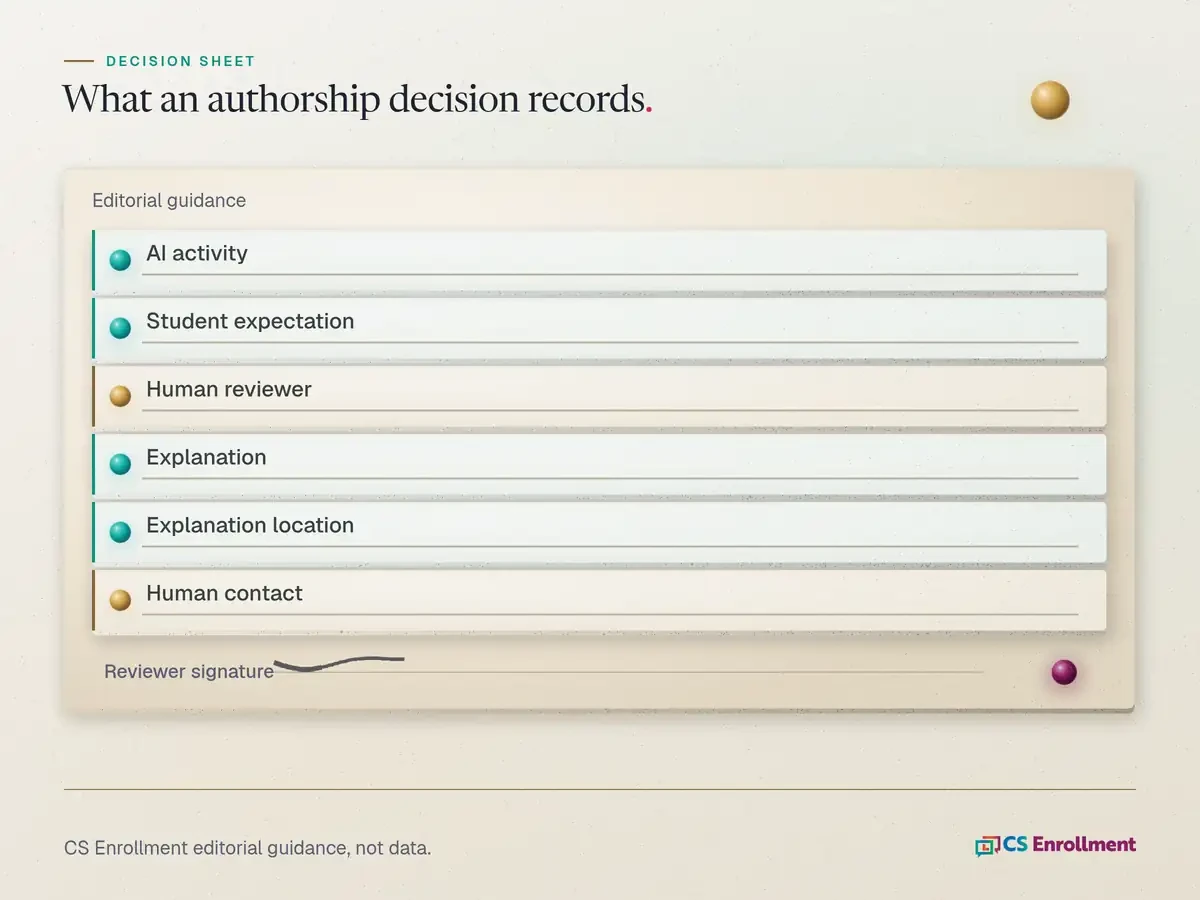
Complete a decision sheet for each workflow before choosing a label:
| Decision field | Campus entry | |---|---| | AI activity and message type | | | What a student could reasonably assume | | | Responsible human reviewer | | | Proposed explanation of AI's role | | | Where that explanation appears | | | Working route to a human | |
Name a backup for the reviewer and the reply owner. Keep the approved explanation beside the template so staff do not have to reconstruct the policy when covering an absence. If nobody can verify a claim or support the promised reply route, hold the message until the gap is resolved. Approval of a template does not cover later changes to its facts.
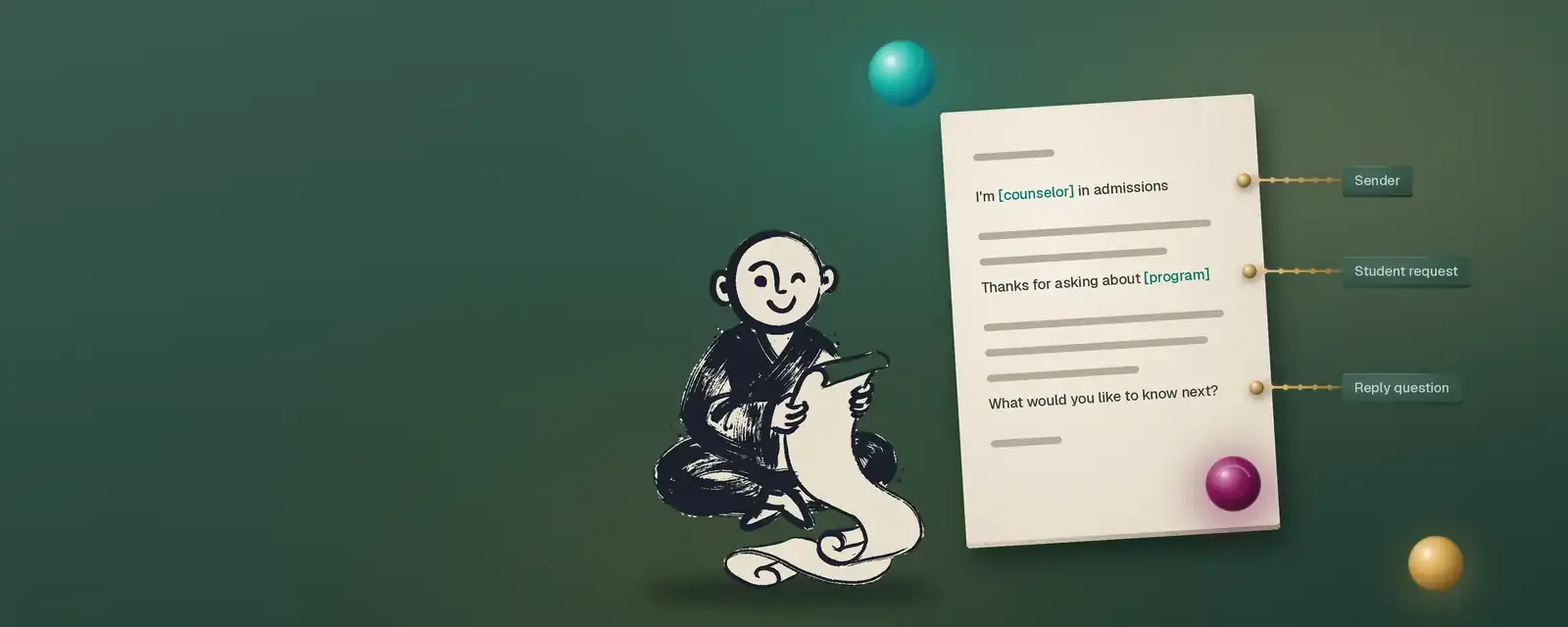
A counselor signature should not imply personal knowledge the counselor does not have. Remove a claim such as "I enjoyed learning about your interests" if nobody actually reviewed those interests.
Treat a workflow change as a reason to revisit the sheet. A disclosure approved for staff reviewed drafts may become inaccurate if messages later go out automatically.
What should a disclosure say?
Describe the work that happened. For a message genuinely drafted with AI, reviewed by staff and connected to a staffed reply route, the wording could be:
Composed example, not a legal template or a tested message.
> AI helped draft this message. Our admissions team reviewed the information, and you can reply with a question.
Do not use that explanation unless the review and reply coverage actually happen. "Reviewed" should mean someone checked the information, not merely approved the tone.
For a genuinely automated interaction, use a different explanation:
Composed example, not a legal template or a tested message.
> You are chatting with an automated assistant. Ask to speak with our admissions team if you need a person.
Use this wording only when that request reaches a person through a working process. State the staffed hours or response expectation if relevant, without implying someone is waiting live.
Place the explanation where the student encounters the message or conversation. A general policy page can provide detail, but should not contradict the visible impression of who is speaking. Have the campus policy owner review the wording and placement.
Who checks the facts before the message goes out?
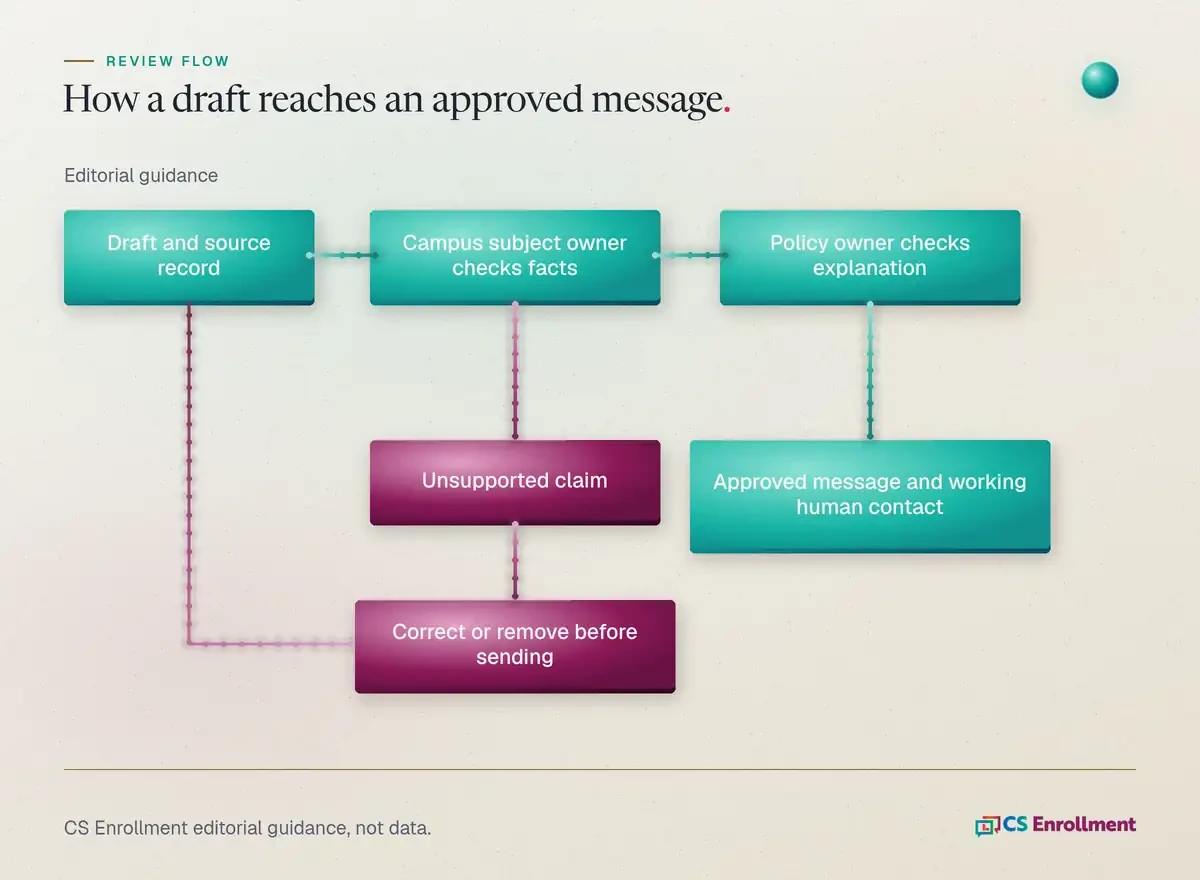
Assign factual review by subject. Program staff check availability and delivery format. Financial aid staff check aid language. Admissions staff check deadlines and eligibility against current official sources.
Keep the source and reviewer with the approved message. Do not generate financial aid promises, invented testimonials or personal connections. Do not infer a student's circumstances from a name or a broad expression of interest.
Keep student records and sensitive information out of an AI tool unless the college's approved process permits that use. An authorship label does not make an unapproved data practice acceptable.
Authorship also differs from contact permission. The college recruitment data transparency guide addresses where a contact record came from. Explaining who drafted a message does not establish permission to send it.
Likewise, how colleges show up in AI answers concerns search visibility. This policy governs the messages the college prepares, not how an outside search tool describes it.
What should happen when a student challenges the message?
Give the student a working human contact and assign a campus role to handle the concern. Preserve the disputed message and its source record under campus policy.
Check the challenged statement against the authoritative source. Correct an error plainly, tell the student what changed and update the template or automated answer that produced it. An AI disclosure is not a reason to leave inaccurate information in place.
Review complaints, substantive questions, corrections and opt outs separately. A complaint about an invented personal connection needs a different response from a request to stop contact.
If the team compares disclosure wording, involve the policy owner and keep the audience and remaining message comparable. Do not hide material information as a test condition. A change in replies alone would not prove a change in trust or retention.
Can a recognizable sender still be accountable?
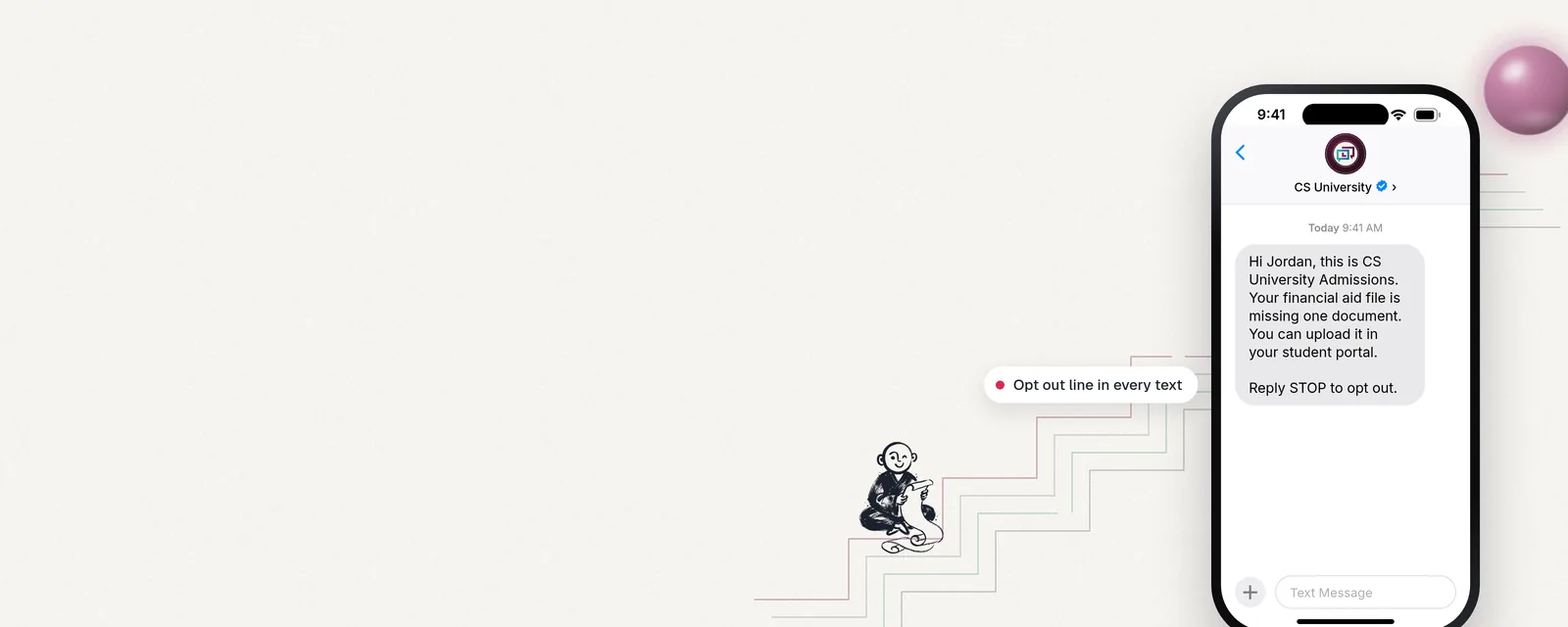
CS Enrollment Pathways uses branded, verified text messaging to make the sender recognizable. Recognition does not replace an honest explanation of how a message was prepared or a person who can answer a student's question.
Before approving the next template, make sure the team can explain who prepared it, who checked it and who owns the reply. The written policy and the student experience should agree.
To see how a branded student conversation starts, request the sample walkthrough.
Sources
- Kelsey Libert, Fractl and Search Engine Land, AI search adoption rises as consumer trust declines: Study. Vendor research: 1,008 United States consumers and a separate sample of 150 marketers surveyed in Q2 2026. The written content labeling finding is reported in the disclosure section; sample details appear in Methodology. The author identifies herself as a Fractl cofounder. General consumer research, not prospective student research.