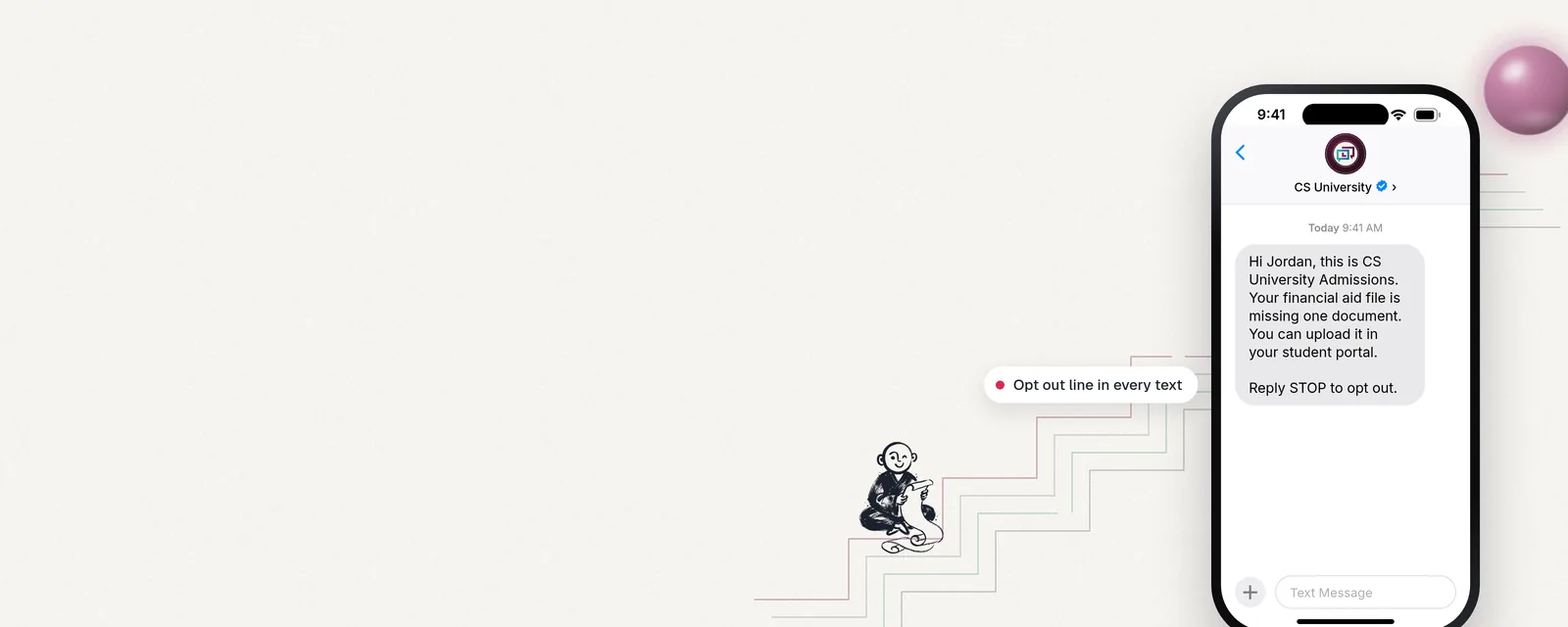
Who is accountable when a student cannot move forward?
Retention can involve the whole campus and still need a clearly assigned owner for an unresolved student issue. Our take: before launching another reminder campaign, check whether someone accepts the handoff, helps the student reach the right office and confirms what happened.
That is an editorial management recommendation, not a finding that a particular workflow improves retention. Reminders can serve a useful purpose. They cannot replace the work required to address the problem a student describes.
For a VP of Enrollment at a small or midsize college, the practical starting point is a continuing student's unresolved issue. Follow it beyond the message queue. Identify who coordinates the response and which office can actually make the decision.
What did last week's conference coverage bring into focus?
In last week's conference coverage, Inside Higher Ed reporter Johanna Alonso described retention as part of strategic enrollment management. Her reporting from the AACRAO Strategic Enrollment Management conference highlighted a tension between broadly shared responsibility and explicit accountability.
This was practitioner discussion reported by a journalist, not a national survey or a retention intervention study. It does not establish how common an ownership gap is or which remedy works best.
The useful management distinction is narrower. A campus can agree that retention matters without agreeing who follows an unresolved student issue through its next action. Enrollment leaders can make that agreement explicit without taking authority away from the offices that hold it.
Where does a continuing student's issue go after a reply?
Consider a hypothetical situation, not a reported case: a continuing student replies that they cannot register and do not know which office can help.
The message establishes a request for assistance. It does not establish the cause of the registration problem, the student's eligibility or an eventual outcome. Staff should avoid guessing at any of those facts.
Trace where that reply lands. Check whether a staff member reviews it, identifies the authorized office and stays responsible for coordination until the receiving office accepts it. Note whether the student must explain the same issue again.
If the next action is merely another reminder to register, the original request still needs an answer. A message can carry the request; it cannot remove a hold or make an eligibility decision.
What does an accepted handoff look like?
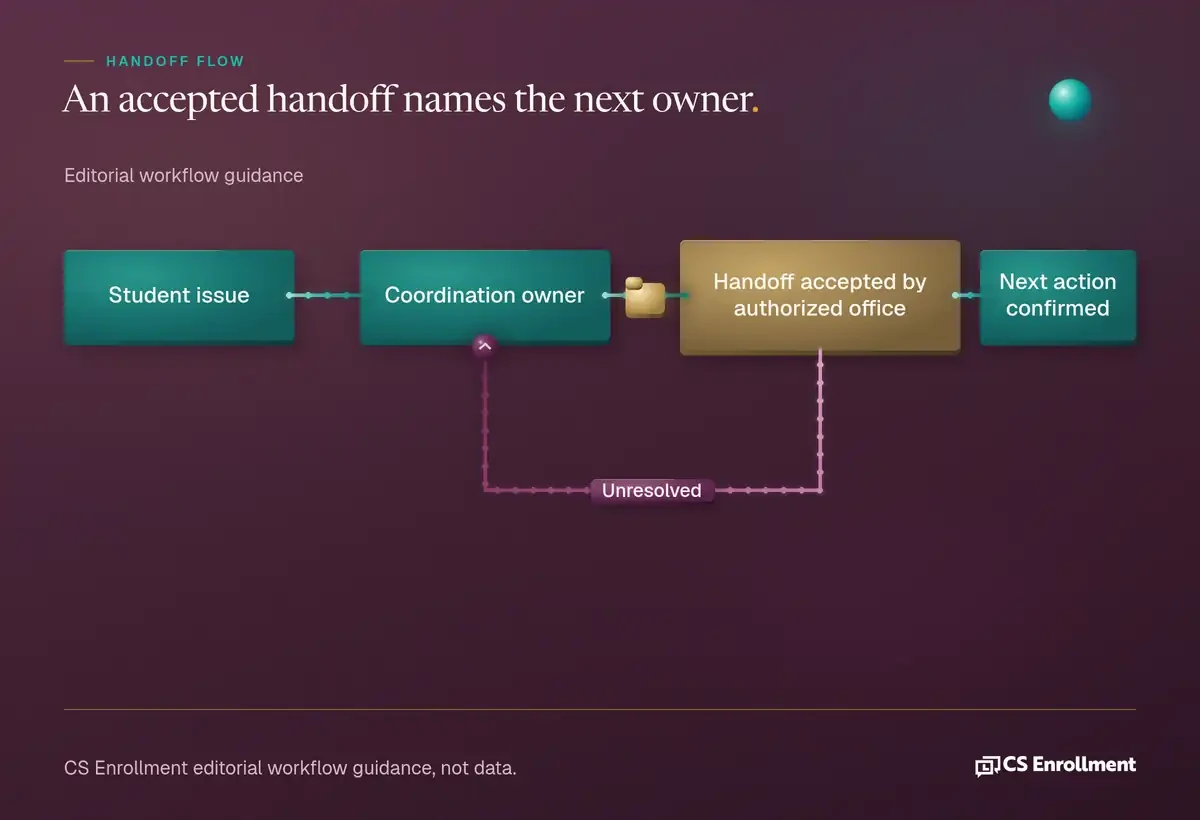
Separate the coordination owner from the office authorized to resolve the issue. The coordinator keeps the next action visible. The receiving office makes decisions within its remit. A person may hold both roles, but the roles still need to be clear.
Use this blank worksheet as editorial workflow guidance, not a model policy:
| Ownership field | Local agreement | |---|---| | Issue category | | | Current coordination owner | | | Receiving office with decision authority | | | Confirmation that the handoff was accepted | | | Next action and local response expectation | | | Person responsible for the student update | | | Evidence required to confirm resolution | | | Escalation route if the issue remains unresolved | |
Forwarding an email to a shared inbox is not, by itself, confirmation that someone accepted responsibility. Agree on what acceptance looks like in the campus's approved system. Set response expectations the available staff can meet rather than borrowing a universal deadline.
What should the enrollment team ask other campus offices to agree on?
Agree on who needs access to the information, who has decision authority and who communicates status to the student. Use approved systems and limit access to what each role needs. Do not ask students to send sensitive records in a casual text thread.
For an urgent safety concern, follow the campus's existing urgent response procedure rather than leaving it in a marketing queue. This worksheet does not replace those procedures or provide legal guidance.
Small teams may combine responsibilities. They still need a named backup and an escalation route when the usual owner is unavailable. Record the next action where the receiving staff can find it without exposing unnecessary student information.
How do you know whether the issue is closed?
Keep communication activity separate from issue status. Sent, delivered and replied describe messages. Assigned and accepted describe ownership. Resolved requires evidence appropriate to the underlying issue.
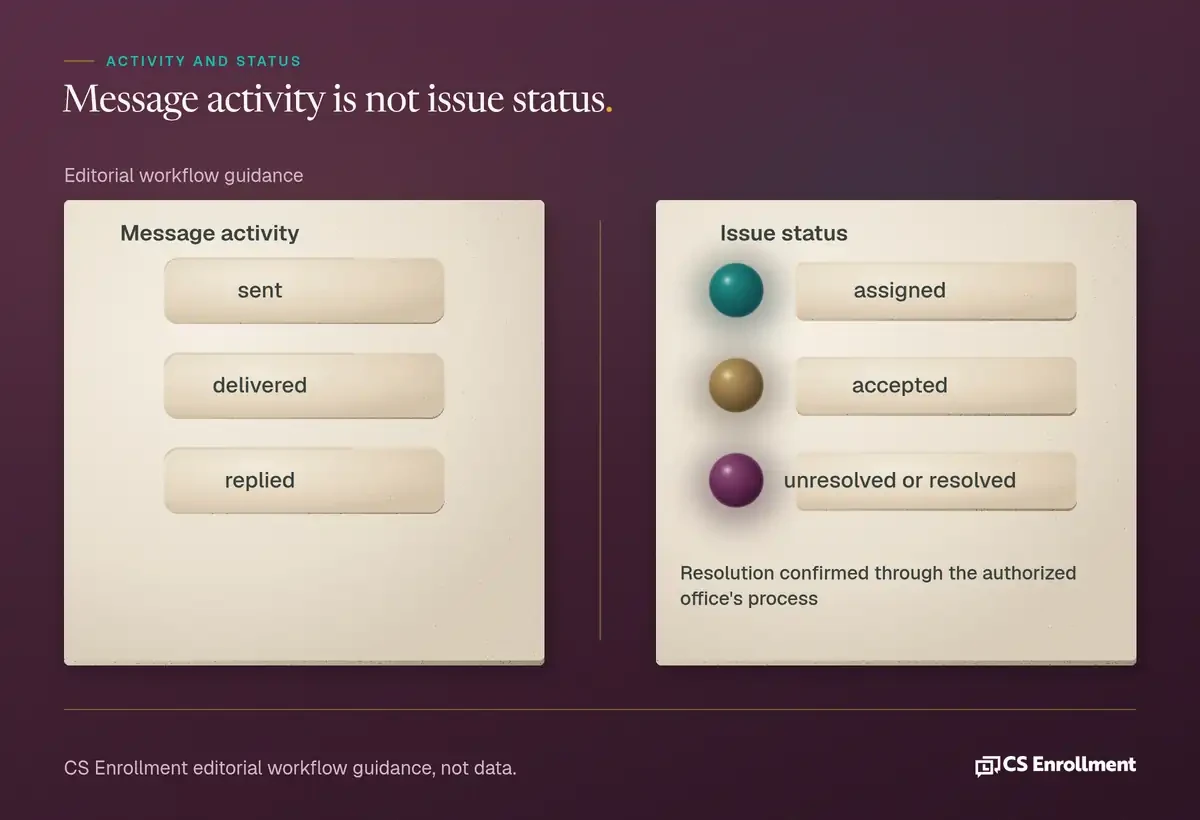
Agree with the relevant office on the evidence and confirmation process needed to close the record. Track unresolved issues separately from completed staff tasks. An unanswered message does not establish why a student left, and a resolved issue does not prove that outreach caused persistence.
Review continuing enrollment outcomes later with institutional research, using a documented cohort and observation window. The enrollment funnel stage guide helps distinguish recruitment counts from later outcomes; those recruitment stages do not define continuing student retention.
Where does messaging belong?
CS Enrollment Pathways uses branded, verified text messaging to make a college's outreach recognizable. A recognizable message is a starting point when a student needs help. The campus still needs a person responsible for the next action and an office authorized to resolve the problem.
Before expanding reminders, review an unresolved handoff with the receiving office. Make ownership visible before asking a student to respond again.
To see how a branded student conversation starts, request the sample walkthrough.
Sources
- Johanna Alonso, Inside Higher Ed, 3 Takeaways on Enrollment Management. Conference reporting, specifically the retention section. Not a quantitative retention study.