
Does adding football increase enrollment?
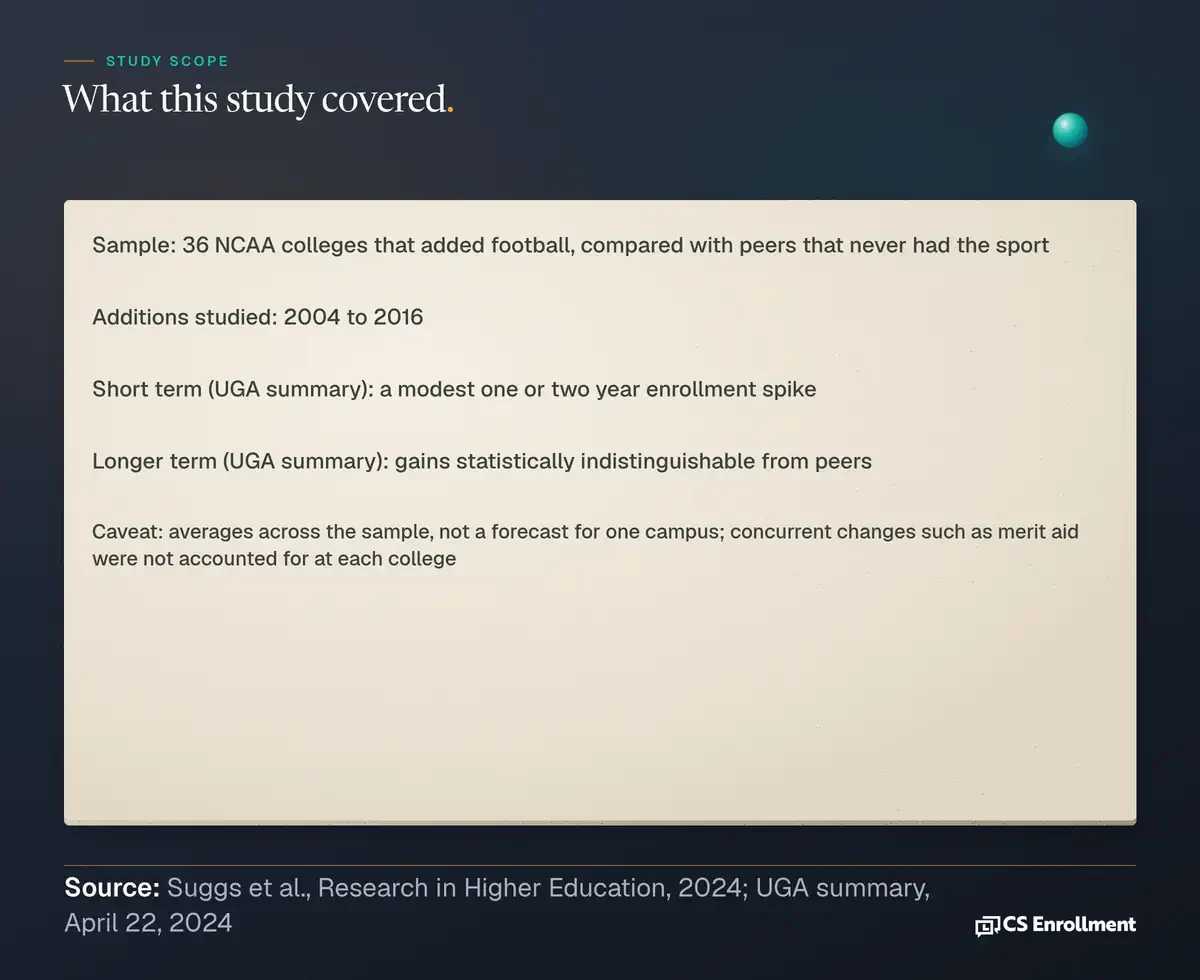
A peer reviewed study of 36 colleges that added football found a short enrollment bump, after which they were statistically indistinguishable from similar colleges. The study, "Institutional Effects of Adding Football: A Difference-in-Difference Analysis," appeared in the journal Research in Higher Education in 2024.
That is an average across those colleges, not a prediction for any one campus. A college that adds a team could land above or below that average, and the study cannot say which.
Our suggestion, offered as editorial decision guidance rather than a finding: plan a new team as one recruiting channel, alongside a recruitment plan for students who are not athletes. Decide before launch what evidence would show that the team worked for enrollment.
What did the study measure?
Welch Suggs, Alex Monday, Jennifer May-Trifiletti and James C. Hearn of the University of Georgia compared NCAA member colleges that added football with peers that never had the sport. They used a difference in difference design. That method compares how both groups changed over the same years, instead of looking only at the colleges that added a team.
The analysis drew on NCAA and U.S. Department of Education data. In it, 36 NCAA colleges that added football between 2004 and 2016 saw a modest one or two year enrollment spike; afterward, gains were "statistically indistinguishable" from peers. The University of Georgia summary reports the same pattern for male enrollment.
According to UGA's summary, colleges that added football did not realize a statistically significant increase in tuition revenue per student compared with peer colleges.
What the study cannot tell you
The university summary is direct about one limit. A particular college may have seen an enrollment boost after adding football, but it may also have taken other steps at the same time, such as awarding more merit scholarships or adding other activities. The study could not account for those factors at each institution.
The scope is narrow as well. The study looked at football only, at NCAA members only, and at additions inside its study window. Other sports were not part of this research, so it offers no finding about them.
The cited summaries do not report findings on retention of athletes, alumni giving, campus life or community visibility, and they give no answer for a single college. Pilot work on the project was supported by the Council of Independent Colleges, according to the article's funding note.
What should a cabinet ask before adding a team?
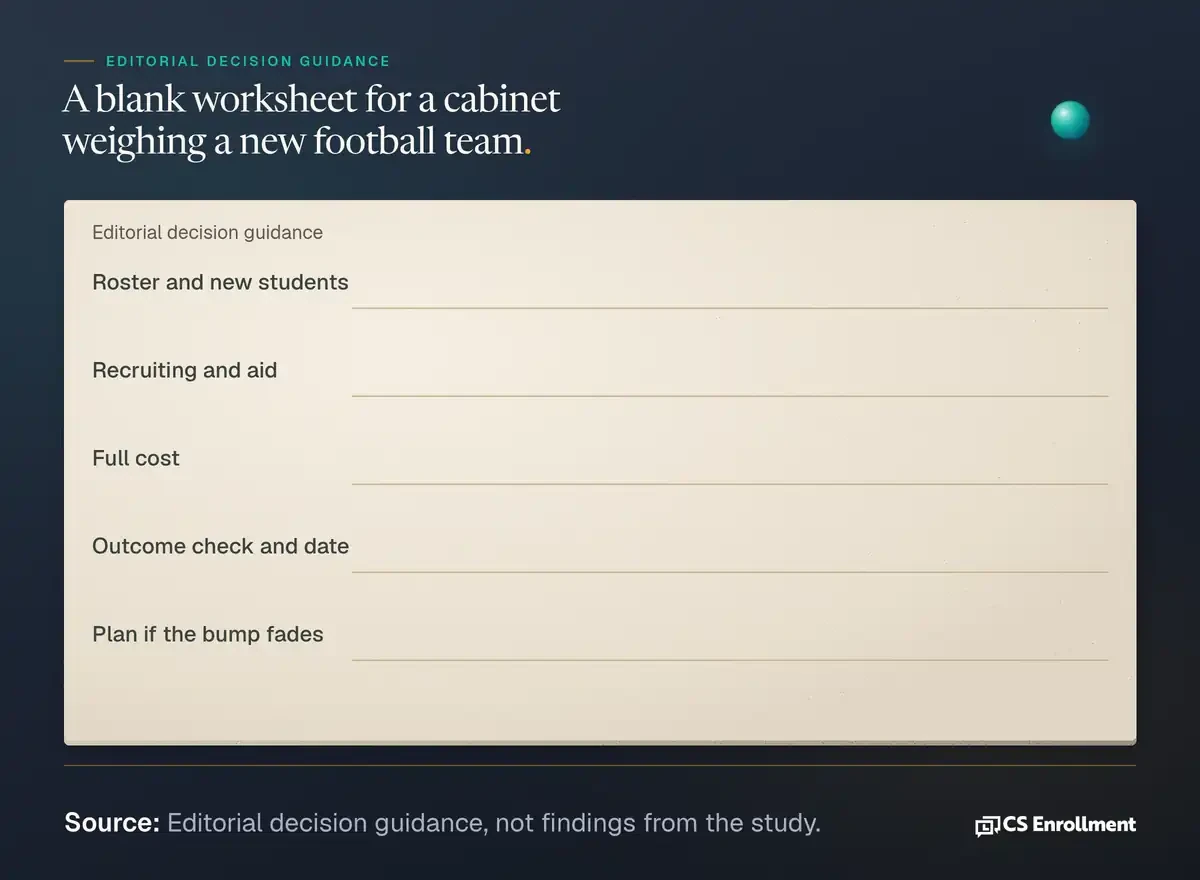
The questions below are editorial decision guidance from CS Enrollment, not items from the study. Fill in each field with local figures before a vote. Leave a field blank rather than borrowing a number from another campus.
| Decision field | Your college's answer | |---|---| | Expected roster, and how many players would be new to the college rather than already admitted | | | Who recruits those players, and with what aid | | | Full costs: coaches, facilities, equipment and travel | | | Title IX obligations, including any women's sports added alongside football | | | The outcome you will check: new students, net tuition revenue, or retention of athletes compared with other students | | | When you will check it, and who reports the result | | | What you will do if an early enrollment bump fades | |
The Title IX worksheet row is editorial diligence for the cabinet, not legal advice. Separately, the article's note 1 states that colleges adding football usually add women's sports to comply with the U.S. Department of Education's gender equity guidelines under Title IX. Those programs bring their own coaches, recruiting and aid.
How do you measure whether it worked?
Start with a defined baseline. Compare the athletic cohort with the classes the college enrolled before the team existed, and with the students who are not athletes enrolling alongside it. State the cohort, the term and the counting rule before the first season.
Separate players who would have enrolled anyway. A student admitted before the team was announced, or one who planned to attend regardless, is not a new enrollment created by football. Ask how each player first reached the college and when.
Track net tuition revenue rather than headcount alone. A roster supported by heavy aid can raise headcount while doing less for the budget than the count suggests. The cost per enrolled student method shows how to set a cost boundary for a channel. The enrollment funnel stage guide keeps inquiries, applications and enrollments counted the same way across channels.
There is no benchmark here for what a successful team looks like. Set the local target before launch, so a short bump is not mistaken for a lasting result.
What about the rest of the class?
Even a team that adds students fills only part of an entering class. The rest of the class still has to be found, reached and enrolled each year. The demographic cliff guide covers why the size of that pool matters.
As editorial guidance, and not as a proven alternative to athletics, keep a sustained recruitment plan for students who are not athletes. Give it its own budget, owner and measures. The enrollment marketing strategies guide lays out the broader plan for small colleges.
Whatever a college decides about athletics, it still needs a plan for reaching prospective students who are not recruited athletes. CS Enrollment Pathways helps a small admissions office reach those students with branded, verified text messaging they can recognize.
Common questions
Does adding any sport increase enrollment? This study covered football only. Other sports were not studied, so it offers no answer for them.
Can football raise tuition revenue? According to UGA's summary, colleges that added football did not realize a statistically significant increase in tuition revenue per student compared with peer colleges. That is an average result, and the study measured revenue per student, so it does not settle what happened to any single college's budget.
Is the study saying football never helps a college? No. It reports averages across the colleges it studied, and it could not see every other change each college made at the same time.
If a new team's early bump faded, what part of your recruitment plan would carry the classes after it?
To see how a branded conversation with a prospective student starts, request the sample walkthrough.
Sources
- Welch Suggs, Alex B. Monday, Jennifer May-Trifiletti and James C. Hearn, Institutional Effects of Adding Football: A Difference-in-Difference Analysis. Peer reviewed journal article; abstract, notes and funding statement. DOI: https://doi.org/10.1007/s11162-024-09786-7.
- University of Georgia Grady College, Colleges adding football teams do not experience long-term enrollment or tuition advantages, study shows. University summary of its faculty's study.
- American Council on Education, Higher Education Today, College Football's Unexpected Impact on Enrollment. Research summary of the same article; source for the 2004 to 2016 study window.