Why should families see a net price before they inquire?
Make an honest net price estimate easy to find and easy to ask about before a family has to decide whether to inquire. A family that sees only the published price may not know what it could pay after aid.
That is our judgment, not a finding from last week's College Board report. The report measures prices and aid. It does not measure how many families rule out a college because of its sticker price.
What did last week's College Board report show?
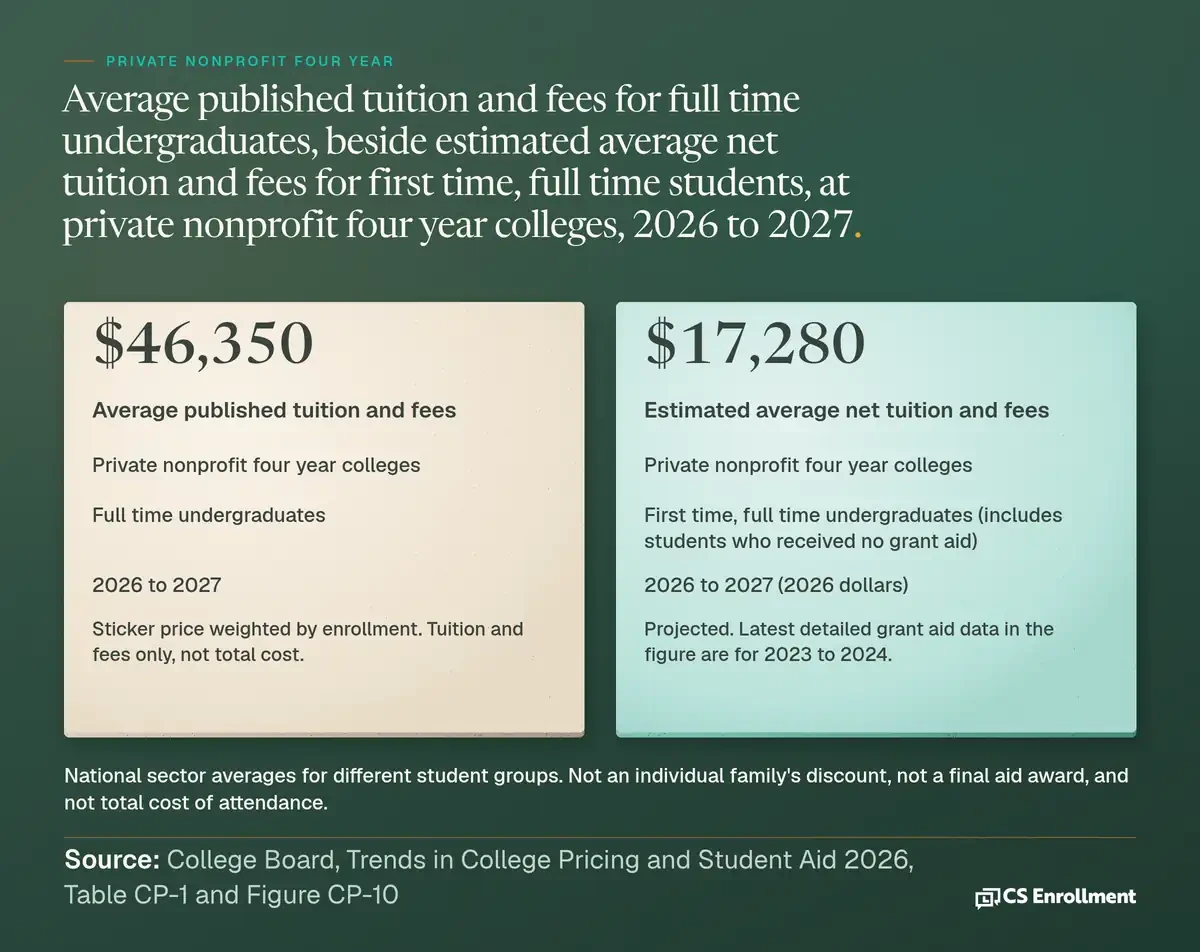
College Board released Trends in College Pricing and Student Aid 2026 on November 5. At private nonprofit four year colleges, average published tuition and fees for full time undergraduates are $46,350 for 2026 to 2027, according to the report.
For first time, full time students in the same sector, estimated average net tuition and fees are $17,280 for 2026 to 2027. College Board calculates that net price as the published price minus average grant aid from federal, state and institutional sources. The average includes students who received no grant aid.
The $17,280 is an estimate. The latest detailed grant aid data in the report are for 2023 to 2024, so net prices for 2024 to 2025 and later are projected.
After adjusting for inflation, estimated average net tuition and fees at private nonprofit four year colleges fell from $20,350 in 2016 to 2017 to $17,280 in 2026 to 2027, both in 2026 dollars.
Both figures are national averages for the sector. Neither is total cost, neither describes a single college, and $17,280 is not every family's price.
Jessica Howell, College Board's vice president of research, made the practical point in the release: "Families need clear net price information early in the college application process."
Tuition is not the whole bill
College Board estimates the average net cost of attendance for first time, full time students at private nonprofit four year colleges at $38,540 for 2026 to 2027. That figure adds housing, food, books and supplies, transportation and other personal expenses, and subtracts average grant aid. It is also projected.
Averages hide wide variation by family and by college. A family's own estimate depends on its finances and on the aid a specific college offers.
Where does the sticker show up first in your funnel?
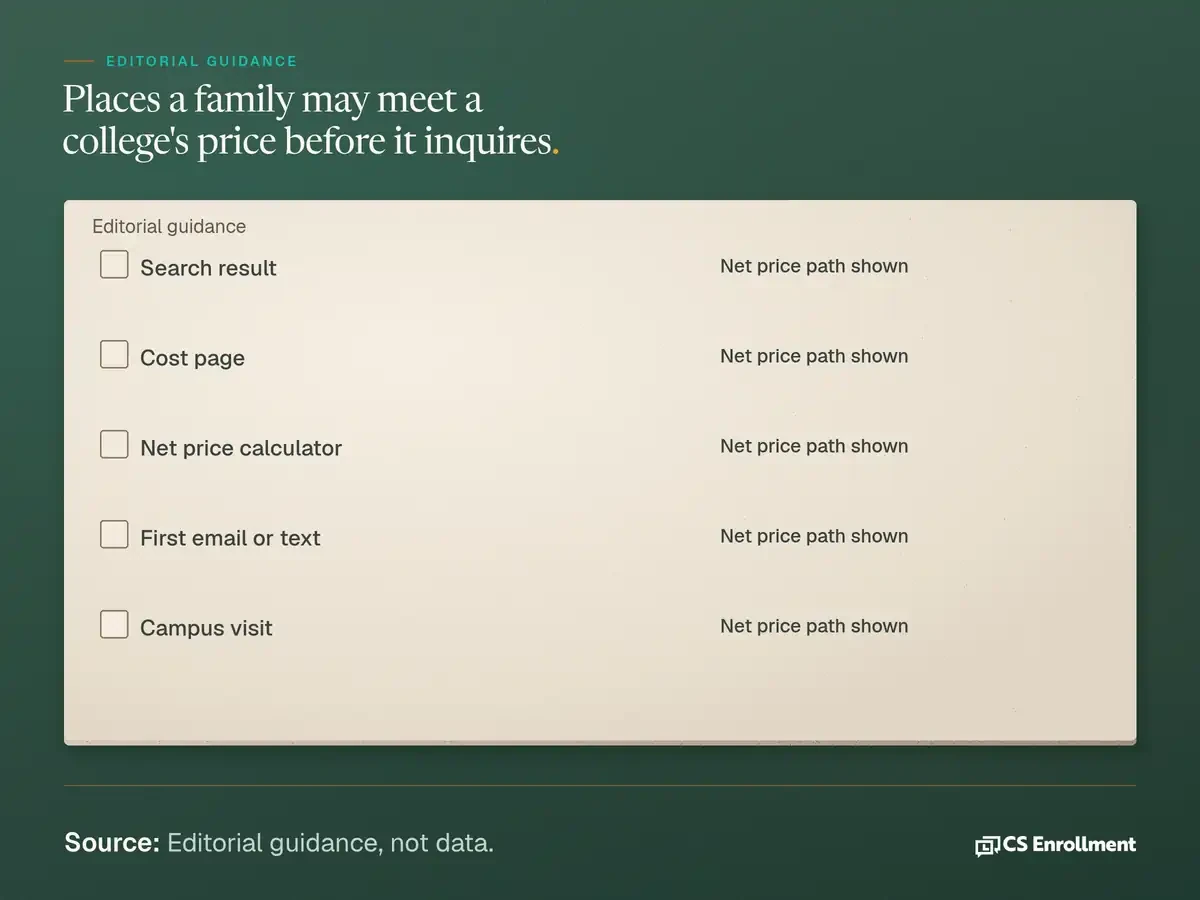
As editorial guidance, list the places a family is likely to meet your price before it inquires, and note whether a net price path appears at each one:
- A search result or a college comparison page that shows your tuition
- Your cost of attendance page
- Your net price calculator
- Your first email or text to a prospective student
- The campus visit, including the admissions presentation
Federal law already requires colleges that participate in the federal student aid programs under Title IV to post a net price calculator on their website. Each estimate must carry a clear and conspicuous notice that it is not a final determination or actual aid award, is not binding and may change (20 U.S.C. 1015a(h)). This is a plain summary, not legal advice.
The practical question is whether families can find the calculator before they inquire, and whether a person can help them read the result.
What should the first price conversation sound like?
A composed outline, not a tested script:
- Acknowledge the published price directly instead of avoiding it.
- Explain that the price a family pays after grant aid can differ from the sticker. If you cite a national figure, attribute it: College Board's Jessica Howell said about 70% of full time undergraduate students receive grant aid. That share covers full time undergraduates overall, not the private nonprofit first time, full time net price average.
- Point to the net price calculator and say what information the family will need to complete it.
- Offer a named person who can talk through the estimate with the family.
Avoid promising any family a specific amount of aid, and avoid language suggesting that college will cost nothing. The first message guide covers how to structure that first contact. The parent engagement guide covers reaching parents and other family members.
How will you know it helped?
Track calculator use and price questions, each with its own denominator, and keep inquiries by source so a change in one channel is not credited to another.
This post makes no claim that showing net price earlier raises inquiries, applications or yield, and last week's report does not test that. Treat any local change as something to measure, using consistent stage definitions from the inquiry to application conversion guide. For the institutional side of the same gap, the tuition discount rate guide explains how discounting works.
Common questions
Is the $17,280 what my students pay? No. It is a national estimate for first time, full time students at private nonprofit four year colleges, covering tuition and fees only.
Do colleges have to show a net price? Colleges that participate in Title IV federal student aid programs must post a net price calculator on their website, under 20 U.S.C. 1015a(h). The calculator gives a nonbinding estimate, not an actual aid award. This is not legal advice.
Where messaging fits
CS Enrollment Pathways helps an admissions team start that price conversation early with branded, verified text messaging, so a family can ask a real person what the college would cost them.
How many of last cycle's inquiries saw a net price before their first visit?
To see how a branded conversation with a family starts, request the sample walkthrough.
Sources
- College Board, Trends in College Pricing and Student Aid 2026. Table CP-1, page 10 (published prices, full time undergraduates, enrollment weighted) and Figure CP-10, page 19 (net prices in 2026 dollars, first time, full time students, private nonprofit four year; net prices for 2024 to 2025 and later are projected).
- College Board Newsroom, Average Sticker Prices at Public Colleges Rise Less than Inflation; Grant Aid Brings Average Net Tuition at Public 4-Year Colleges Below $2,000. Release and Jessica Howell quote.
- 20 U.S.C. 1015a(h), Net price calculator, via Cornell Law School Legal Information Institute, 20 U.S. Code § 1015a: Transparency in college tuition for consumers. Statute text; not legal advice.