Why isn't our new program filling?
In our judgment, a new program often has an awareness problem before it has a demand problem. Families cannot choose a program they have never heard of, and they will not choose one they cannot explain to someone else. Plan its marketing as a sequence of explanations and follow ups, not a single announcement.
Leaders at three colleges that launched three year bachelor's degrees told Inside Higher Ed that their biggest challenge is building awareness. They said parents, students and counselors are not yet widely familiar with the idea.
What three year degrees show about new programs
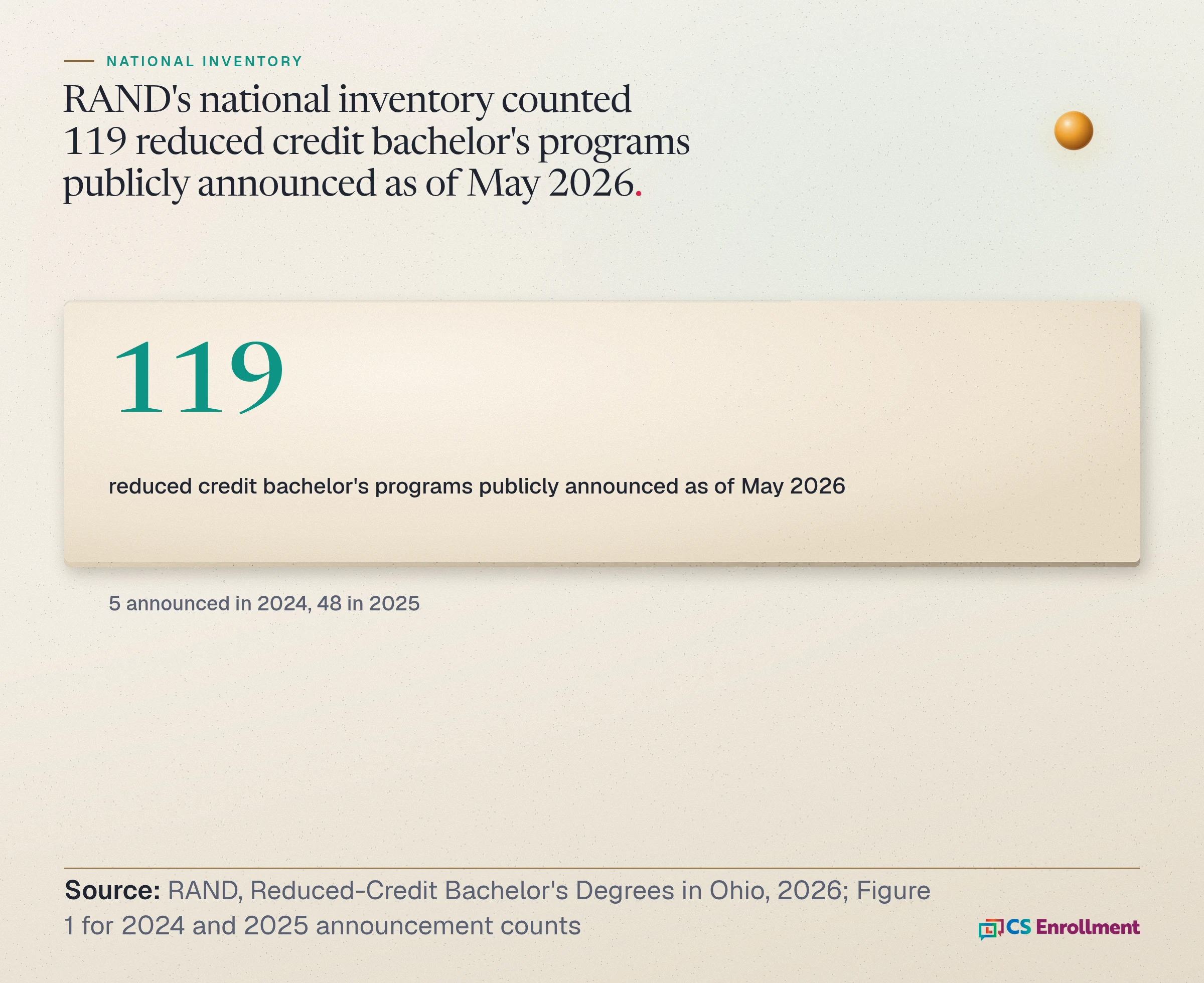
RAND's national inventory identified 119 reduced credit bachelor's programs publicly announced as of May 2026, most of them in applied and workforce facing fields. The inventory is part of an Ohio feasibility study that RAND published on August 20, 2026, sponsored by Arnold Ventures. RAND defined a reduced credit bachelor's degree as a stand-alone bachelor's degree requiring about 90 to 115 semester credits, and excluded programs that only shorten the calendar while keeping 120 credits.
RAND counted five such programs announced in 2024 and 48 announced in 2025 (Figure 1). 93 of the 119 programs were announced by four year private nonprofit institutions (Figure 3). RAND notes that the inventory concluded in May 2026 and did not capture announcements made later in the year. Treat 119 as a dated count, not a current total.
Inside Higher Ed reported that colleges in this wave are reducing the minimum credits for a bachelor's degree to around 90, though the exact number varies. It reported, paraphrasing a director of the College-in-3 Exchange, that many of the colleges launching them do not have extensive marketing budgets.
Outcome evidence is thin. A 17 member task force convened by Arnold Ventures, Strada Education Foundation and the College-in-3 Exchange, in a framework released October 20, 2026, said that because most of these programs have not yet produced graduates, evidence on student outcomes remains limited. That is a funder and advocacy release, not an independent study. The same task force's view is that programs meeting bachelor's learning outcomes should be recognized as bachelor's degrees, without required naming modifiers. That is the task force's recommendation, not a finding about how a program should be marketed.
We use three year degrees here as the clearest current example. The steps below are our editorial guidance for any new program, whether a new major, a certificate or an online option. They are not findings from RAND or the task force.
Write the sentence a parent can repeat
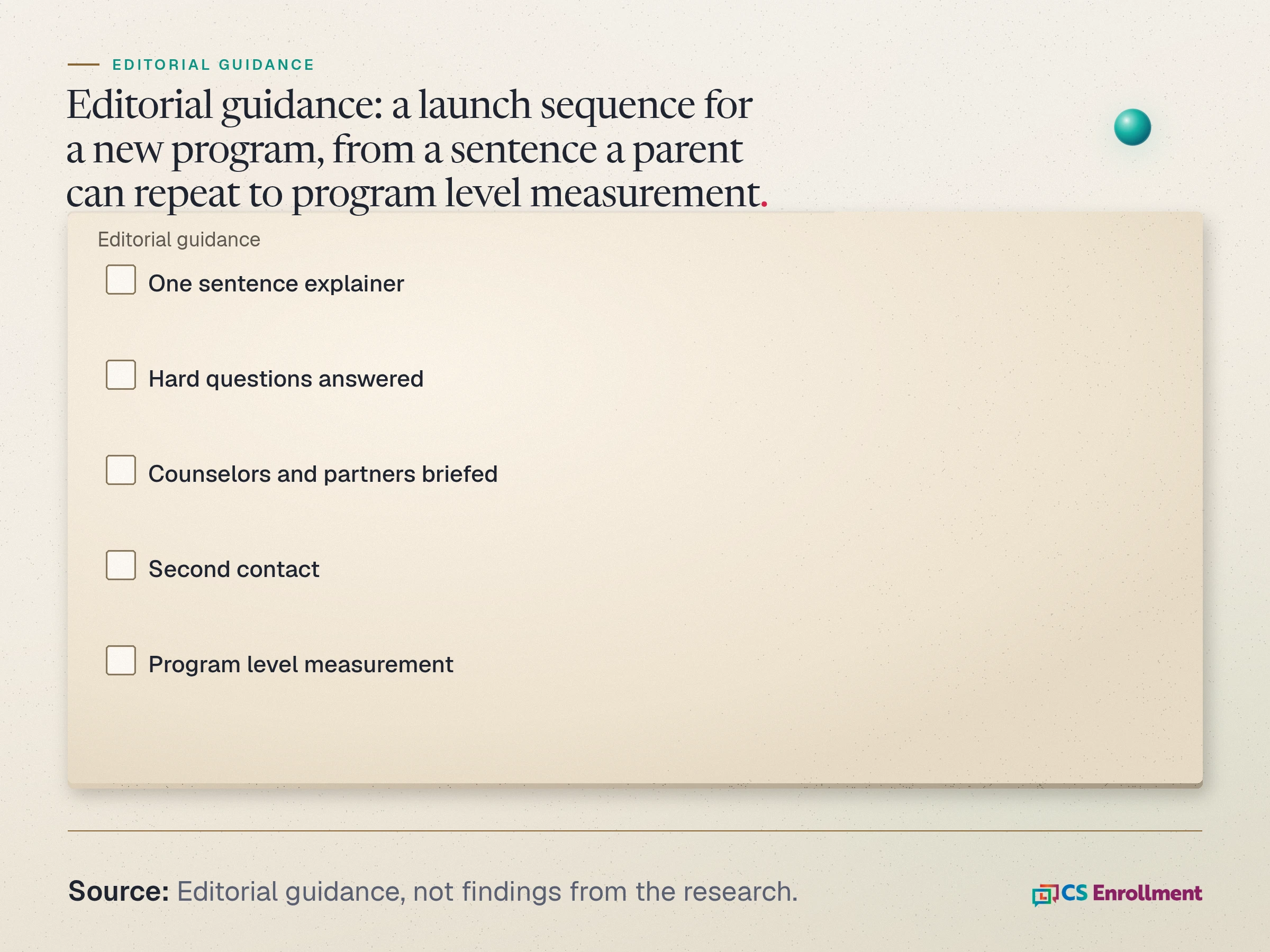
Editorial guidance: before any campaign, write one plain sentence that says what the program is, who it is for, what it leads to and what it costs in time.
Composed example, not a real program: "A bachelor's degree in business operations for students who want to start working in entry level management roles, finished in three years of full time study instead of four."
Test the sentence on someone outside the admissions office. If that person cannot repeat it back accurately, rewrite it. Then put the same sentence on the program page, in the first email and in the first text, so the explanation does not change from channel to channel.
Answer the hard questions before families ask
RAND reports continued uncertainty about how these degrees will be treated for credit transfer, graduate and professional programs, licensing and hiring, and says clear communication to students about those uncertainties is essential.
Editorial guidance: write down the questions a parent will ask, and answer them on the program page before anyone has to ask:
- Will it transfer?
- Will a graduate school accept it?
- Does it lead to a license?
- What do employers think?
Answer what is known. Say plainly what is not yet known. Never promise an outcome the program has not produced. For a three year degree, that includes saying outcome evidence is still limited.
Price is the other question families bring. The net price post covers how to make a realistic price easy to find before a family inquires.
Brief the people who explain it for you
Inside Higher Ed describes colleges with three year degrees briefing high school counselors and working through community college transfer partners. Those are approaches the reported colleges are trying, not tactics shown to work.
Editorial guidance: list the people who explain your programs to families, and give each the same plain sentence and the same answers to the hard questions. Include parents as well as counselors and transfer advisors. The parent engagement guide covers how to reach them directly.
Consider audiences beyond recent high school graduates. RAND says reduced credit pathways might be promising for adult learners and students returning to college. That is a possibility the report raises, not a finding that these programs work for those students. If a new program could fit those students, the adult learner recruitment post covers how to reach them.
Plan the second contact
Editorial guidance: a student who asks about a new program once needs to hear about it again, from a sender they recognize, before the deposit deadline.
The first message answers the question the student asked. The first message guide covers how to write it. The second contact returns to the program with something new: an answer to one of the hard questions, a chance to talk with faculty, or a reply to what the student said they wanted to learn. A survey led student search is one way to find out what that is.
Schedule the second contact when the inquiry arrives. We make no claim that a second contact raises deposits. For how this sequence fits a wider plan, see the enrollment marketing strategies post for small colleges.
Measure it program by program
Editorial guidance: track inquiries, applications and deposits for the new program separately from the rest of the college, each with its own denominator. Then compare those rates with the college's other programs over the same period.
Separate counts show where the program loses students: at awareness, at the move from inquiry to application, or at deposit. The inquiry to application conversion guide explains the calculation, and the enrollment funnel stages post defines each stage so the counts stay consistent from year to year.
There is no published benchmark for a new program's conversion rates, and this post does not offer one. The useful comparison is with your own programs.
Where messaging fits
CS Enrollment Pathways helps an admissions team make that second contact with branded, verified text messaging students can recognize, so a family's questions about a new program reach a real person.
Of the students who asked about your newest program, how many heard from you about it a second time before the deposit deadline?
To see how a branded conversation with a family starts, request the sample walkthrough.
Sources
- RAND, Lee, Kramer, Nguyen, Kushner, Chao and Kim, Reduced-Credit Bachelor's Degrees in Ohio: Opportunities, Constraints, and Field-Level Feasibility. Sponsored by Arnold Ventures. Official PDF (RR-A4772-1): Key Findings (PDF page 1) for the 119 count, uncertainty wording, and "might be promising"; printed page 3 for the 90 to 115 credit definition; printed page 6 for inventory timing and the 2024 and 2025 announcement counts; printed page 8, Figure 3, for 93 of 119 at four year private nonprofit institutions.
- Johanna Alonso, Inside Higher Ed, As 3-Year Degrees Proliferate, Some Pioneers Face Roadblocks. Trade press reporting: awareness as the biggest challenge, counselor briefings and transfer partnerships, around 90 credits, and marketing budgets. No colleges named here.
- Arnold Ventures newsroom, National Task Force Releases Framework for High-Quality Three-Year Bachelor's Degrees. Funder and advocacy release; task force convened by Arnold Ventures, Strada Education Foundation and the College-in-3 Exchange. Used for the outcomes evidence sentence and the naming recommendation.