What should admissions say about paid internships?
Our judgment: be ready to tell a prospective student, in the first conversations, which paid internships, practicums, cooperative education placements, research roles or apprenticeships students in their program actually get, and how a student gets one. Use your own records, or describe the opportunities without a number.
Families want to know what a degree leads to. Paid experience during college is one concrete, checkable part of that answer, and it is something a small college can describe program by program.
What did Strada's 2026 index find?
Strada Education Foundation released its 2026 State Opportunity Index on November 10, 2026. It is a foundation report, now in its third year, that measures how states connect education after high school to career opportunity.
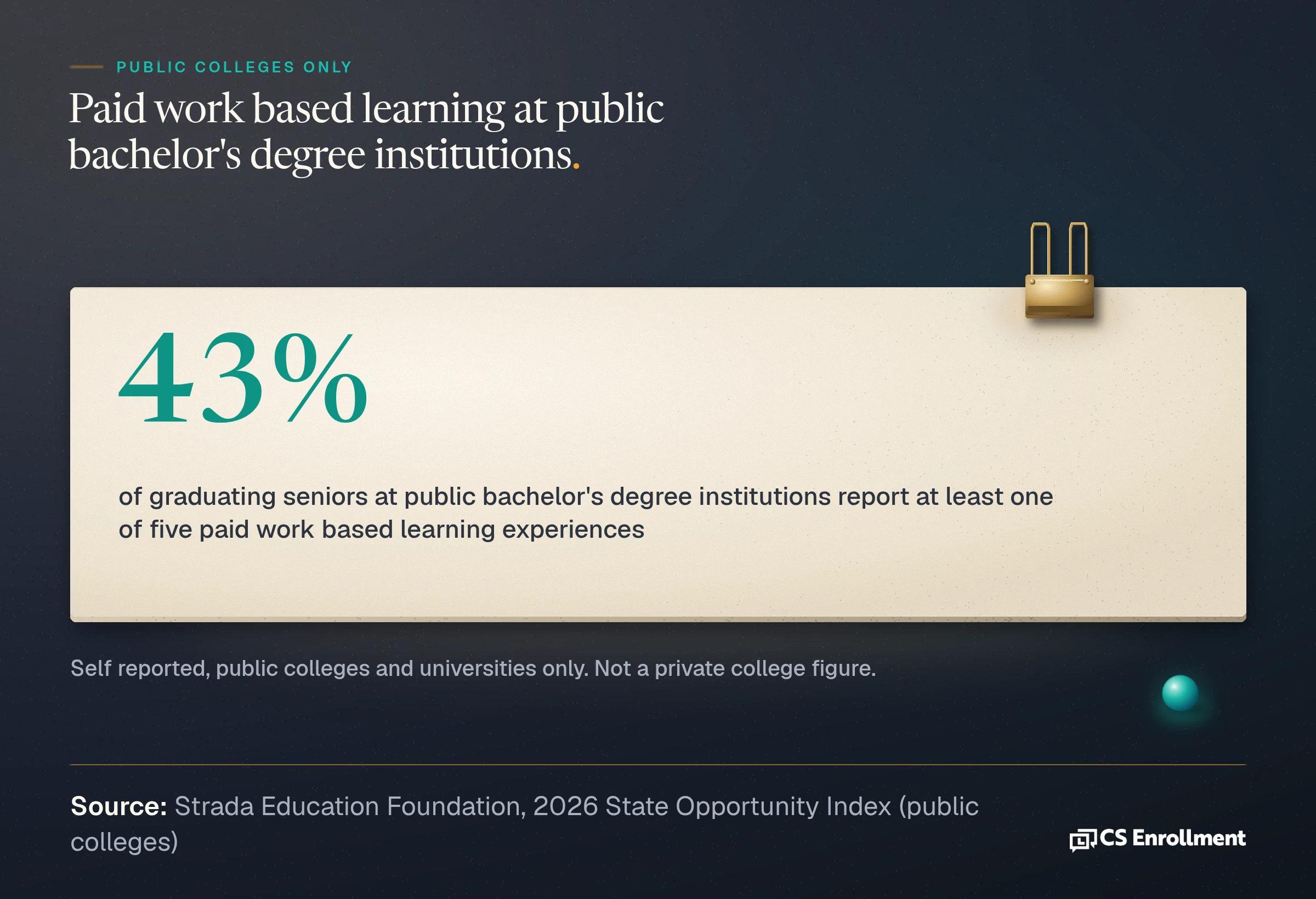
The headline work based learning finding: 43% of graduating seniors at the nation's public bachelor's degree institutions report having had at least one of five immersive paid work based learning experiences. Strada says that share was consistent with the year before. At public associate degree institutions, 14% of currently enrolled students reported one of the five experiences, which Strada calls a slight decline.
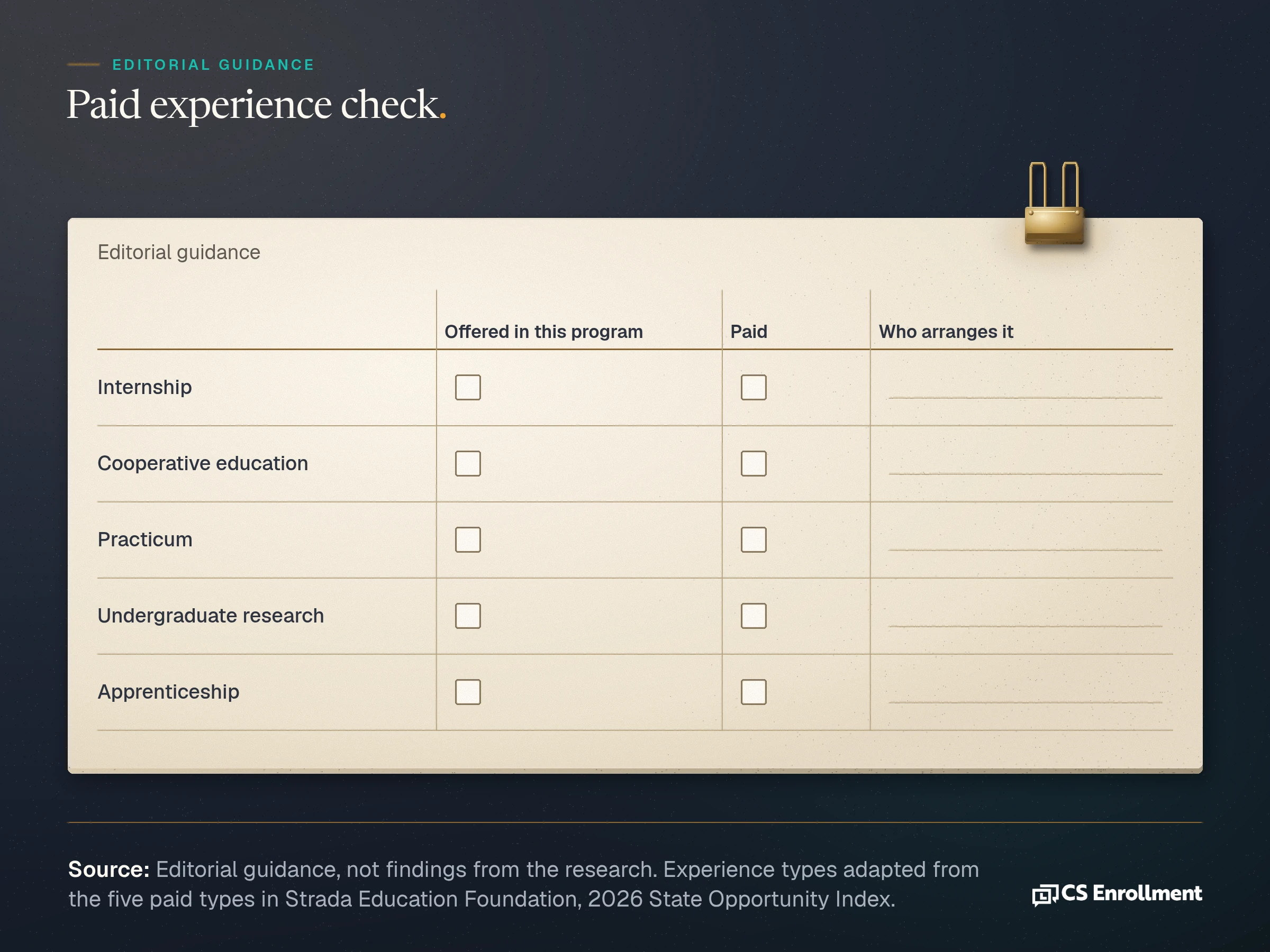
The five types Strada counts are a paid internship, a paid cooperative education placement, a paid practicum (such as student teaching or a nursing clinical), paid undergraduate research outside of a course, and a paid apprenticeship.
The scope matters. These results come from more than 110,000 responses to a nationally representative survey of students at public colleges and universities, collected in 2025 and 2026. Bachelor's level results are based on graduating seniors, and the data are self reported. The 43% describes public bachelor's degree institutions only. No figure in this post describes private colleges, and none describes your college.
Why this is an admissions question
Strada's Quality Coaching measure asks students whether they received timely labor market information "before enrolling or within the first year" of college, on career paths, job opportunities, potential earnings and the outcomes of graduates. In its release, Strada says the area with the most room for growth is "providing students with data on potential earnings and the outcomes of graduates from their program."
Our reading: "before enrolling" puts part of that job in the admissions office. For many families, the first real conversation about outcomes happens during recruiting, with a counselor, in a first message or on a program page. That is a reason to make the answer accurate, not a finding that it changes enrollment. The earnings test post covers the earnings data side.
Can your counselors answer the paid internship question?
Editorial guidance: run a short check on your two largest programs.
1. Ask three people in admissions the same thing: how students in this program get a paid internship or practicum. 2. Compare their answers with what career services and the program itself can document. 3. For each program, list which of Strada's five types exist, whether each is actually paid, and who arranges it.
Strada points to "the large number of students who report participating without pay." Some practicums and internships are unpaid, and a counselor should know which. Where the answer is unknown, treat it as a data gap to close with the program, not a line to improvise for a family.
Put the true answer where families meet you
Editorial guidance: once the program can document its paid experiences, put the same answer in each place a family meets it.
- The program page. Name the types of paid experience students in the program get and how they get them.
- The first message. Answer the career question the student asked, using the program's own information. The first message guide covers how to write it.
- A note for parents. Give parents the same answer the student gets. The parent engagement guide covers reaching them directly.
- The admitted student survey. Ask whether paid experience mattered in the decision, so you learn whether it matters to your students. The admitted student survey questions post has a starting list.
For working adults, paid experience raises different questions, such as how a practicum fits around a job they already hold. The adult learner recruitment post covers that audience.
We make no claim that describing paid experience raises inquiries, deposits or yield. Strada's index does not test that.
What not to say
Editorial guidance:
- Do not present a national number as your college's number. The 43% describes public bachelor's degree institutions.
- Do not promise a guaranteed internship unless the college guarantees one in writing.
- Say "paid" only when the experience is paid.
- Make no promise about what a graduate will earn.
For any program, new or established, the new academic program post covers how to say what is known and what is not.
Common questions
Does the 43% apply to private colleges? No. The survey covers students at public colleges and universities, and the 43% describes graduating seniors at public bachelor's degree institutions.
Does offering paid internships raise enrollment? Strada's index does not answer that, and this post makes no such claim.
Where messaging fits
CS Enrollment Pathways helps an admissions team ask a student early which career they are aiming for, with branded, verified text messaging, so the answer about paid experience in that field comes from a real person.
If a parent asked your newest counselor today how students in your largest program get a paid internship, what would they hear?
To see how a branded conversation with a family starts, request the sample walkthrough.
Sources
- Strada Education Foundation, 2026 State Opportunity Index shows momentum across states. Foundation report release. Top findings: 43% of graduating seniors at public bachelor's degree institutions, consistent with the year prior; most room for growth in data on potential earnings and graduate outcomes; third year of the Index.
- Strada Education Foundation, 2026 State Opportunity Index. Foundation report web version. Work Based Learning section ("What we measured": more than 110,000 responses, public colleges and universities, graduating seniors for bachelor's results, the five paid types; "What we found": 43% and 14%); Overview of progress (unpaid participation); Quality Coaching section ("What we measured": "before enrolling or within the first year").
- Strada Education Foundation, 2026 State Opportunity Index.