How much confidence do Americans have in higher education?
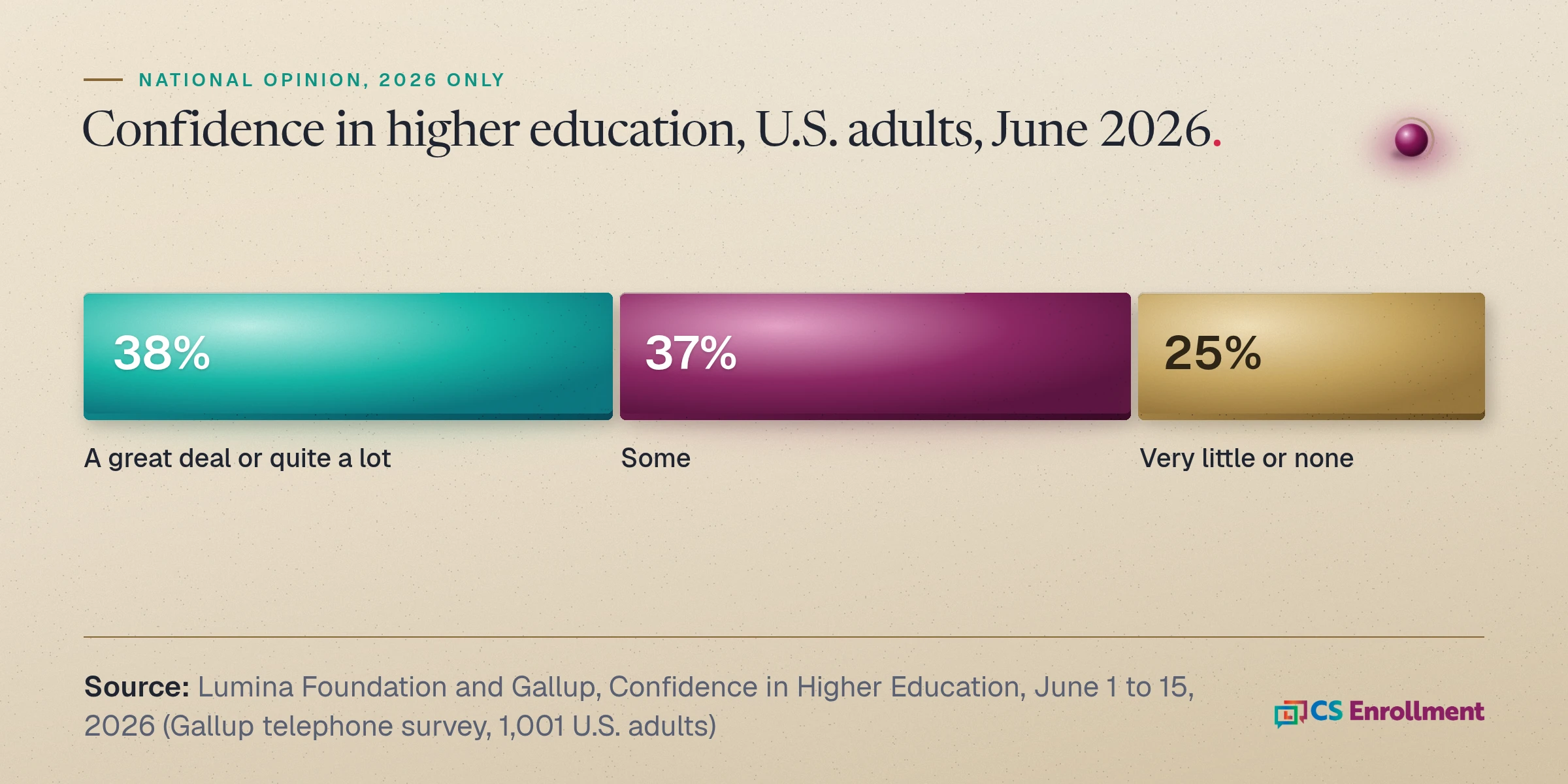
In June 2026, 38% of U.S. adults told Gallup they had a great deal or quite a lot of confidence in higher education, down from 42% a year earlier and 57% when Gallup first asked in 2015. Another 37% had some confidence and 25% had very little or none.
Gallup asked the confidence question in telephone interviews with a random sample of 1,001 U.S. adults, June 1 to 15, 2026 (margin of error plus or minus 4 percentage points), as part of the Lumina Foundation and Gallup Confidence in Higher Education survey. Gallup published the results on July 13, 2026. We will update this post when the next edition is released.
Why it matters to a small college: the families you recruit bring these views into the first conversation with your office. That is our framing, not a survey finding. The survey measures national opinion about higher education as an institution. It says nothing about any one college, and nothing in this post describes yours.
Why people doubt college, in their own words
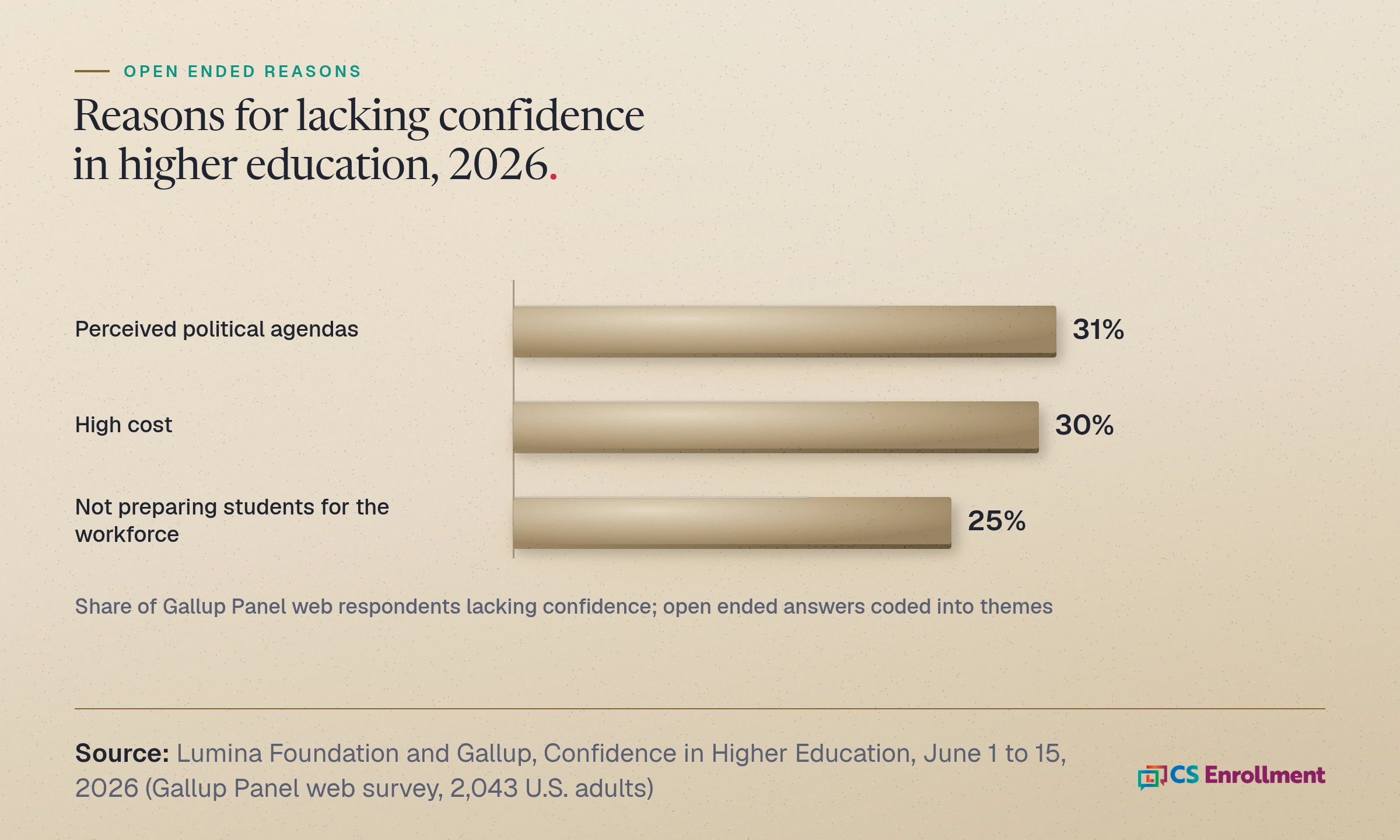
The reasons come from a separate Gallup web survey of 2,043 Gallup Panel members, fielded the same dates (margin of error plus or minus 3 points for all adults, and larger for the smaller groups who were or were not confident). Gallup coded the open ended answers into themes, so the shares are not meant to add to 100.
Among people in that web survey who lack confidence, Gallup reports three broad themes: perceived political agendas on college campuses (31%), the high cost of a college education (30%), and colleges not preparing students well for the workforce (25%). These shares describe people who lack confidence, not all adults.
The other side matters just as much. Among those who are confident, the most common reasons were that higher education provides good training for students in critical thinking and other skills (33%), makes students informed and knowledgeable (30%), and provides better job opportunities (19%).
Courtney Brown, chief data and research officer at the Lumina Foundation, which cosponsors the survey, reads the results this way: "confidence has become conditional." In her words, it is "a judgment people make after weighing costs, outcomes, and alternatives." That is the cosponsor's interpretation. In our reading, two of the three doubts, cost and workforce preparation, are about value a college can show with its own facts.
The doubts a recruitment team can answer
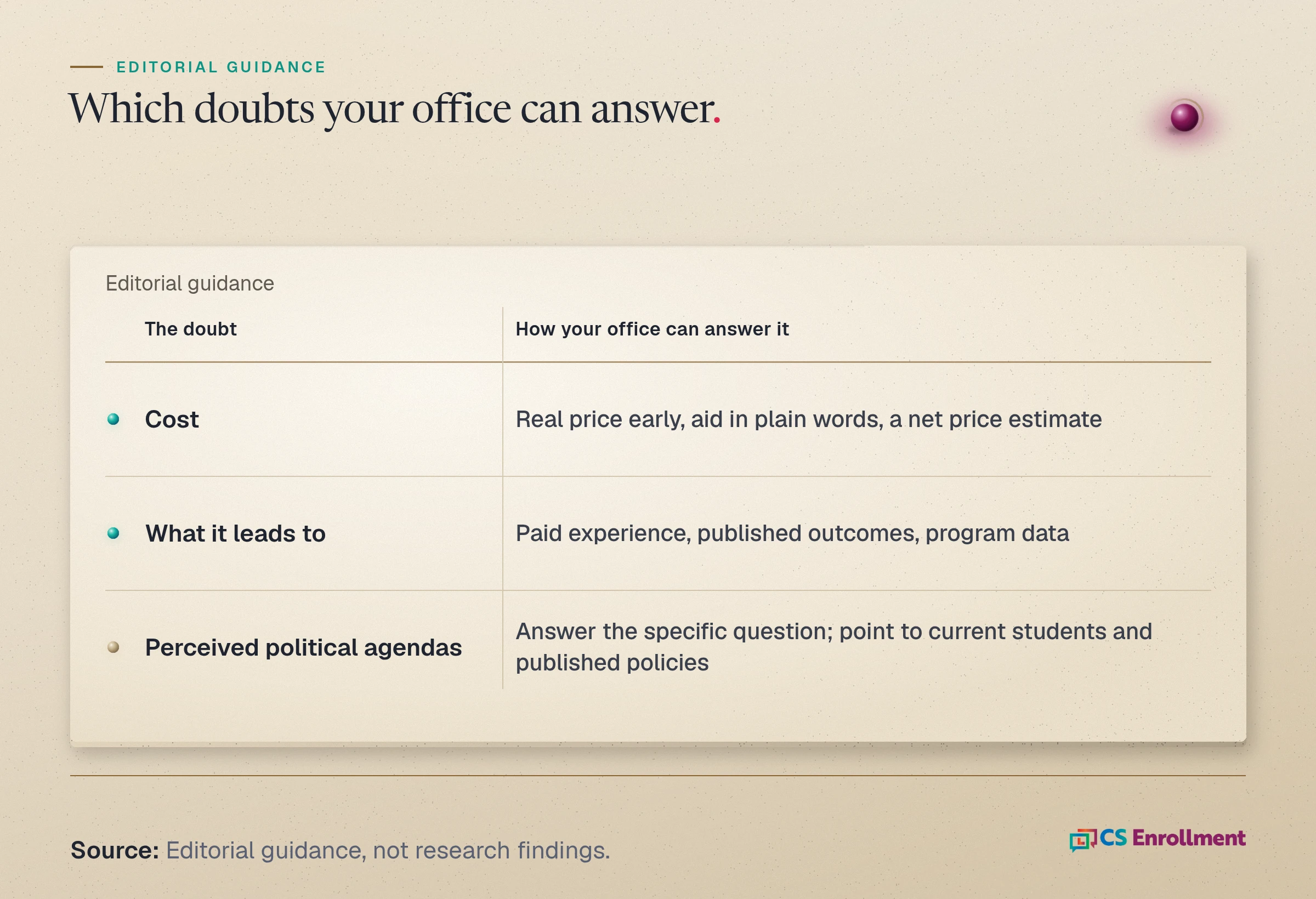
Editorial guidance: a recruitment office cannot change national opinion. It can answer the questions a family actually asks. Of the three reasons, two are questions your college can answer with its own facts: what it costs, and what it prepares students to do.
Perceived political agendas is a campus wide question, and this post takes no position on it. The recruitment job there is narrow. Answer the specific question a family asks, plainly, and point them to current students and to the college's published policies rather than to slogans.
Answer the cost question before families rule you out
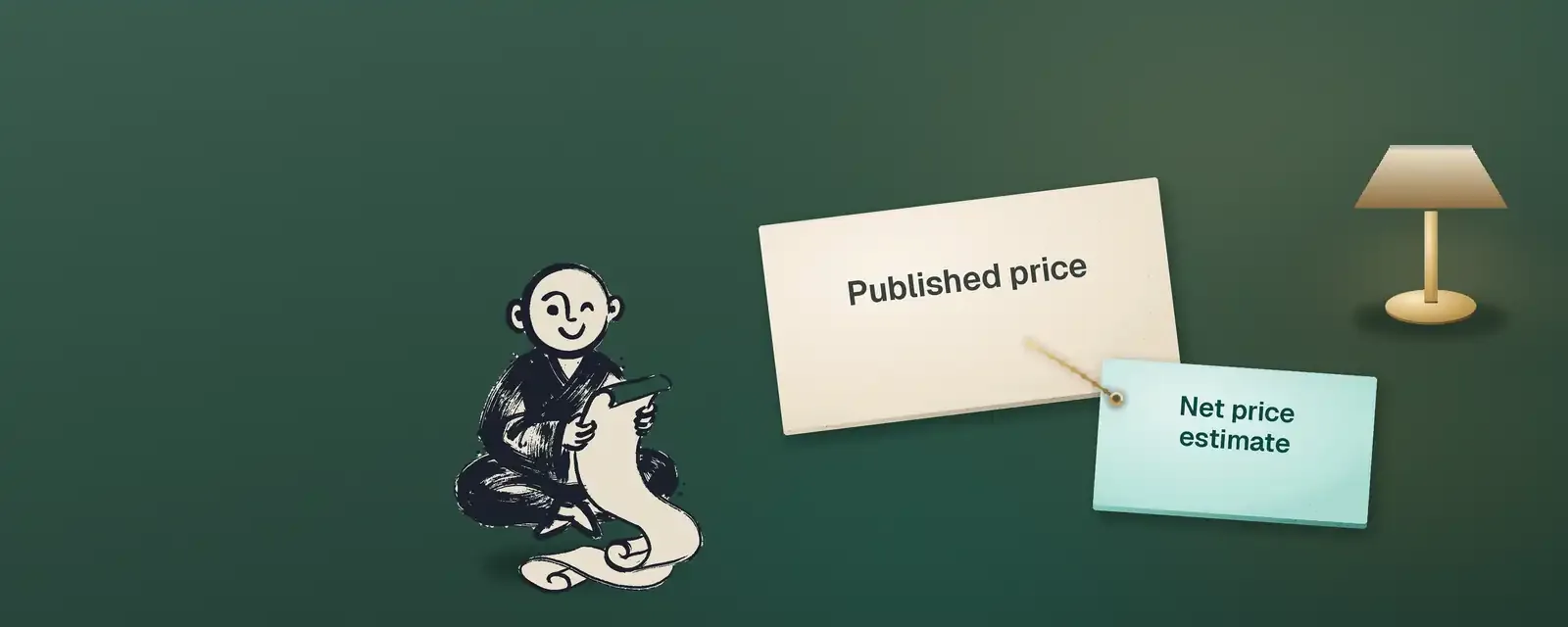
Editorial guidance: cost is the doubt a family can act on before they ever talk to you. If the price is unclear, a family may assume it is out of reach.
1. Say the real price early. Put the cost of attendance and the typical price after aid where a family will see it in the first visit to your site, not three clicks deep. 2. Explain aid in plain words. Say what grants are, what loans are, and which aid a family has to apply for. Skip the jargon. 3. Give an estimate a family can use. Point to your net price calculator in the first message, and say what information a family needs to run it.
The net price before inquiry post covers why the price conversation starts before a student ever contacts you. If your college discounts heavily, the tuition discount rate post explains how to talk about sticker price and aid together.
Show what your college leads to
Editorial guidance: workforce preparation is the other doubt you can answer, and it lines up with the reasons confident people give: skills and job opportunities. Answer it with outcomes your own college can source and date.
- Paid experience. Name the paid internships, practicums and placements students in each program get, and how they get them. The paid internships post walks through that check.
- Published outcomes. Use the career placement figures your college already publishes, with the year and the population they describe.
- Program level data. Where federal or state earnings data exists for a program, use it carefully. The earnings test post covers how.
Where your college does not have a number, describe the opportunities without one. A plain description beats an invented figure.
Ask families what they doubt
Editorial guidance: before writing the message, ask. A short question at inquiry or after admission can tell you which doubt a family holds, instead of guessing.
- At inquiry. One question: "What worries you most about choosing a college: cost, what the degree leads to, or fitting in on campus?" The survey led student search post covers asking students what they want early.
- After admission. Add the same question to your admitted student survey. The admitted student survey questions post has a starting list.
- For parents. A parent may hold a different doubt than the student. The parent engagement guide covers reaching them directly.
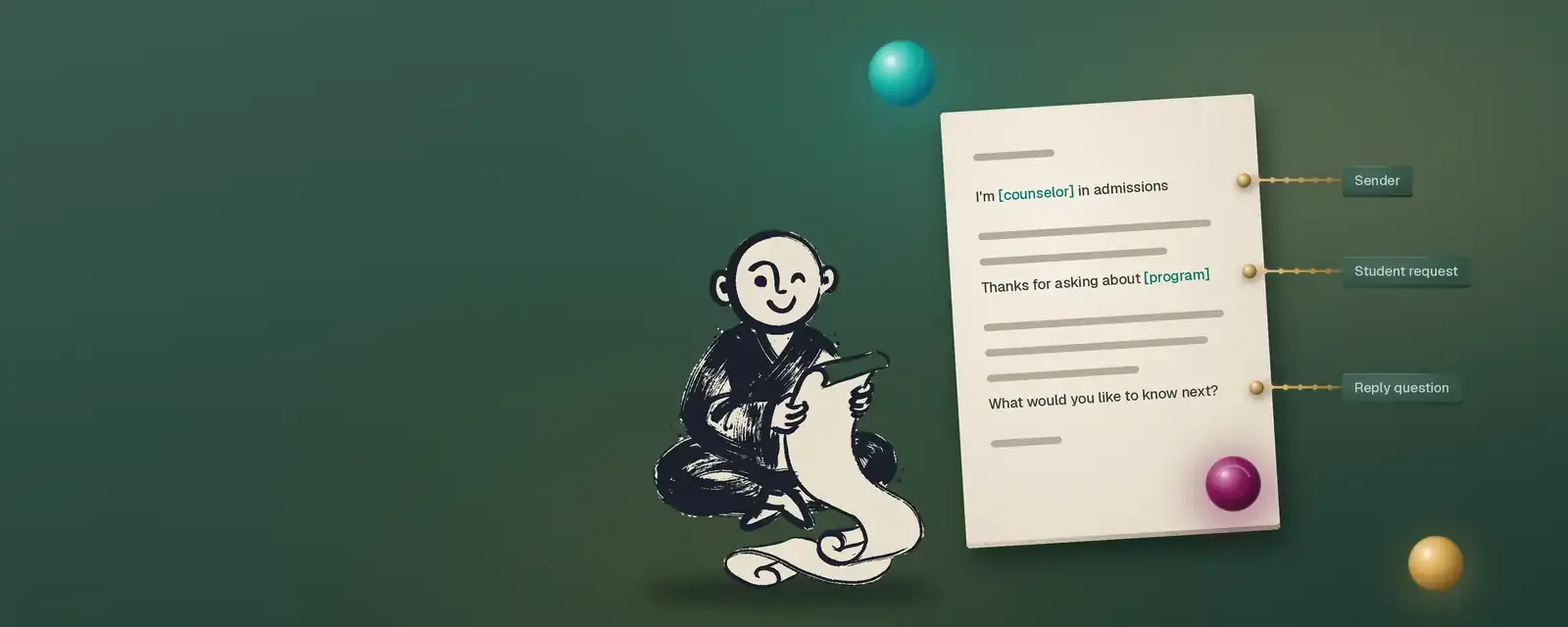
Then answer in plain language, from a sender the family recognizes. The first message guide covers how to write that answer, and the data transparency post covers telling a student where you got their contact information.
We make no claim that answering these doubts, or asking about them, raises inquiries, applications, deposits or yield. The survey does not test that.
Common questions
What percentage of Americans have confidence in higher education? In June 2026, 38% of U.S. adults said they had a great deal or quite a lot of confidence in higher education, according to the Lumina Foundation and Gallup survey.
Why do Americans lack confidence in higher education? Among those who lack confidence, the main reasons were perceived political agendas (31%), cost (30%) and workforce preparation (25%). Answers were open ended, from Gallup's web survey of 2,043 adults.
Has confidence in higher education gone up or down? Down over the long run. It was 57% in 2015 and 42% in 2025, then 38% in 2026.
Where messaging fits
CS Enrollment Pathways helps a small college answer these questions early, with branded, verified text messaging from a sender families can recognize, so a question about cost or outcomes gets a reply from a real person at the college.
If a family asked your office today what your college costs and what it leads to, how fast would they get a plain answer?
To see how a branded conversation with a family starts, request the sample walkthrough.
Sources
- Jeffrey M. Jones, Confidence in U.S. Higher Education Slips Back Slightly. Lumina Foundation and Gallup Confidence in Higher Education survey, June 1 to 15, 2026. Opening paragraphs (38%, 42%, 57%, 37%, 25%); "Cost, Politics, Instruction" section (31%, 30%, 25%); "Confidence Rooted in Training, Knowledge, Job Opportunities" section (33%, 30%, 19%); Survey Methods; topline PDF (https://news.gallup.com/file/poll/712331/260714_Higher%20education.pdf), page 1, confidence trend.
- Courtney Brown, Americans haven't given up on higher ed. They're asking more of it. Foundation commentary from the survey's cosponsor.