How should a college judge an AI tool for enrollment?
Our judgment: decide which student number the tool should change before you buy it, count it the same way before and after, and keep a named person accountable for every reply a student gets. If the only result you can show is staff time saved, you have measured the office, not the student.
Why now: campus leaders report that AI is saving staff time, but nearly a third have not yet detected measurable gains for students. That gap is the subject of this post. It is written for enrollment and marketing leaders at colleges of about 250 to 10,000 students who are being sold AI tools or are already piloting one.
This post is about the college's own tools. For the student side of AI, see how students find colleges through AI answers.
What do campus leaders say AI has changed so far?
Inside Higher Ed's 2026 Survey of College and University Student Success Administrators, conducted with Hanover Research Aug. 22 to Oct. 5, 2026, surveyed 271 student success leaders, most in student affairs at the executive level at public and private nonprofit colleges (margin of error plus or minus 6 points). The independent editorial survey was supported by Studiosity and the Gates Foundation.
One caution before the numbers. These respondents are student success administrators, not admissions or enrollment staff. Their answers describe AI across campus services, not inside an admissions office.
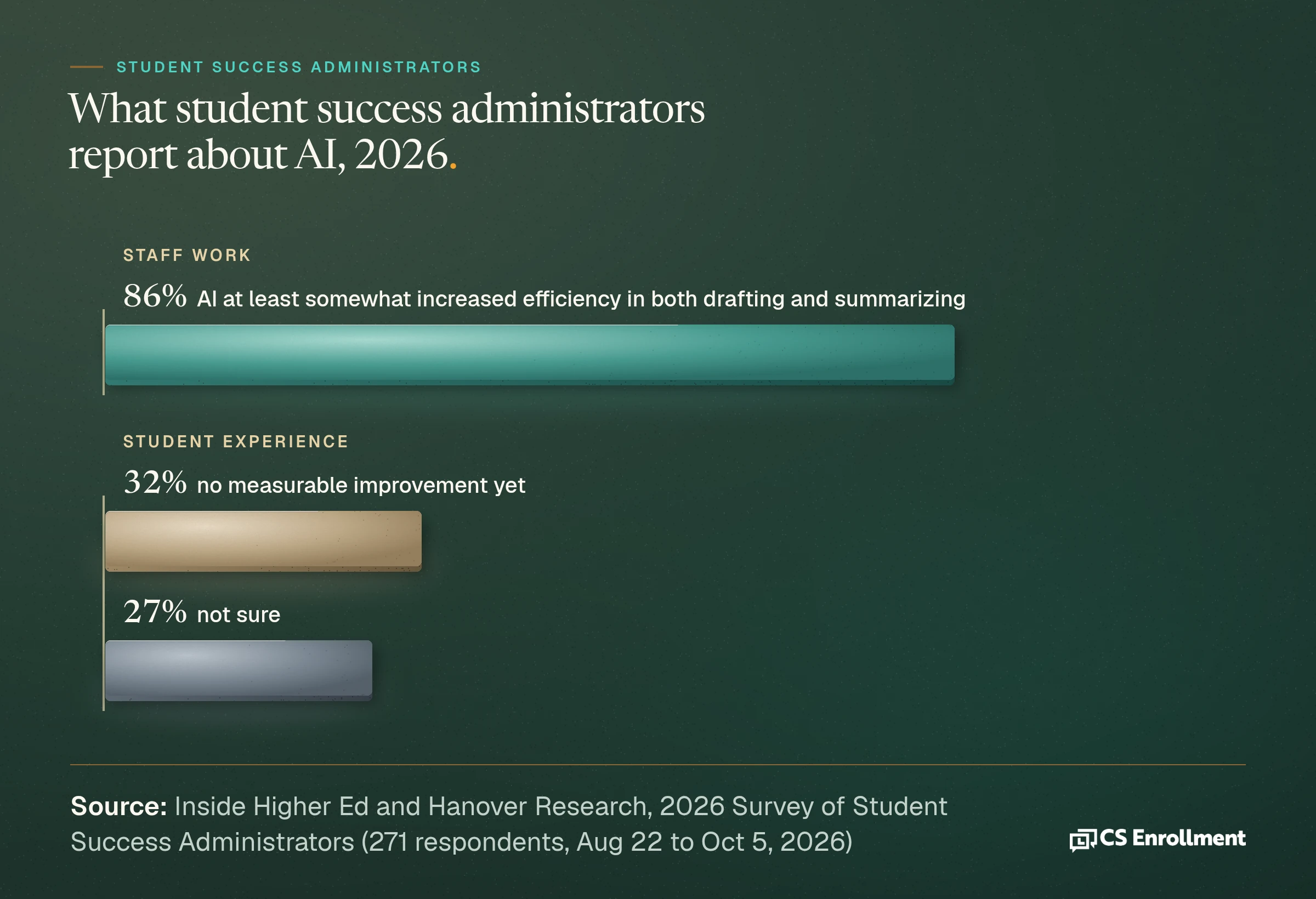
Start with staff work. 86% say AI has at least somewhat increased efficiency or impact for faculty and staff in both drafting and editing communications and summarizing information.
When it comes to the student experience, 32% say they have not yet detected measurable or demonstrable improvements from AI. Another 27% aren't sure whether they have. The clearest student gains respondents reported were in retention and early intervention and in career services, each cited by 21%.
Looking three years ahead, 69% see significant or transformative potential for AI to improve students' interactions with general administrative and campus services.
Staff time is not a student result
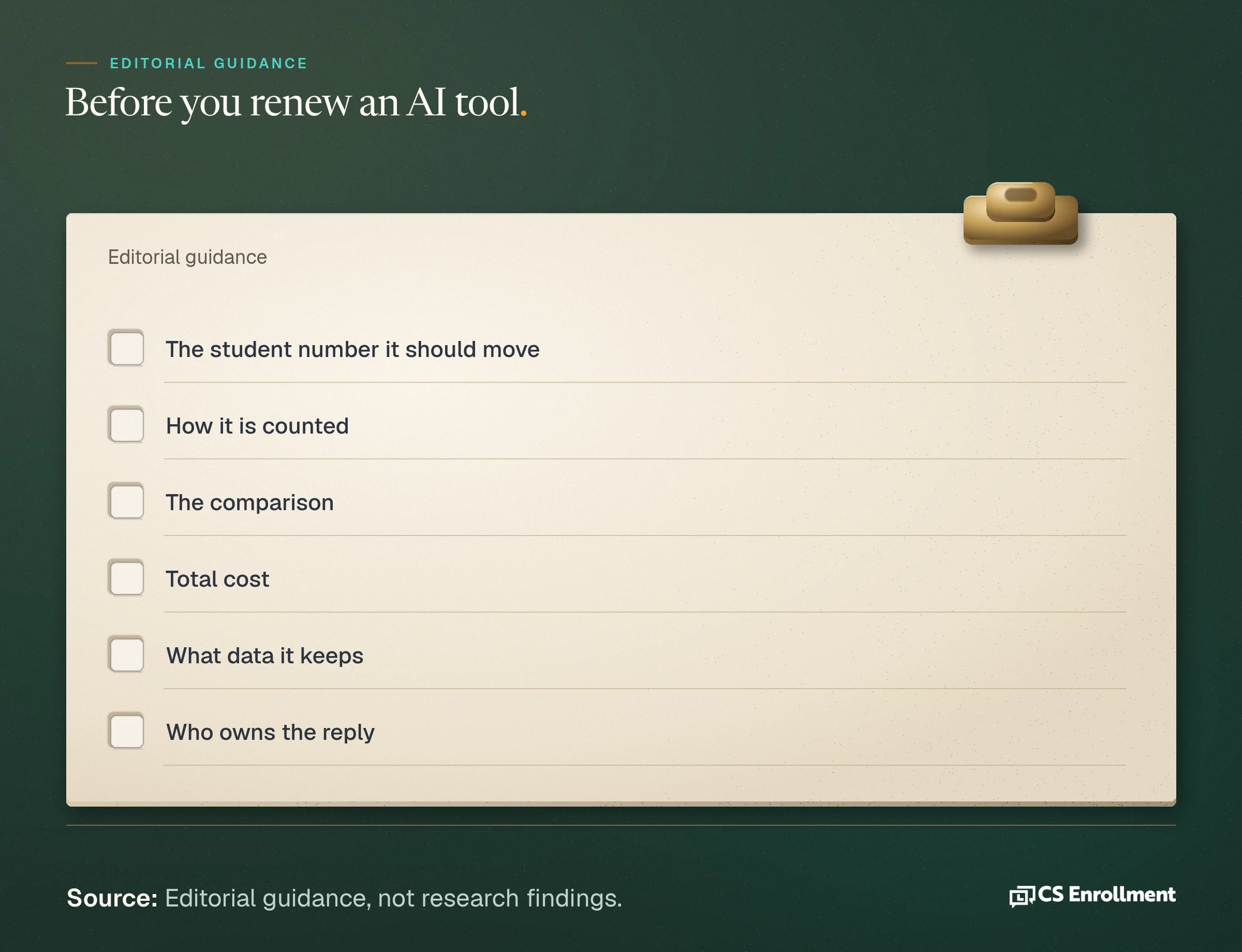
Editorial guidance: a faster draft only matters if a student gets a better answer sooner, finishes a step or stays enrolled. Saved hours are worth having, but they measure the office. Before you call a tool a success, tie it to a stage of the student's path.
Start with the enrollment funnel stages and name the stage the tool touches. Then pick one measure your office already tracks at that stage:
- Inquiry. Time from a student's first question to the first reply from a person.
- Application. Inquiry to application rate. The inquiry to application conversion post covers how to count it.
- Completion. The share of started applications that get finished.
- Deposit. The share of admitted students who deposit.
- Cost. Cost per enrolled student, which the cost per enrolled student post breaks down.
If a tool cannot be tied to any of these, it is better to learn that before the contract is signed than at renewal.
Run a small, fair test
Editorial guidance: a pilot only tells you something if it was set up to answer a question.
1. Pick one use. For example, drafting replies to common inquiry questions, rather than "AI across the office." 2. Pick one stage and one measure from the list above, and count it the way you counted it last year. 3. Set a comparison. Use a group of students the tool does not touch, or the same weeks of last cycle. 4. Fix the end date before the test starts. 5. Write down what counts as success before anyone sees results, and who makes the call. 6. Ask students what changed for them. One short question in a survey can tell you whether the faster reply was also a better one. The admitted student survey questions post has a starting list.
Keep the test small enough that your team can watch it closely. A clear answer about one use is worth more than a vague answer about ten.
Ask for evidence before the renewal
When evaluating AI enabled student support tools, respondents most often prioritize demonstrated evidence of improved student outcomes (56%), total cost (55%) and data privacy and security (53%). Those answers are about student support tools, not admissions tools specifically, but the questions carry over to any AI tool an enrollment office is weighing.
Editorial guidance: turn them into plain questions for a vendor or for your own team.
- What student outcome has this changed? Measured how, where and against what comparison.
- What does it cost in total? The license, the setup and the staff time it takes to review what the tool produces.
- What student data does it use and keep? Where it is stored, for how long and who can see it. The data transparency post covers how to explain data use to students.
Keep a person on the reply
Editorial guidance: a tool can draft a message, but a person has to own the conversation. Name who is responsible for a student's question when the tool gets something wrong, the same way you would name an owner for any outcome. The retention accountability post covers how to assign that ownership.
Say when AI helped write a message. The AI disclosure post covers how to do that. Then read the draft as a student would. The first message guide shows what a clear first reply looks like.
One leader told the survey: "AI is a tool and not a crutch."
We make no claim that AI tools raise or lower inquiries, applications, deposits or yield. The survey does not measure that, and neither does this post.
Common questions
Does AI improve student outcomes in higher education? Not yet shown for many of the leaders surveyed. In the 2026 Inside Higher Ed and Hanover Research survey of student success administrators, 32% say they have not yet detected measurable or demonstrable improvements from AI. Another 27% aren't sure whether they have.
Where are colleges seeing AI gains? In staff work, by these leaders' account: 86% say AI has at least somewhat increased efficiency or impact for faculty and staff in both drafting and editing communications and summarizing information. The clearest student gains respondents reported were in retention and early intervention and in career services, each cited by 21%.
What should we look for in an AI tool? When evaluating AI enabled student support tools, respondents most often prioritize demonstrated evidence of improved student outcomes (56%), total cost (55%) and data privacy and security (53%).
Where messaging fits
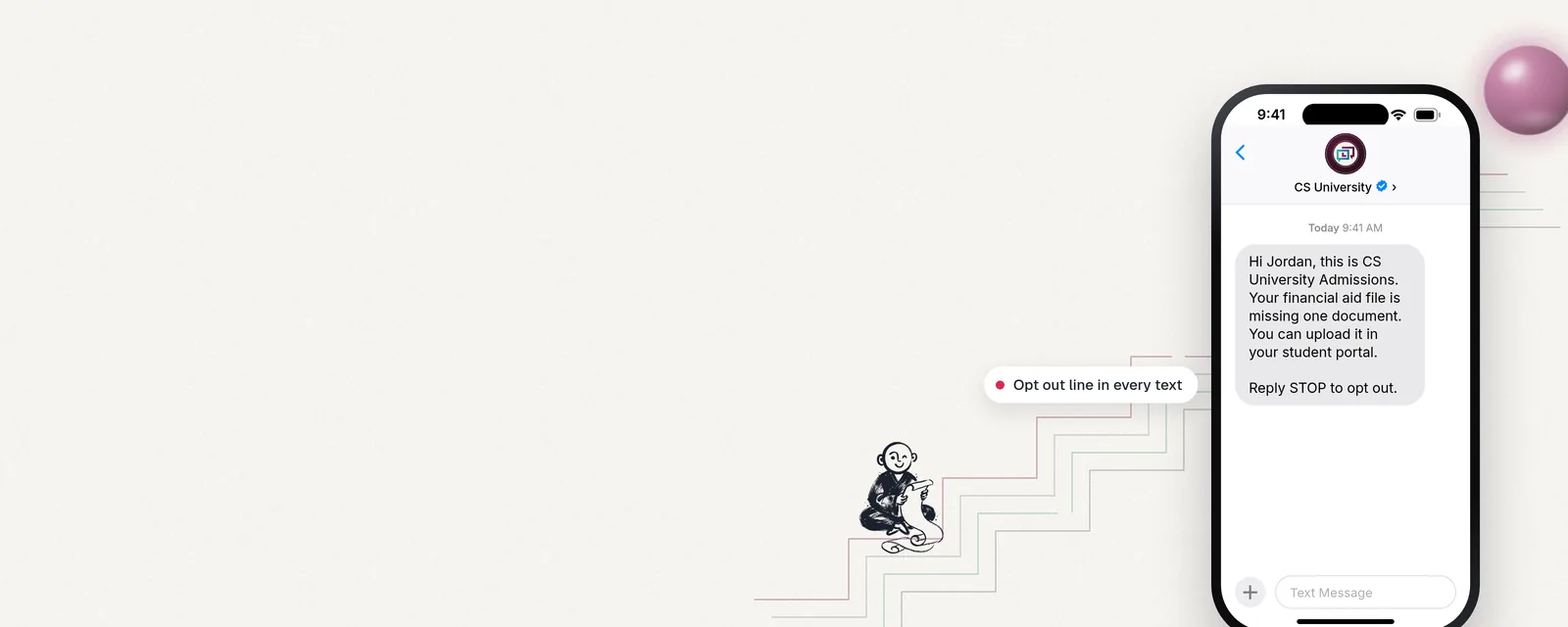
CS Enrollment Pathways is held to the same test: branded, verified text messaging from a sender students recognize, with replies answered by a real person at the college, judged by the funnel numbers your office already tracks.
What student number would have to move for your AI tool to be worth renewing next year?
To see how a branded conversation with a student starts, request the sample walkthrough.
Sources
- Colleen Flaherty, Student Success Is the Priority. Capacity Is the Challenge. Inside Higher Ed's 2026 Survey of College and University Student Success Administrators with Hanover Research, 271 respondents, Aug. 22 to Oct. 5, 2026, margin of error plus or minus 6 percentage points; independent editorial survey supported by Studiosity and the Gates Foundation. "More on the Survey" box (method); "A Design Opportunity?" section (86%, 32%, 27%, 21%, 69%, the respondent quote and 56%, 55%, 53%).
- Inside Higher Ed, 2026 Survey of College and University Student Success Administrators. report landing page.