
What should a financial aid offer include?
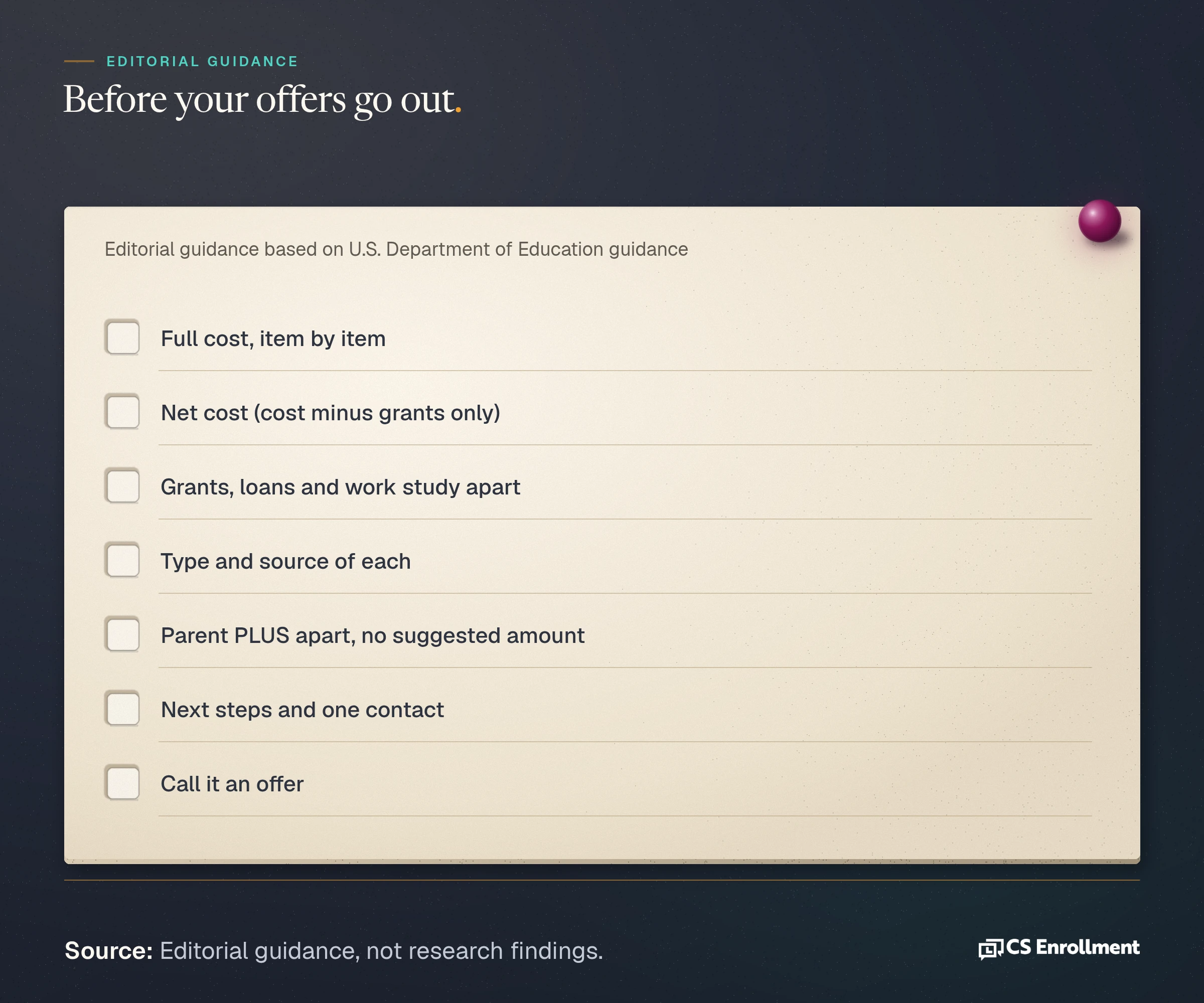
Our judgment, built on U.S. Department of Education guidance: a clear offer shows the full cost of attendance, item by item; lists grants and scholarships apart from loans and work study; subtracts only grants and scholarships to show the net cost; says where each piece of aid comes from; and tells the student exactly what to do next and who to ask.
A federal review of aid offers found that no college in its sample followed all 10 federal best practices. A family can't say yes to a price it can't find, so the offer deserves the same care as any other message an admitted student gets from your office. This post is for enrollment leaders at colleges of about 250 to 10,000 students who share the offer with financial aid.
What did the federal review of aid offers find?
The U.S. Government Accountability Office (GAO) collected 522 financial aid offers from a nationally representative sample of 176 colleges. The offers went to recently accepted, dependent, full time undergraduates for the 2021 to 2022 academic year, and each included a Pell Grant and a federal student loan. The sample spans public, nonprofit and for profit colleges, two year and four year, and GAO says it was not designed to compare types of colleges. Its estimates have a margin of error of no more than plus or minus 7 percentage points. This is the most recent national federal review of aid offers we found.
GAO measured each offer against 10 best practices drawn from the Department of Education and the Financial Literacy and Education Commission. What it found in those 2021 to 2022 offers:
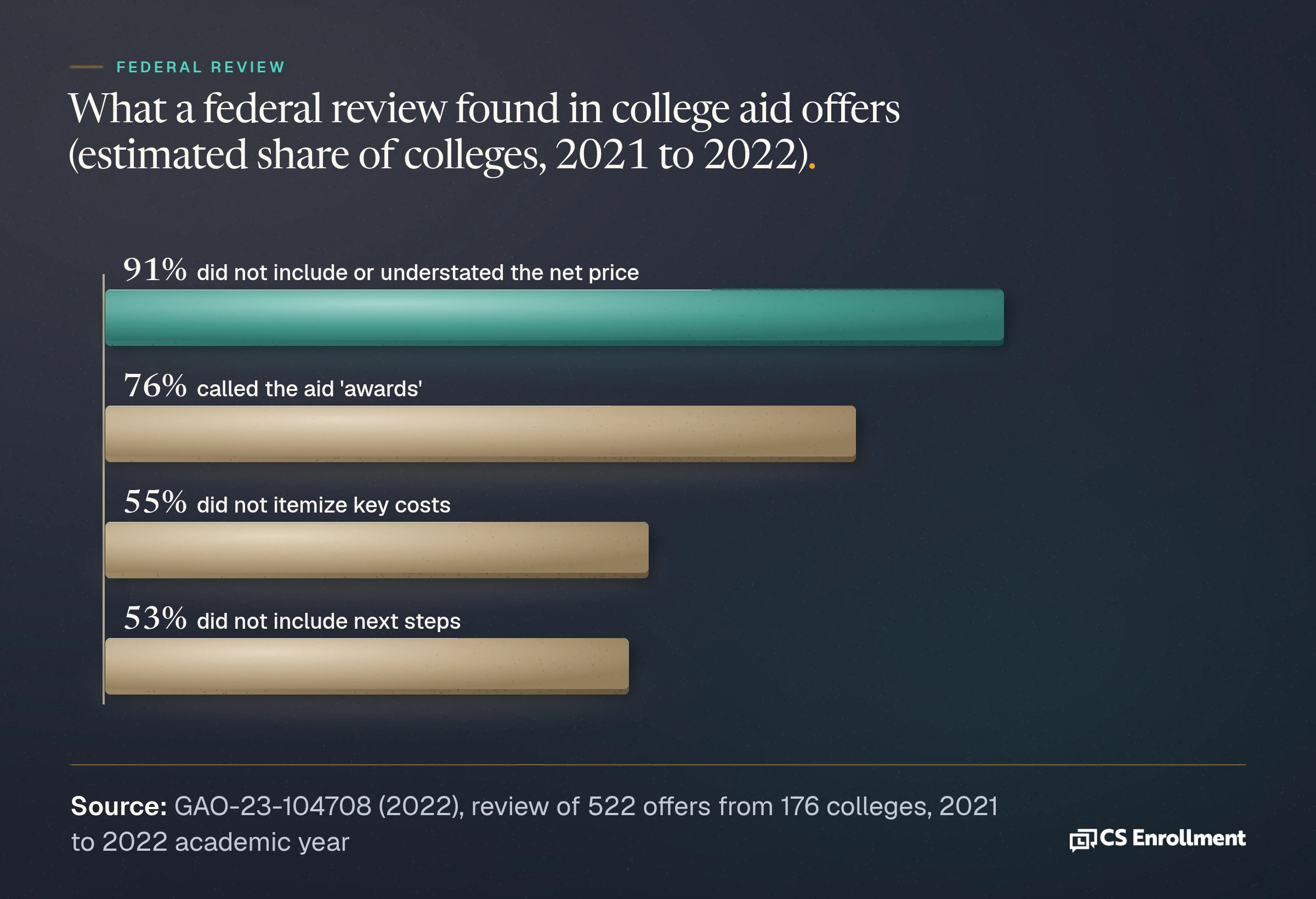
- An estimated 91% of colleges do not include or understate the net price. That is 41% that leave it out and 50% that understate it.
- An estimated 63% follow five or fewer of the 10 best practices.
- No college in the sample followed all 10.
- An estimated 76% refer to the aid as "awards."
GAO also notes that federal law does not require colleges to include clear, standard information in all of their financial aid offers.
Show the whole cost, then the net cost
GAO estimates that 55% of colleges do not itemize key direct and indirect costs. Separately, 55% do not give a total cost of attendance that includes those costs. GAO notes these are not the same colleges, so the two figures should be read on their own.
The Department of Education defines net cost as "the difference between the total cost of attendance (COA) and all grant/scholarship aid received." Its 2021 guidance also says colleges should not present net cost in ways that confuse students, such as subtracting private or Parent PLUS loans from the cost of attendance or using those loans to zero out the cost.
Editorial guidance:
1. List every cost. Tuition, fees, housing, meals, books, transportation and personal expenses, each on its own line, with a total. 2. Subtract only grants and scholarships. Loans and work study do not lower the price. They are ways to pay it. 3. Put the net cost on the first screen. If a parent opens the offer on a phone, that number should be the first one they see.
This is the same honesty a family should get earlier in the funnel, covered in our post on showing net price before inquiry.
Label every dollar
Editorial guidance: group the aid by type (grants and scholarships, loans, work study) and say where each piece comes from: federal, state, the college or a private source.
Parent PLUS loans need extra care. GAO estimates that 31% of colleges include Parent PLUS loans in their offers, and 21% do not list key details about how those loans differ from student loans, as Education's 2019 best practices suggest. The Department's 2021 guidance goes further: list Parent PLUS apart from federal student loans as one option among others, without a dollar amount.
The federal limits also changed this year. Starting July 1, 2026, the most all parents together can borrow in Parent PLUS loans for one dependent student is $20,000 a year and $65,000 in total. Students who were already enrolled and had a federal loan for their program before that date can keep the old limits for a limited time. The offer only needs to describe the option plainly; your financial aid office handles each family's case.
Call it an offer, and say what happens next
The Department of Education advises colleges to avoid calling the offer an "award" or a "letter." In its words, "Loans are not awards." Work study is not an award either; it is a chance to earn money through a job.
GAO estimates that 53% of colleges did not include actionable next steps in their offers, such as how to accept, adjust or decline aid and who to contact with questions.
Editorial guidance: end every offer with:
- How to accept, decline or change each piece of aid, and by what date.
- How to ask for a review if the family's situation has changed.
- One named person, with a direct email and phone number.
If a student has not filed the FAFSA yet, the offer is only an estimate. Our post on FAFSA completion and yield covers how to help those students file.
Use the federal template as a check
The Department of Education's College Financing Plan is a standard offer template that colleges can choose to use, updated each year. The 2027 to 28 version was announced Sept. 8, 2026. GAO estimated that 35% of colleges sent it to all students (based on its questionnaire of 185 colleges) and that only 3% used it as their official offer.
Editorial guidance: for most students it is optional, but it makes a good test. Lay your offer beside it and note anything yours leaves out.
Walk families through it
Editorial guidance: the offer starts a conversation; it does not finish one. Send it with a short note that states the net cost in one sentence and names the person to call. Invite parents into that same conversation, as our post on parent engagement in college admissions describes.
Then ask. A short question about whether the student opened the offer and understood what they would pay belongs in your admitted student survey.
Understanding cost is hard even after students enroll. In Inside Higher Ed's 2026 survey of 271 student success administrators, only 16% said students understand the total cost of attendance very or extremely clearly. That is a view of enrolled students, not admits, but the offer should not be the last word on price. For the wider plan around deposits, see how to increase college yield.
Common questions
What is the difference between cost of attendance and net cost? Cost of attendance is the full estimated cost of a year. Net cost, as the Department of Education defines it, is the cost of attendance minus grants and scholarships only.
Should a financial aid offer include Parent PLUS loans? The Department's 2021 guidance says to list them apart from federal student loans, as one option, without a dollar amount. New federal limits on Parent PLUS borrowing took effect July 1, 2026.
Is there a standard financial aid offer form? The Department of Education's College Financing Plan is a standard template that colleges can choose to use. GAO reports that federal law does not require colleges to include clear, standard information in all of their financial aid offers.
Where messaging fits
CS Enrollment Pathways lets your team tell an admitted student the offer is ready and invite questions in branded, verified text messaging, so the family can ask a real person what the net cost means for them.
If a family read only the first screen of your offer, would they know what they will pay?
To see how a branded conversation with an admitted student starts, request the sample walkthrough.
Sources
- U.S. Government Accountability Office, Financial Aid Offers: Action Needed to Improve Information on College Costs and Student Aid. Federal review of 522 financial aid offers from a nationally representative sample of 176 colleges, 2021 to 2022 academic year; margin of error no greater than plus or minus 7 percentage points. Product page (91%, 41%, 50%, no federal requirement); report pp. 2 to 3 (method), 8 (63%, none followed all 10), 9 and note 16 (55%, 55%), 23 (31%, 21%), 25 (53%), 26 (76%, 35%, 3%; questionnaire of 185 colleges).
- Full report (ERIC copy, ED628355).
- Federal Student Aid, Issuing Financial Aid Offers: What Institutions Should Include and Avoid.
- Federal Student Aid, 2027-2028 College Financing Plan Now Available.
- U.S. Department of Education, College Financing Plan.
- 20 U.S.C. 1087e.
- Federal Student Aid, Frequently Asked Questions: Loan Limits.
- Colleen Flaherty, Student Success Is the Priority. Capacity Is the Challenge. Inside Higher Ed's 2026 Survey of College and University Student Success Administrators with Hanover Research, 271 respondents, August 22 to October 5, 2026, margin of error plus or minus 6 percentage points.