Should a college waive its application fee?
Our judgment: waiving the fee is a reasonable way to remove a barrier, and in the studies we found, offers that included a waiver brought more applications, especially from students with less money. The research we found does not show that a waiver alone brings more enrolled students. If you waive the fee, plan the follow up before the applications arrive.
The reason is in three randomized experiments, covered below. Each one paired the waiver with other help, and each one tracked whether students went on to enroll. This post is for enrollment leaders at colleges of about 250 to 10,000 students weighing a no fee policy or a fee free month.
How common is a free application?
Free applications are now ordinary. Common App says 700+ colleges on its platform have no application fee for U.S. students, and 550K+ applicants received a Common App fee waiver in 2025 to 26. Common App had 1,146 member colleges that season.
The students who use waivers are a growing group. In Common App data, applicants reporting fee waiver eligibility grew 6% from 2024 to 25 to 2025 to 26, against less than 1% for other applicants. Over a longer span, from 2016 to 17 to 2025 to 26, they grew 165%, against 39% for applicants who did not report eligibility. Common App notes that waiver eligibility is self reported and often used as a proxy for low income status.
Editorial guidance: because so many colleges charge nothing, a free application on its own is not a reason for a student to choose you. It removes one small reason not to apply.
What happens to applications and enrollment when the fee goes away?
None of these experiments tested a fee waiver by itself. Read each result as the effect of a package.
Four U.S. states (2023). Researchers worked with six public and private universities in four states and a pooled sample of 31,481 students. Students got a guaranteed admission offer, an application fee waiver and a simpler form. They were 2.7 percentage points (or 12%) more likely to submit a college application, with larger effects for first generation and low income students. They were not more likely to enroll. The authors call the approach "insufficient alone to increase enrollment given other barriers to access, including the ability to pay for college."
Canada (2016). A school based experiment ran application workshops in high schools with low college going rates, where applying cost about $100. In the second experiment, run in 66 schools in 2013 to 14, the workshops that included fee waivers raised application rates by 20.4 percentage points among high school graduates, but did not significantly change enrollment. Workshops without fee waivers had no significant effect on applications. The first experiment, in 86 schools in 2011 to 12, paired waivers with more personal guidance on programs students were eligible for. Applications rose from 64 to 78 percent, and enrollment rose 5.2 percentage points the next year, with virtually all of that increase at two year colleges. This is an NBER working paper, which is not peer reviewed.
785,000 students (2019). In research by College Board staff, a campaign reached 785,000 low and middle income students in the top half of PSAT and SAT scores. Some were offered extra encouragement, such as reminders or application fee waivers. The researchers found no changes in college enrollment patterns.
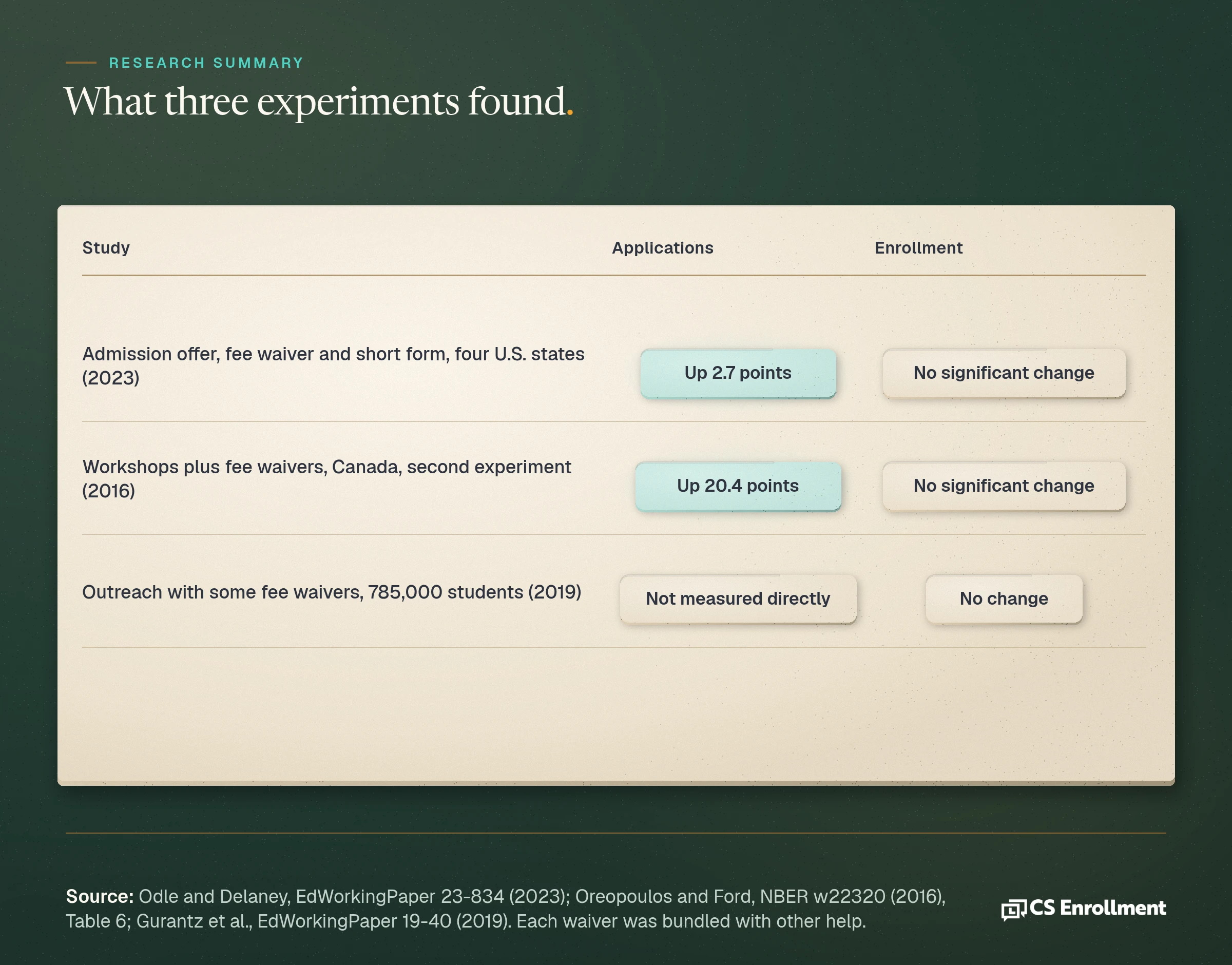
Editorial guidance: a free application lowers the cost of saying "maybe." It does not answer "can I afford it" or "do they want me." Only one of these tests raised enrollment overall, Canada's first experiment, and it also gave students a personalized list of programs they were likely to be admitted to. That points to the work after the application, not the fee itself.
Who a waiver helps, and why that changes your follow up
Applicants reporting fee waiver eligibility have grown faster than other Common App applicants, as the figures above show. They also tend to apply more widely. In Common App's 2021 to 22 data on 1,222,473 applicants (excluding students who applied only early decision), those who received a Common App fee waiver submitted 1.5 more applications than those who did not. That is a correlation. Common App offers one hypothesis: removing the cost of an application fee removes a financial disincentive to submitting more applications.
Editorial guidance: when each application costs a student nothing, each one is a lighter commitment. A free application tells you less about intent than a paid one. Measure completed applications and admits, not starts, as our post on inquiry to application conversion explains. Expect some free applications to be the first time you hear from a student at all, the pattern described in our post on stealth applicants.
If you waive the fee, plan these four things first
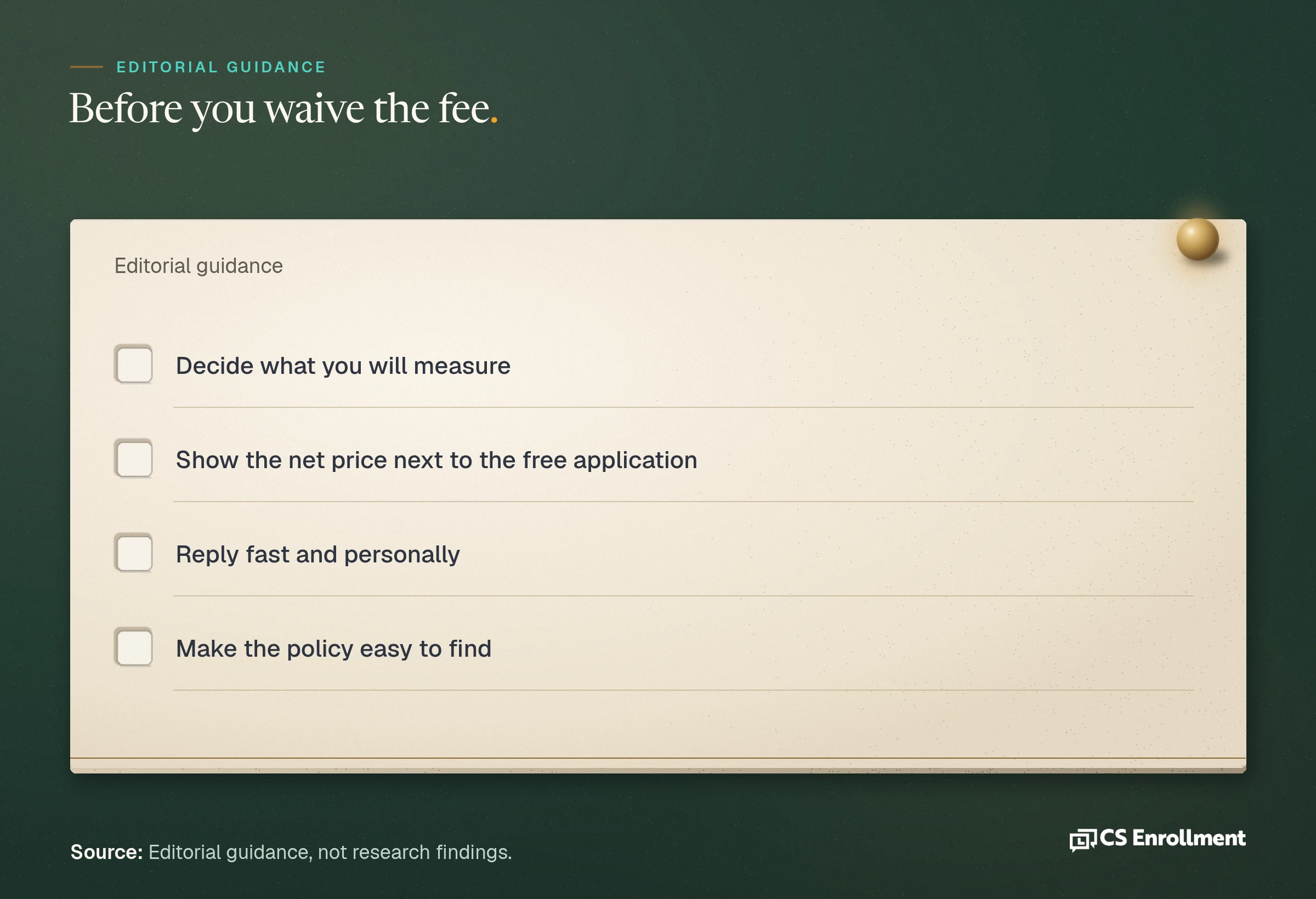
Editorial guidance:
1. Decide what you will measure. Track completed applications, admits and deposits from the waived group against the same period last year. Lost fee revenue is a real cost, so count it with the rest of your spend, as in our post on cost per enrolled student. 2. Show the net price next to the free application. The four state authors name the ability to pay as a barrier the experiment left in place. Put an honest price where the student applies, as covered in showing net price before inquiry. 3. Reply fast and personally when a free application lands. A named person, a clear next step and an answer to the cost question. Our post on the first message to prospective students covers what to say. 4. Make the policy easy to find. State the fee, the waiver rules and the deadline in plain words on your site, so search tools and AI answers repeat them correctly. See how students find colleges in AI answers.
Common App now asks colleges that charge a fee to say whether they accept its fee waiver for all students, U.S. students only or no students. Say yours plainly in the same places.
Common questions
Do application fee waivers increase applications? In the experiments we cite in four U.S. states and in Canada, packages that included a fee waiver raised application rates. Each waiver came bundled with other help.
Do application fee waivers increase enrollment? Not on their own in the experiments we found. The four state study, Canada's second experiment and the College Board campaign found no significant change in enrollment. Canada's first experiment raised enrollment when waivers came with workshops and personal guidance.
How do students get a Common App fee waiver? Students answer the fee waiver question in the profile section of their Common App, and a counselor is asked to confirm eligibility. Students can still submit without a fee while the counselor confirms.
Where messaging fits
CS Enrollment Pathways lets your team follow up on every new application in branded, verified text messaging, so a student who applied for free hears from a real person about next steps and cost while the decision is still open. For the plan from admit to deposit, see how to increase college yield.
If your next hundred applications came in free, who on your team would talk to each of those students this week?
To see how a branded conversation with a new applicant starts, request the sample walkthrough.
Sources
- Common App, Understanding application fees & fee waivers. Common App data: 700+ colleges with no application fee for U.S. students; 550K+ applicants received a Common App fee waiver in 2025 to 26; counselor confirmation.
- Common App, End of season report, 2025 to 2026: First year application trends. Common App data: 1,146 member institutions; fee waiver eligibility growth of 6% against less than 1%, and 165% against 39% since 2016 to 17.
- Common App, First-year applications per applicant: Patterns of high-volume application activity at Common App. Common App data, 2021 to 22 season, 1,222,473 applicants excluding early decision only applicants; Finding 3.
- Common App, What's new with Common App: 2026 to 27 first year app updates. webinar deck for counselors and advisors.
- Taylor Odle and Jennifer Delaney, Experimental Evidence on "Direct Admissions" from Four States: Impacts on College Application and Enrollment. Academic working paper; randomized experiment, six universities, 31,481 students.
- Philip Oreopoulos and Reuben Ford, Keeping College Options Open: A Field Experiment to Help All High School Seniors Through the College Application Process. Academic working paper, not peer reviewed. Phase II application effect: Table 6.
- Abdul Latif Jameel Poverty Action Lab, The Impact of In-School Application Support on College Application and Enrollment Rates in Canada. evaluation summary of the same study (Phase II application and enrollment results).
- Oded Gurantz, Jessica Howell, Michael Hurwitz, Cassandra Larson, Matea Pender and Brooke White, Realizing Your College Potential? Impacts of College Board's RYCP Campaign on Postsecondary Enrollment. Research by College Board staff; all six authors were College Board employees when the research was conducted. PDF: https://edworkingpapers.com/sites/default/files/ai19-40_v1.pdf.