What does a double deposit mean for a small college?
Our judgment: a second deposit means a student still has a question open. It does not tell you which one. Treat every deposit as the start of the next conversation, not the end of the last one, and find out what is still open while there is time to answer it.
A deposit is a milestone. It is not a seat you can count on in the fall. This post is for enrollment leaders at colleges of about 250 to 10,000 students who want to read next spring's deposit list more carefully.
How common are double deposits?
The newest figures come from Human Capital Education, an enrollment consultancy. Its 2026 admitted student survey is vendor research: 72,187 admitted students at 91 participating institutions responded between May and July 2026, after they had made their fall 2026 decisions. The institutions chose to take part, so this is not a random national sample.
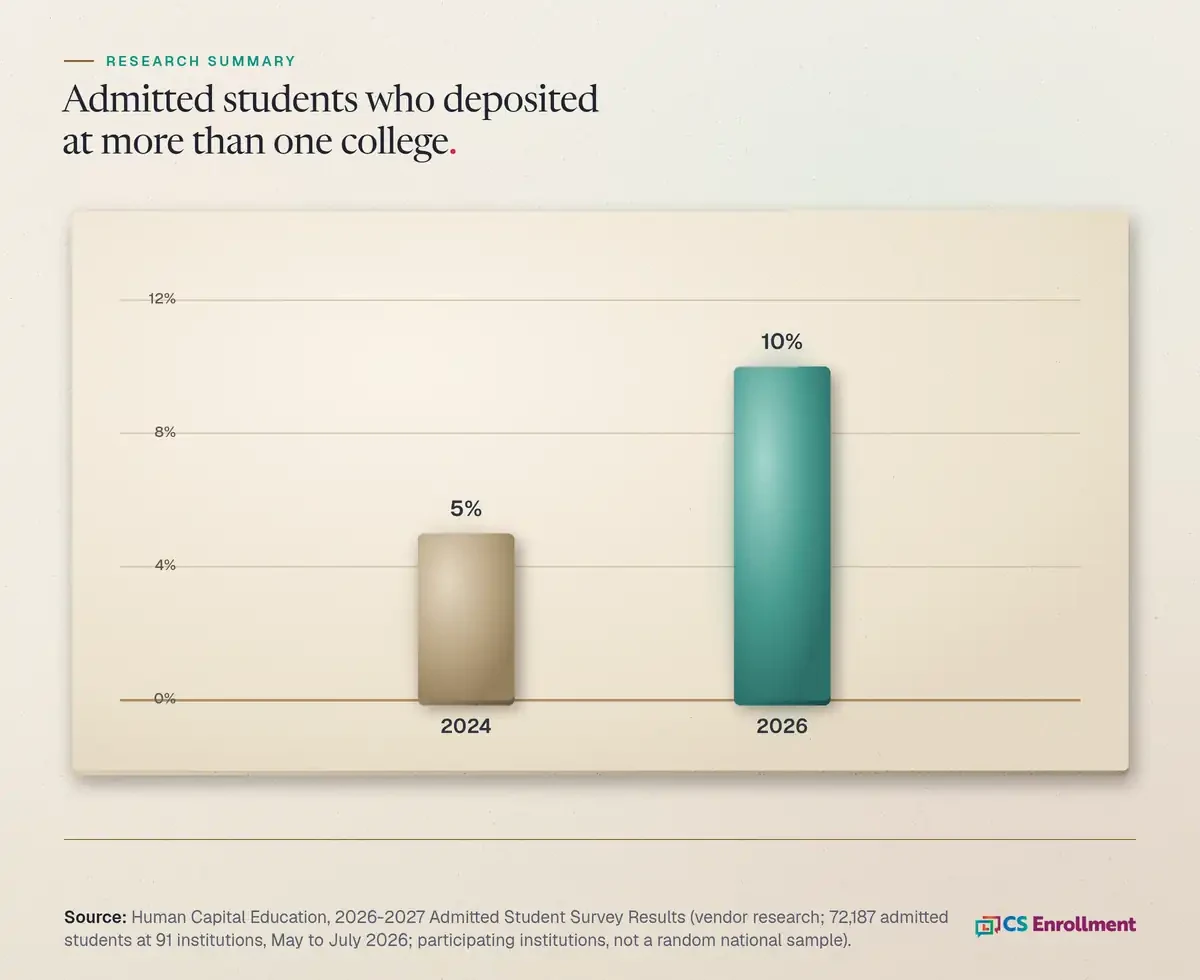
In that survey, 10% of admitted students deposited at more than one college in 2026. Human Capital reports 5% in 2024 and calls the 2026 rate double the 2024 rate. Its published results do not say whether the 2024 survey used the same questions or the same institutions.
Decisions are also running later. In the same survey, students holding out until the enrollment decision deadline day rose from 11% in 2025 to 15% in 2026. Twenty nine percent waited for their financial aid package before deciding, including 36% of first generation students. For many admits the offer comes before the decision, which is why a clear financial aid offer matters this early.
Why do students hold two deposits?
Certainty did not separate the groups in Human Capital's data. Students identified as very certain in their decision double deposited at an 11.0% rate, and uncertain students at 10.4%. Human Capital's own reading: "While a second deposit tells you another option is still open, it does not explain why."
College Board's counselor guidance lists the usual reasons a student holds two deposits: to buy time to decide between colleges that admitted them, to keep negotiating financial aid with more than one college past the May 1 decision deadline, or because they are on a waiting list somewhere else and want a seat in case it falls through.
Editorial guidance: at a small college, the open question is often cost, fit or a waitlist at another school. The deposit record cannot tell you which. A conversation with the student can.
What do the rules say about double depositing?
Two documents set the expectation, and neither one is a law.
NACAC's Guide to Ethical Practice in College Admission asks its members to educate students and families about their ethical responsibilities, including counseling students that it is unethical to "maintain an active enrollment deposit or the equivalent at more than one US college." The guide is a statement of recommendations. NACAC's older recruiting rules were abolished in September 2019, after the Justice Department identified elements of them that it considered anticompetitive.
Common App applicants affirm that they will send an enrollment deposit, or equivalent, "to only one institution," and that sending more than one "may result in the withdrawal of my admission offers from all institutions." There is one exception: a student admitted from a waitlist may deposit at the second college, provided they tell the first one they will no longer be enrolling. College Board notes that some colleges reserve the right to rescind an offer of admission if they discover a double deposit.
Our view: these rules ask students and counselors to act in good faith. They do not stop a second deposit, and a college cannot plan its class on them. A warning in your deposit confirmation does less than a person who asks what is still open. This is not legal advice.
How to read your deposit list
Editorial guidance:
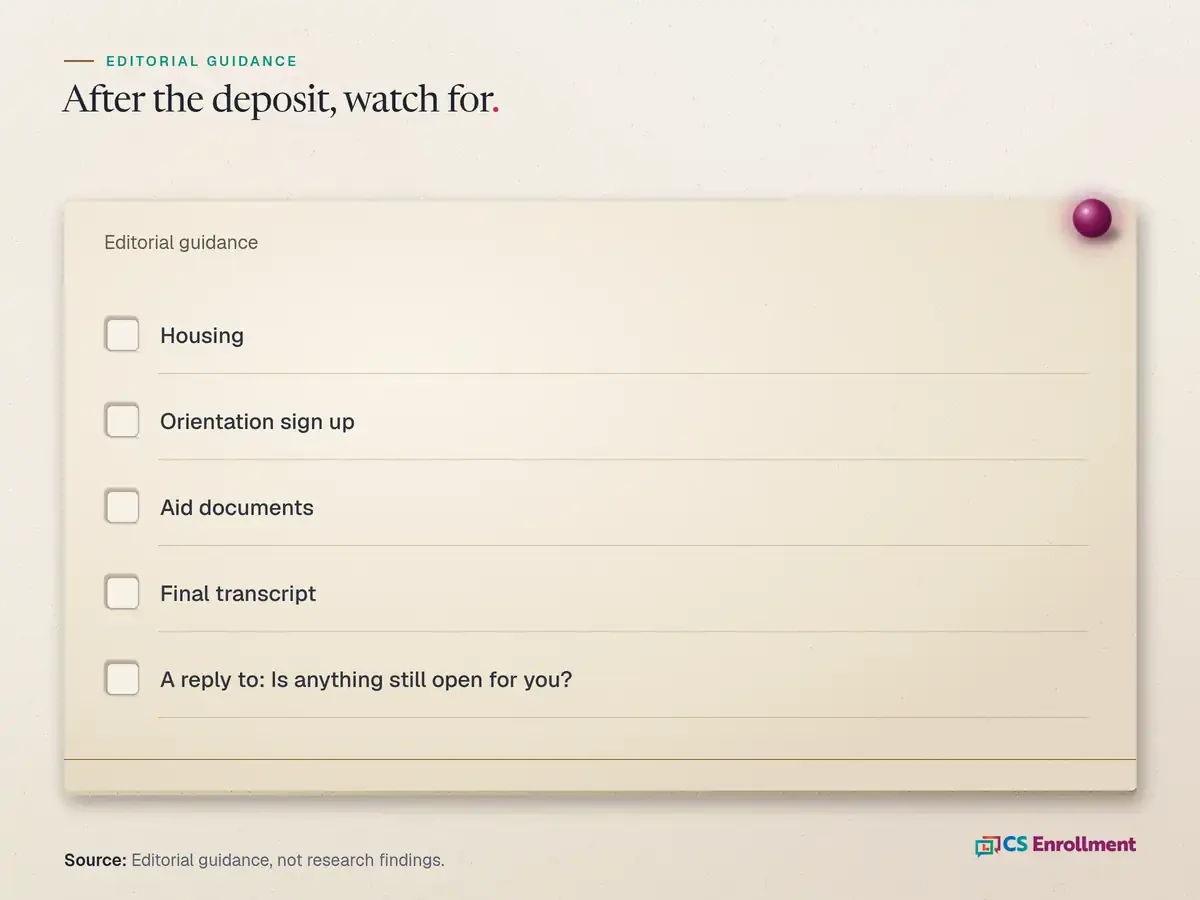
1. Count deposits, then count what happens next. Track housing forms, orientation sign up, aid documents, the final transcript and portal log ins for every deposited student. Human Capital, in a recommendation for analytics it sells, says behavior "such as portal visits, onboarding steps, and email engagement" gives "a clearer read on summer melt risk" than a ratio of deposits to enrolled students. Treat that as a vendor's view, not a finding; the records you already keep are enough to start. 2. Ask one kind question within a week of the deposit. "Is anything still open for you?" It invites an honest answer without accusing anyone. Our post on admitted student survey questions covers how to ask well. 3. Answer cost questions first and fast. See FAFSA completion and yield for the aid steps that come before the bill. 4. Bring the family in when the question is money. Our post on parent engagement in college admissions covers how. 5. Let a current student answer fit questions. In Human Capital's survey, 26% of admitted students called current students very influential in shaping how they saw a college, and 24% said the same of admissions staff. 6. Hand every deposited student to a summer plan. Our summer melt plan lays out the weeks from deposit to the first day.
Common questions
What is a double deposit? A double deposit is an enrollment deposit, or an equivalent commitment, held at more than one college at the same time.
Is double depositing allowed? NACAC's guide calls it unethical, and Common App applicants affirm they will deposit at only one college. Common App's one exception is a student admitted from a waitlist, who must tell the first college they will no longer be enrolling.
How many admitted students double deposit? In Human Capital Education's 2026 survey (vendor research, not a random national sample), 10% of admitted students deposited at more than one college, up from 5% in 2024.
Where messaging fits
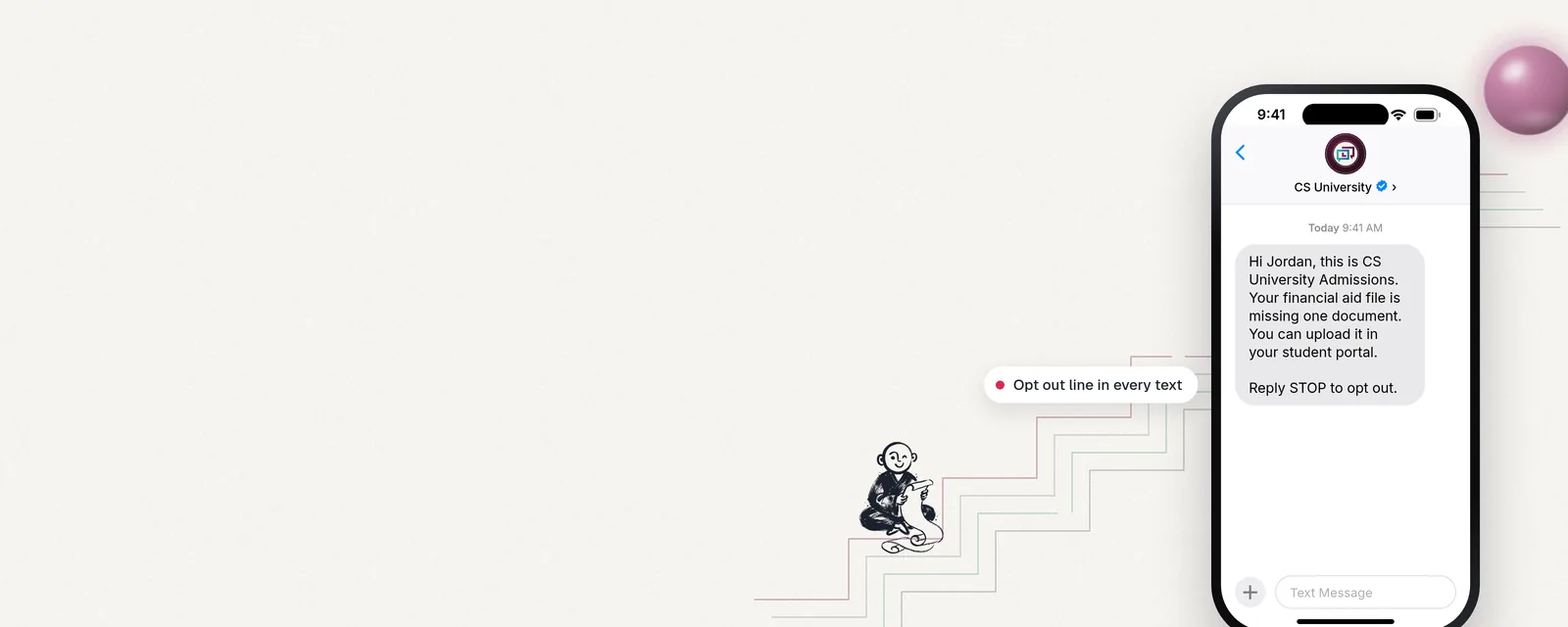
CS Enrollment Pathways lets your team check in with every deposited student in branded, verified text messaging from a sender they recognize, so the question that is still open reaches a real person at your college while there is time to answer it. A one question check in, "Is anything still open for you?", is how we start. For the work from admit to deposit that comes first, see how to increase college yield.
How many of your deposited students has anyone at your college heard from since they paid?
To see how a branded conversation with a deposited student starts, request the sample walkthrough.
Sources
- Human Capital Education, 2026-2027 Admitted Student Survey Results: Six Shifts Shaping the 2027 Class. 19, 2026). Vendor research from an enrollment consultancy: 72,187 admitted students at 91 participating institutions, May to July 2026; not a random national sample.
- NACAC, Guide to Ethical Practice in College Admission. Preamble and Article I, section B.1.b.
- Common App, Application affirmations. Deposit affirmation and waitlist note; the same wording appears in Common App's previous year affirmations: https://commonapp.my.site.com/membersupport/s/article/Previous-Year-Affirmations.
- College Board, College Application Ethics. counselor resource, Double Deposits section.