
What does Open Doors 2026 mean for a small college?
Our judgment: the drop is in new students and master's programs, not in undergraduates already here, and smaller colleges reported holding up better this fall than responding institutions overall. For 2027, start with the international students already within reach of your campus, and make sure someone answers every admitted student.
That reading draws on two releases from the Institute of International Education (IIE) on Nov. 16, 2026. It is written for enrollment leaders at colleges of about 250 to 10,000 students. The two releases measure different years and different groups of institutions, so we keep them apart below.
What did Open Doors 2026 count?
Open Doors 2026 is the full census of the 2025/26 academic year, sponsored by the U.S. Department of State and carried out by IIE. It describes last year, not this fall.
Open Doors 2026 counted 1,146,163 international students at U.S. colleges and universities in 2025/26, down 3%. In the same census, new international students, those at their college or university for the first time, fell 18% to 228,123.
The loss sat mostly in graduate study. Open Doors 2026 counted 423,078 international graduate students in 2025/26, down 13%, a decline it says was driven mainly by master's students (down 22%). Doctoral students rose 3%.
Undergraduates held about level. In IIE's words, undergraduate enrollments "remained stable at 356,165 students, with a modest 0.3% decline." Participation in Optional Practical Training (OPT) rose 14% to 335,785 in 2025/26.
What does this fall look like?
IIE's Fall 2026 Snapshot is a preliminary survey of 809 responding U.S. institutions, collected Oct. 1 to 20, 2026, a subset of the nearly 3,000 institutions surveyed each year for Open Doors. The figures are reported by the institutions themselves, and they describe fall 2026.
Respondent institutions in the Snapshot report total international students down 9%, a figure that includes students on OPT. The same respondents report new international students down 15%.
By level, Snapshot respondents report undergraduates down 3%, graduate students down 15% and OPT down 6%.
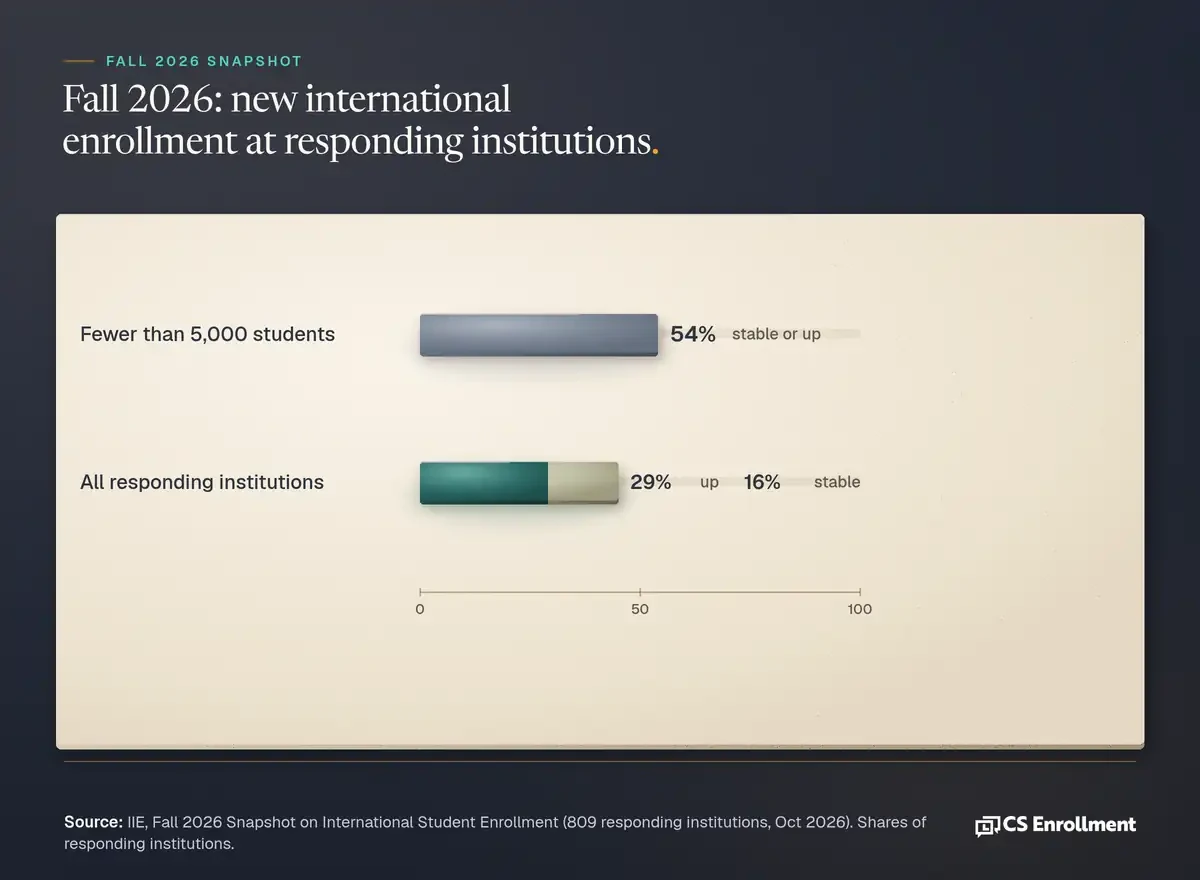
The Snapshot also reports how many institutions moved each way. In fall 2026, 29% of responding colleges and universities report an increase in new international enrollment, 16% report stability and 56% report a decrease (IIE's rounded figures).
Editorial note: the census and the Snapshot cover different years and different sets of institutions. Read them as two separate pictures, not as one trend line.
Smaller colleges held up better this fall
The Snapshot's size split speaks directly to our readers. In the Snapshot, 54% of responding institutions with fewer than 5,000 students report stable or increasing new international enrollment this fall.
That is a higher share than across all responding institutions, where 29% report an increase in new international enrollment and 16% report stability.
These are shares of responding institutions, not counts of students. They do not show that small colleges as a group grew.
Editorial guidance: a college with a master's program should read its graduate and undergraduate international numbers separately. The census decline was concentrated in master's study, so a small college that held steady in undergraduate enrollment can still be losing graduate students. For this fall's other surveys and an offer to arrival checklist, see our post on international student enrollment in 2026.
Where institutions that grew found new students
The Snapshot asked institutions that reported more new international students what contributed, and they could name more than one factor. Athletics was cited by 53%, recruitment efforts by 51% and outreach to admitted students by 44%.
IIE notes that athletics mattered particularly at smaller institutions, and that coaches play an important role in recruiting international students for their teams. IIE describes admitted student outreach as "answering questions, providing guidance, and maintaining communication throughout the enrollment process."
These are factors institutions credited, not proven causes. The survey does not test whether any of them produced growth.
Athletics needs a careful reading. Coaches recruiting for teams a college already fields is a different decision from adding a sport, which our post on adding football covers.
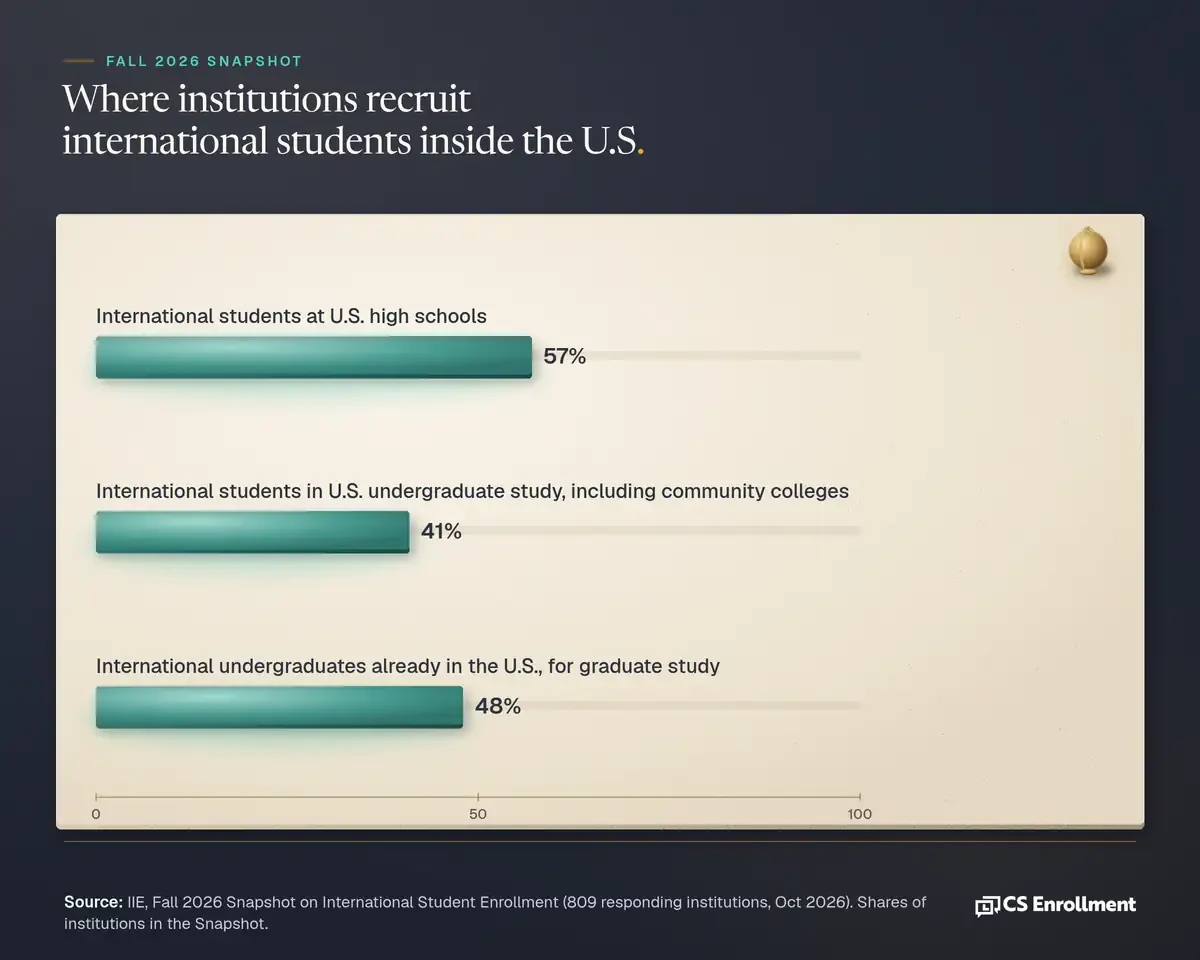
The Snapshot also asked about international students who are already in the United States. These figures cover responding institutions in general, not only those that grew. In the Snapshot, 57% of institutions recruit international students enrolled in U.S. high schools. 41% recruit international students already in U.S. undergraduate study, including at community colleges. 48% recruit international undergraduates already in the U.S. for graduate study.
Our take: start with the students already within reach
Editorial guidance for a small college building its 2027 international list. These steps are our judgment, not findings, and we make no claim that any of them raises enrollment.
1. Start with your own undergraduates. Your current international undergraduates are the first list for your master's programs. Ask who in graduate admissions talks to them before their final year. 2. Look at community colleges near you. International students at nearby community colleges are transfer prospects. Ask your transfer team who owns them. 3. Treat high schools as a domestic visit. U.S. high schools with international students belong on the same map as the rest of your recruiting travel. Our post on how far students travel for college covers building that map. 4. Connect coaches with admissions and aid. Coaches already recruit internationally. Make sure each recruit also hears from admissions and financial aid, not only from the coach. 5. Give every admit a person who answers. Every admitted international student should have a named person at the college who replies. The guide to increasing college yield covers the work from admit to deposit.
Common questions
What did Open Doors 2026 find? Open Doors 2026 counted 1,146,163 international students at U.S. colleges and universities in the 2025/26 academic year, down 3%. New international students fell 18%.
Is international enrollment down in fall 2026? Respondent institutions in IIE's Fall 2026 Snapshot report total international students down 9% and new international students down 15%.
Are small colleges losing international students too? In the Snapshot, 54% of responding institutions with fewer than 5,000 students reported new international enrollment stable or up this fall.
Where messaging fits
CS Enrollment Pathways helps an admissions team keep answering admitted students in branded, verified text messaging from a sender they recognize, so a question about the next step reaches a real person at the college.
How many international students are already within an hour of your campus, and has anyone from your college talked to them this fall?
To see how a branded conversation with an admitted student starts, request the sample walkthrough.
Sources
- Institute of International Education, U.S. Colleges and Universities Host 1.1M International Students in 2025-2026 School Year. 16, 2026. Full census of the 2025/26 academic year: 1,146,163 international students, down 3%; new students down 18% to 228,123; graduate students 423,078, down 13%, master's down 22%, doctoral up 3%; undergraduates 356,165, down 0.3%; OPT up 14% to 335,785. Web version: https://www.iie.org/news/u-s-colleges-and-universities-host-1-1m-international-students-in-2025-2026-school-year/.
- Institute of International Education, Fall 2026 Snapshot on International Student Enrollment: Key Findings. Preliminary, institution reported survey of 809 U.S. institutions, fall 2026: total down 9% including OPT; new down 15%; undergraduate down 3%; graduate down 15%; OPT down 6%; growth factors 51%, 44% and 53%; 57% and 48%.
- Julie Baer and Sumeyra Ekin, Fall 2026 Snapshot on International Student Enrollment. Full report: methodology (809 valid responses, Oct. 1 to 20, 2026, subset of nearly 3,000 Open Doors institutions), p. 3; 29%, 16% and 56%, and the 54% size split, p. 6; growth factors and admitted student outreach, pp. 7 to 8; recruiting inside the U.S. (57%, 41%, 48%), pp. 12 to 13.