
What is an enrollment deposit, and why does it matter more than its size?
An enrollment deposit is how a college confirms that an admitted student plans to enroll. NACAC's Guide to Ethical Practice in College Admission defines enrollment deposits as "the fees or written commitments that confirm a student's intention to enroll," and says they may also be called tuition deposits or enrollment fees. A housing deposit, which holds a place in campus housing, is a separate charge.
The short answer for a small college: the deposit is a policy you set, so set it on purpose. Post the amount, the deadline, the refund rule and the waiver route on a public page before students apply. Repeat them in the offer, and make the waiver a quick request, not an appeal.
Our view: a few hundred dollars due within weeks is a small line in a college budget and can be a hard one for a family. For context, in the Federal Reserve's 2025 survey of household finances, 63% of adults said they would cover a $400 emergency expense with cash or its equivalent, so 37% would not, and 12% said they could not pay it by any means. The survey covers all U.S. adults, not students or parents (12,934 respondents, fielded October 2025, released May 2026).
How often do colleges tell students about the deposit up front?
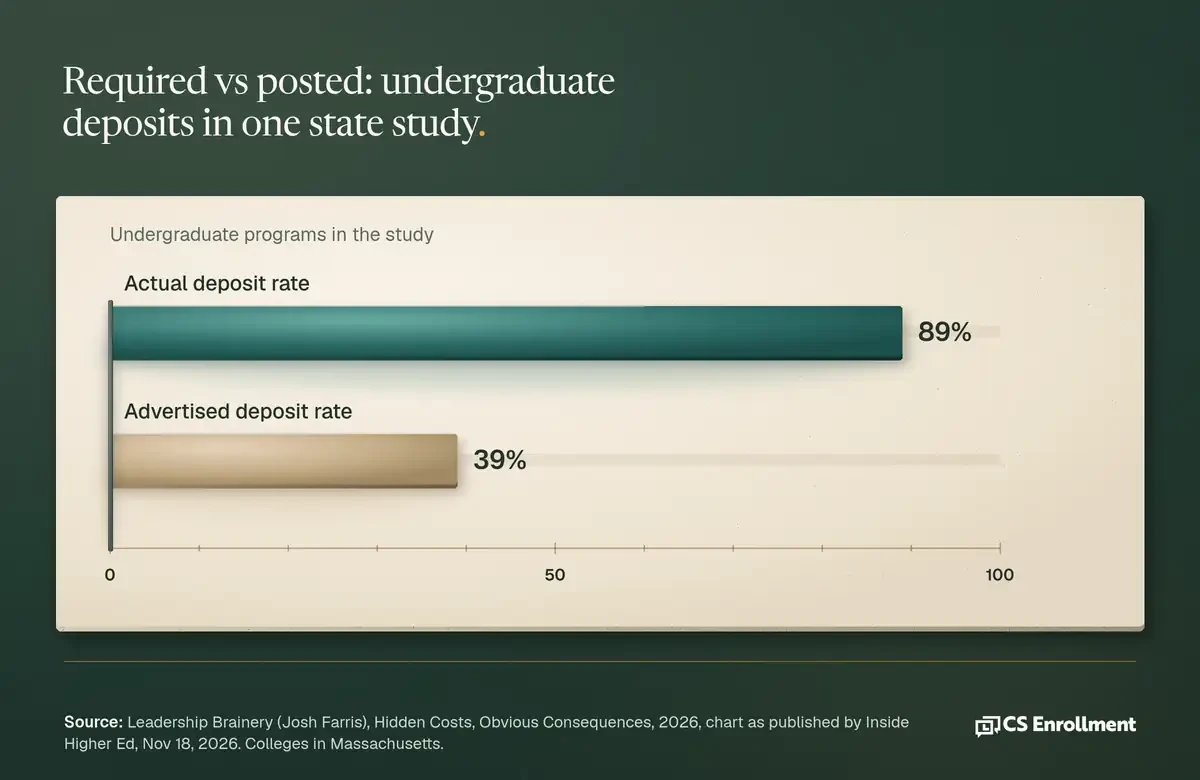
A 2026 study by Leadership Brainery, a nonprofit, examined enrollment deposit requirements at colleges and universities in Massachusetts, using federal data, college websites and direct contact with admissions offices. The study's author, Josh Farris, summarized it in an Inside Higher Ed opinion essay on November 18, 2026. He wrote that "there is a transparency gap across nearly every degree program, including undergraduate programs."
The study's chart, as published by Inside Higher Ed, shows an actual deposit rate of 89% for undergraduate programs in the study against an advertised deposit rate of 39%.
On amounts, Farris wrote that "for undergraduate students, deposits typically fall in the low hundreds." The study's landing page reports that deposits average $209 at public institutions and more than $578 at private institutions. It does not say those averages are limited to undergraduate programs.
These figures come from one state and the study author's own summary; the full report is gated and its sample size is not in hand. They show what one study found, not how every college handles its deposit.
Should a small college require an enrollment deposit at all?
Our take. A deposit gives a college an early count of committed students for housing, course sections and aid planning. It also puts a cost in front of a student at the moment of decision.
There are other ways to get that count. Some colleges use a written or online commitment with no fee. Some keep a deposit but waive it automatically for students with financial need. Others credit the deposit to the first bill. We are not endorsing one.
A deposit also does not stop a student from holding a place at two colleges; see our post on double deposits.
Timing: when should the deposit be due?
NACAC's Guide says colleges "should use the widely recognized date of May 1 as the earliest enrollment confirmation deadline" for first year students entering in the fall. By then, students should have had time to hear about aid and scholarships, honors and other special programs, and housing. Binding Early Decision plans and athletic scholarship recipients are the recognized exceptions. For Early Decision, NACAC says colleges should respond to an aid application "before a deposit is required." It also says no deposit or fee should be required to stay on a wait list.
These are recommendations, not law; the Guide calls itself "a statement of recommendations."
Our reading: a deposit due before the aid offer arrives asks a family to commit before it knows the price. In Human Capital Education's 2026 to 2027 admitted student survey (vendor research; 72,187 admitted students at 91 participating institutions responded, May to July 2026), 29% of students waited for their financial aid package before deciding, including 36% of first generation students. See our post on the clear financial aid offer.
What to put on the page, and in the offer
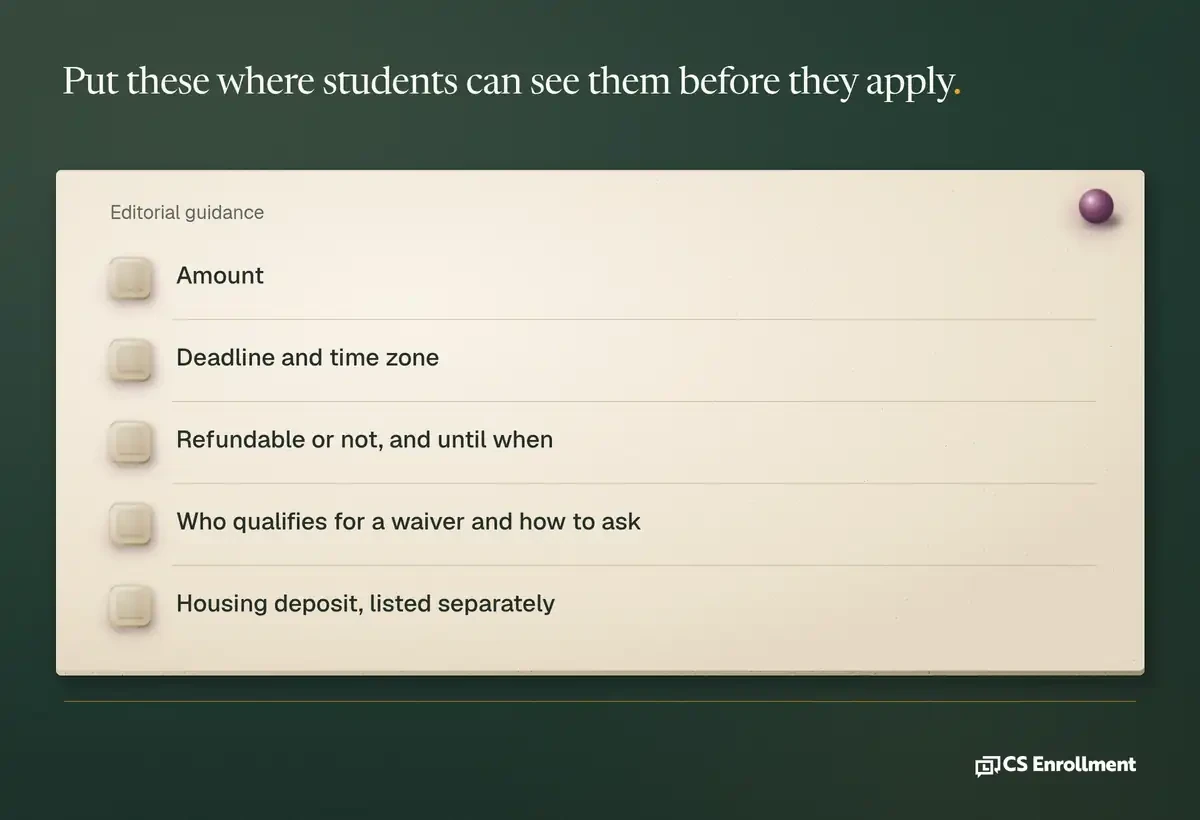
Editorial guidance. Farris recommends that colleges "clearly disclose deposit requirements, amounts, deadlines and refund policies on publicly accessible admissions pages." A practical version:
1. The amount, and whether it is credited to the first bill. 2. The deadline, with the time zone. NACAC asks colleges that set deadlines to say how they are measured, including the time for anything sent electronically. 3. Whether it is refundable, and until when. NACAC: "Offers of admission should state if the deposit is refundable or non-refundable." 4. Who qualifies for a waiver or a later due date, and how to ask. One short form or one reply, not an essay. Farris recommends that students with demonstrated financial need be eligible for deposit waivers. 5. The housing deposit, listed separately, if there is one.
Put the list on a public admissions or cost page students can find before they apply, in the offer itself, and in the first message after admission. Our post on showing net price before inquiry explains why cost information belongs early.
What to do when an admitted student goes quiet before the deadline
Editorial guidance. Before the deadline, have a person reach out with the amount, the date and the waiver route, and ask one question: "Is anything about the deposit holding you up?" We are not claiming this raises deposits.
For the full plan, see how to increase college yield and, after the deposit, how to reduce summer melt.
Common questions
What is a college enrollment deposit? A fee or written commitment that confirms a student plans to enroll, in NACAC's definition. A housing deposit is separate.
Is a college enrollment deposit refundable? It depends on the college. NACAC recommends that offers of admission say whether it is. Check the offer and ask before paying.
How much is a college enrollment deposit? Amounts vary. In one 2026 study of colleges and universities in Massachusetts, undergraduate deposits "typically fall in the low hundreds," the author wrote. The study's page reports averages of $209 at public institutions and more than $578 at private institutions; it does not say those averages are limited to undergraduate programs.
Can a college waive the enrollment deposit? Policies vary, so ask. The study's author recommends waivers for students with demonstrated financial need.
When is the enrollment deposit due? NACAC recommends May 1 as the earliest confirmation deadline for first year fall admission, with binding Early Decision and athletic scholarships as exceptions.
Where messaging fits
CS Enrollment Pathways lets your team send admitted students a branded, verified text message from a sender they recognize, so the deposit amount, deadline and waiver route reach them before the deadline, with a real person to reply to. A one question check in is how we start. Message only admitted students who have agreed to hear from you.
Could an admitted student find your deposit amount, deadline and waiver rule before they applied?
To see how a branded conversation with an admitted student starts, request the sample walkthrough.
Sources
- Josh Farris, Enrollment Deposits a Hidden Barrier (opinion). Opinion essay by the study's author, with the study's charts.
- Leadership Brainery, Hidden Costs, Obvious Consequences: Enrollment Deposits and Access to (Graduate) Higher Education. Nonprofit research on colleges and universities in Massachusetts; study landing page.
- NACAC, Guide to Ethical Practice in College Admission. Association recommendations.
- Board of Governors of the Federal Reserve System, Economic Well-Being of U.S. Households in 2025.
- Human Capital Education, 2026-2027 Admitted Student Survey Results. Vendor research.