What the 2026 Some College, No Credential report found
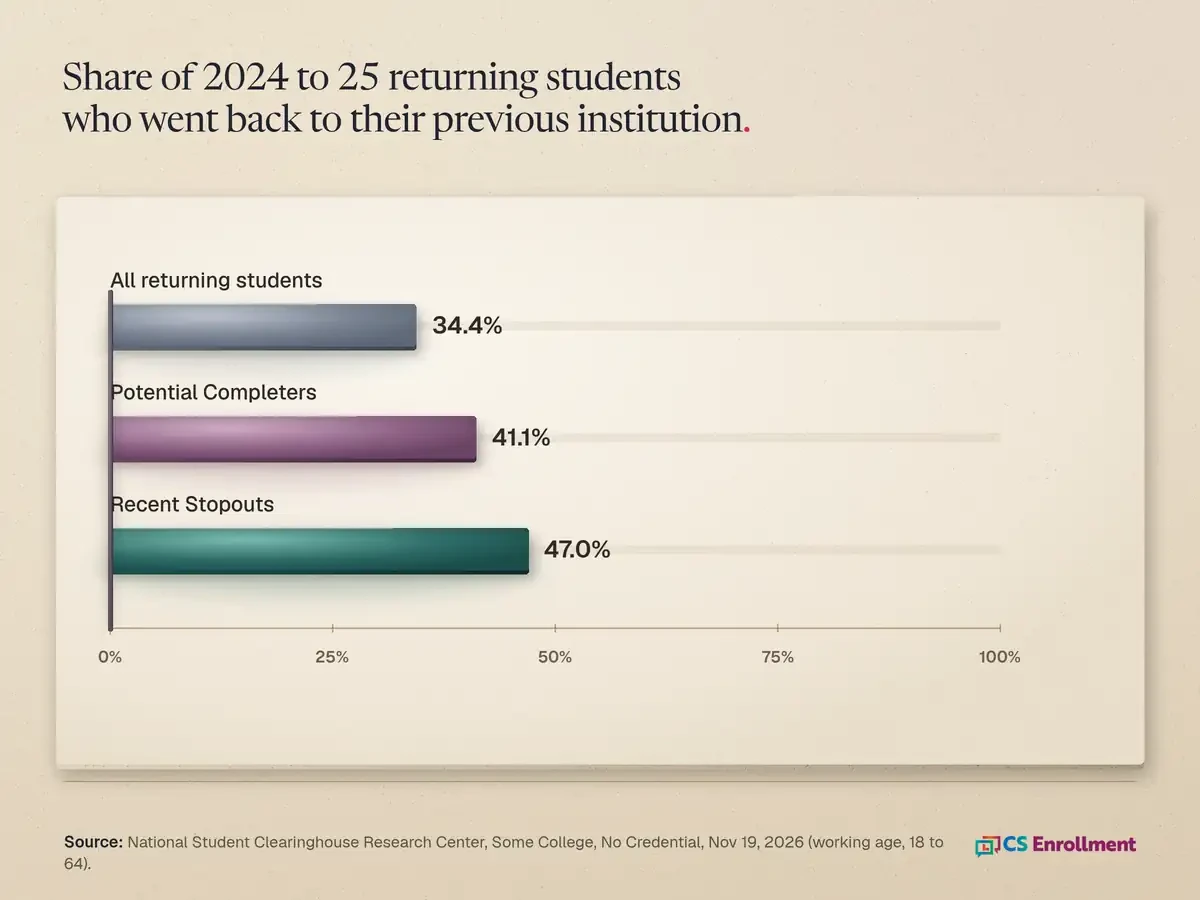
National Student Clearinghouse Research Center data released November 19, 2026, count 37.77 million working age adults, ages 18 to 64, with some college and no credential. That is up about 500,000, or 1.3%, from the start of the previous academic year. In 2024 to 25, 1.03 million of them went back to college. Just over one third of those returning students (34.4%) went back to the institution they had left. Most enrolled somewhere else.
The counts are as of the start of the 2024 to 25 academic year. They come from the Clearinghouse's own enrollment records, not a survey, so they show who came back and where, but not why. The Clearinghouse counts someone in this group after a long break from enrollment with no degree or certificate earned. Its fall enrollment counts are a separate report, covered in our post on fall 2026 enrollment.
The number of returning students rose 3.4% to 1.03 million. The share of the population that returned stayed at 2.7%, a rate the report says "has been steady for three years."
The newest group shrank. About 1.94 million working age adults were Recent Stopouts, the Clearinghouse's term for the most recent leavers. That is about 154,000 fewer than the year before, or 7.3% fewer.
Most returning adults choose a different school
The Clearinghouse reports that most people who returned in 2024 to 25 did so at a different institution from the one they last attended. Just over one third of returning students (34.4%) went back to their previous institution.
Two groups were more likely to go back to the school they left. Recent Stopouts returned to their previous institution at 47.0%. Potential Completers, the Clearinghouse's term for stopped out adults who had already completed a substantial amount of college, did so at 41.1%.
Among those who changed institutions when they returned in 2024 to 25, 67.4% also changed sectors, meaning they moved to a different type of institution. The report names public two year colleges as the most common destination for students coming from almost every sector, and it describes primarily online institutions as "an important destination" for students changing institutions. It does not say why people switch, and this post does not guess.
Our reading: a former student who comes back is choosing a college again. The school they left is competing for them like any other, alongside schools built around convenience. It does not hold them by default, though the recent leavers and the students closest to finishing were more likely to return to it.
The students closest to finishing come back more often
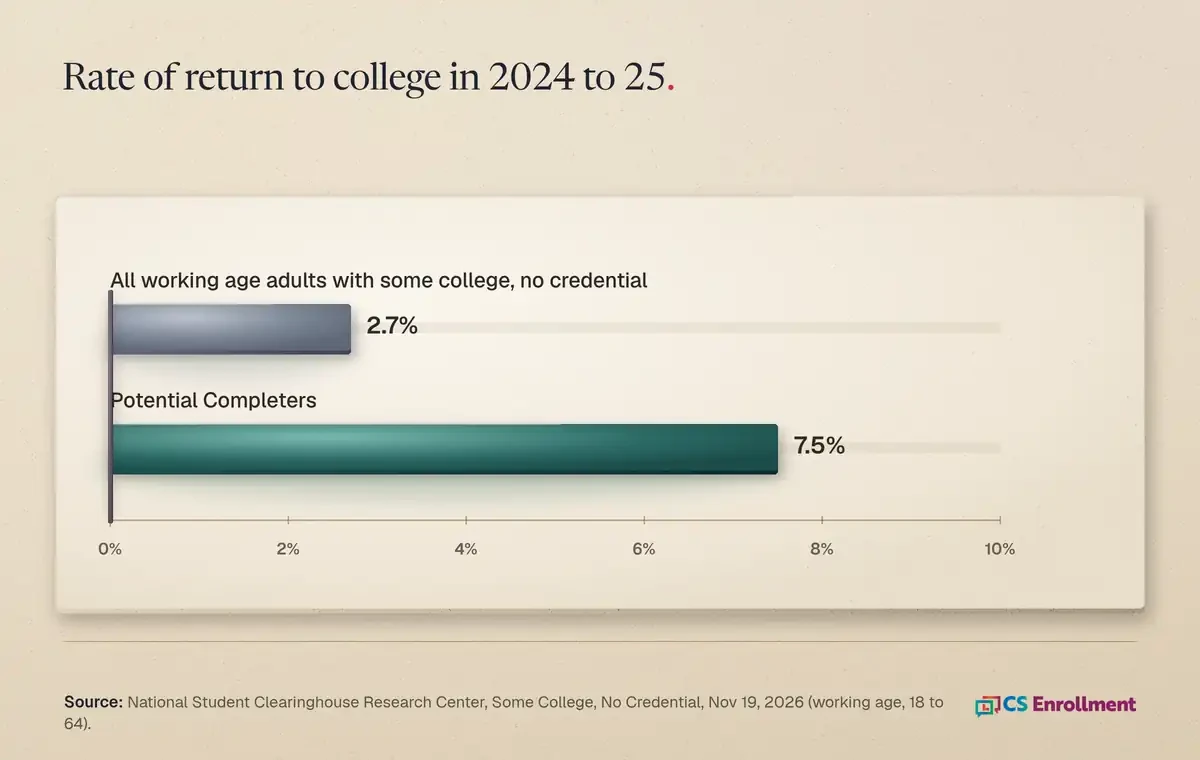
Potential Completers make up 6.8% of the working age population with some college and no credential. They returned to college at a rate of 7.5%, compared with 2.7% for that population overall.
Our reading: your registrar can approximate this group in your own records. Look for former students with substantial credits and no degree who left in recent years. That list is the one to start with. It is an approximation, because the Clearinghouse measure uses enrollment across all institutions, which a single college cannot fully see.
Coming back is the first step. Staying is the second
The report also follows returning students past their first year back, including whether they keep enrolling and whether they earn a credential. Among students who returned in 2023 to 24 and did not earn a credential that year, nearly 574,000 (60.1%) continued their enrollment into 2024 to 25. For a college, that means the plan for a returning adult has to include the second term, not only the first. The adviser who helped them come back, the schedule that made the first term possible and the bill for the next one all matter again a few months later. Our post on retention and enrollment accountability covers who owns that handoff.
Our take: what a small college should do with its own former students
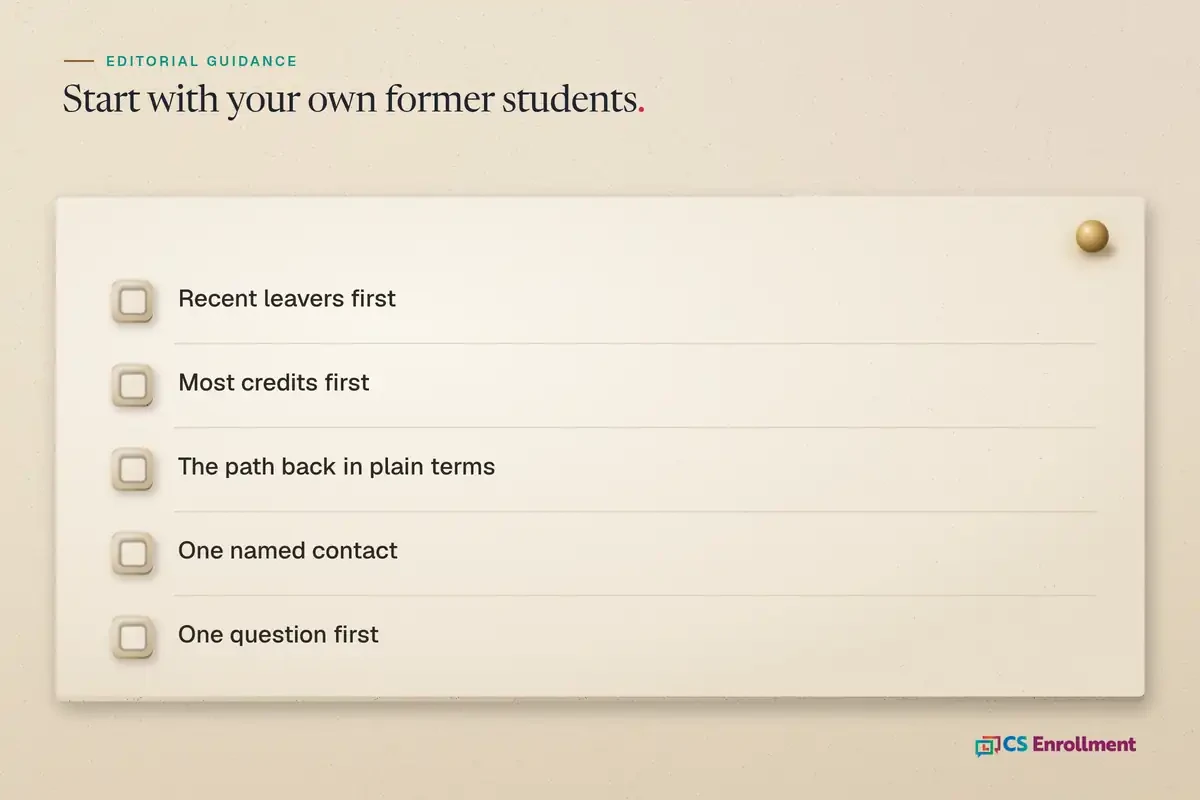
Editorial guidance. For a college of a few hundred to a few thousand students, the warmest part of this pool is its own former students, especially recent ones and those close to finishing. The school that reaches them first with a clear path back has an edge it should not leave to others.
1. Pull the list. Ask your registrar for former students with no degree who left in the last few years. Flag those with the most credits. Start with the most recent leavers, the group most likely to return to the school they left. 2. Lead with the path back in plain terms. Say which credits count, how many terms are left, what it costs this year and who their one contact is. Our adult learner recruitment post covers the broader adult playbook. 3. Write the first message as a person, with one question. For example: "What would make finishing possible this year?" Our post on the first message to prospective students covers tone and timing. 4. Ask first, then route by the answer. Cost goes to financial aid, schedule to an adviser, credits to the registrar, and something at home to a person who can talk it through. 5. Message only people who have agreed to hear from you. Our post on the FCC text opt out rule covers consent and opt outs.
Common questions
How many Americans have some college and no credential? National Student Clearinghouse Research Center data count 37.77 million working age adults, ages 18 to 64, as of the start of the 2024 to 25 academic year. The report was released November 19, 2026.
How many stopped out students go back to college? In 2024 to 25, 1.03 million returned, up 3.4%. That is a rate of 2.7%, which the report says has been steady for three years.
Do students who come back return to the same college? Most do not. Just over one third (34.4%) returned to their previous institution. The shares were higher for Recent Stopouts (47.0%) and Potential Completers (41.1%).
What is a Potential Completer? The Clearinghouse's term for a stopped out adult who had already completed at least two years of full time equivalent enrollment in the past ten years. Potential Completers are 6.8% of the working age pool and returned at 7.5%.
Where messaging fits
CS Enrollment Pathways lets your team reach former students in branded, verified text messaging from your college's name, so they see who is writing before they open it, and a real person can answer the question that decides whether they come back. A one question start, "What would make finishing possible this year?", is how we work.
How many of your former students with two years of credits have heard from a person at your college since they left?
To see how a branded conversation with a former student can start, request the sample walkthrough.
Sources
- National Student Clearinghouse Research Center, Some College, No Credential: 2026 Report for the Nation and the States. National Student Clearinghouse Research Center data: working age adults, 18 to 64, as of the start of the 2024 to 25 academic year. Highlights; Re-Enrollment and Student Outcomes; Re-Enrollment Pathways.
- National Student Clearinghouse Research Center, Some College, No Credential 2026 Methodological Notes. Definitions of the stopout period and Potential Completers, page 2.