The short answer: a small college competes for community college transfers on clarity and speed, not size. Tell students which credits count before they apply, list the colleges you have agreements with, give each transfer one named person, and plan the first year after transfer, not only the admit. The numbers below show how large the pool is and where it goes.
How many students transfer, and where do they go?
National Student Clearinghouse Research Center data show that transfer enrollment grew 4.4% (+50,600) in fall 2024. Transfers were 13.1% of all continuing and returning undergraduates that fall. In fall 2024, nearly 500,000 students moved from a two year to a four year institution.
A growing share of all transfer students are coming back after a break. Returning transfer students, those who stopped out for at least one semester and last enrolled at a different institution, became the majority of transfers: 52.0% in fall 2024. The fall 2024 figures come from a five year fixed panel of institutions (fall 2020 to fall 2024) covering about 11 million students at about 83% of institutions that participate in the Clearinghouse.
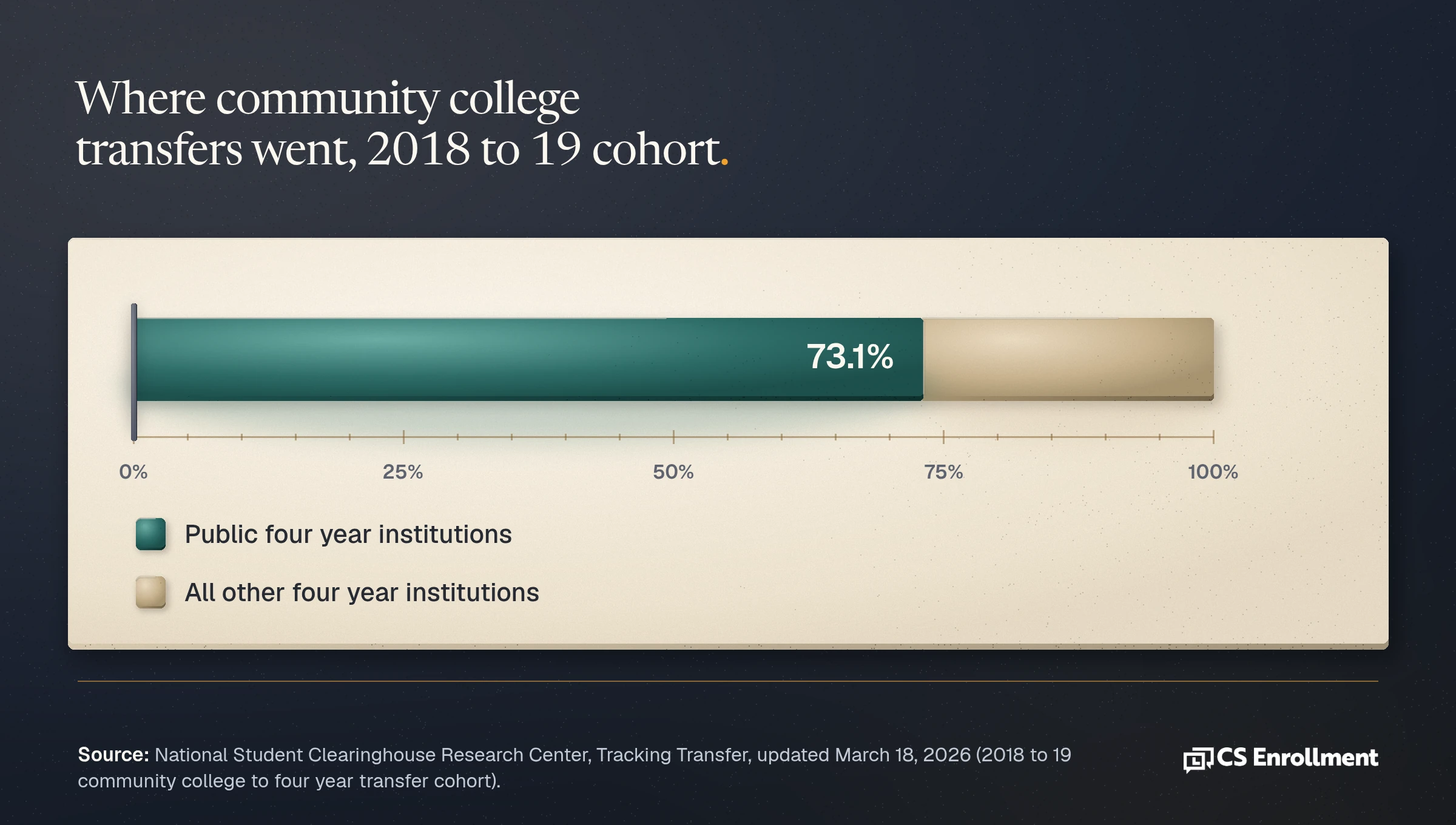
Where they land is just as clear. In the 2018 to 19 academic year, about 480,000 students transferred from a community college to a four year institution. Most of them, 73.1%, attended a public four year institution, according to the Clearinghouse's Tracking Transfer series. Only 7.7% went to a highly selective institution, one that admits fewer than half of its freshman applicants.
Our reading: the pool is large, and most community college transfers go to public four year institutions. A small private college that recruits transfers is choosing to compete for them, and a clear offer matters more than a big one.
Who finishes after transferring?
After transferring from a community college, 81.8% of the 2018 to 19 cohort continued at their transfer institution the next academic year. For students who had earned an award, such as an associate degree or certificate, before transferring, the rate was 86.9%, 9.2 points higher than for those who transferred without one. Forty four percent of the cohort arrived with an award.
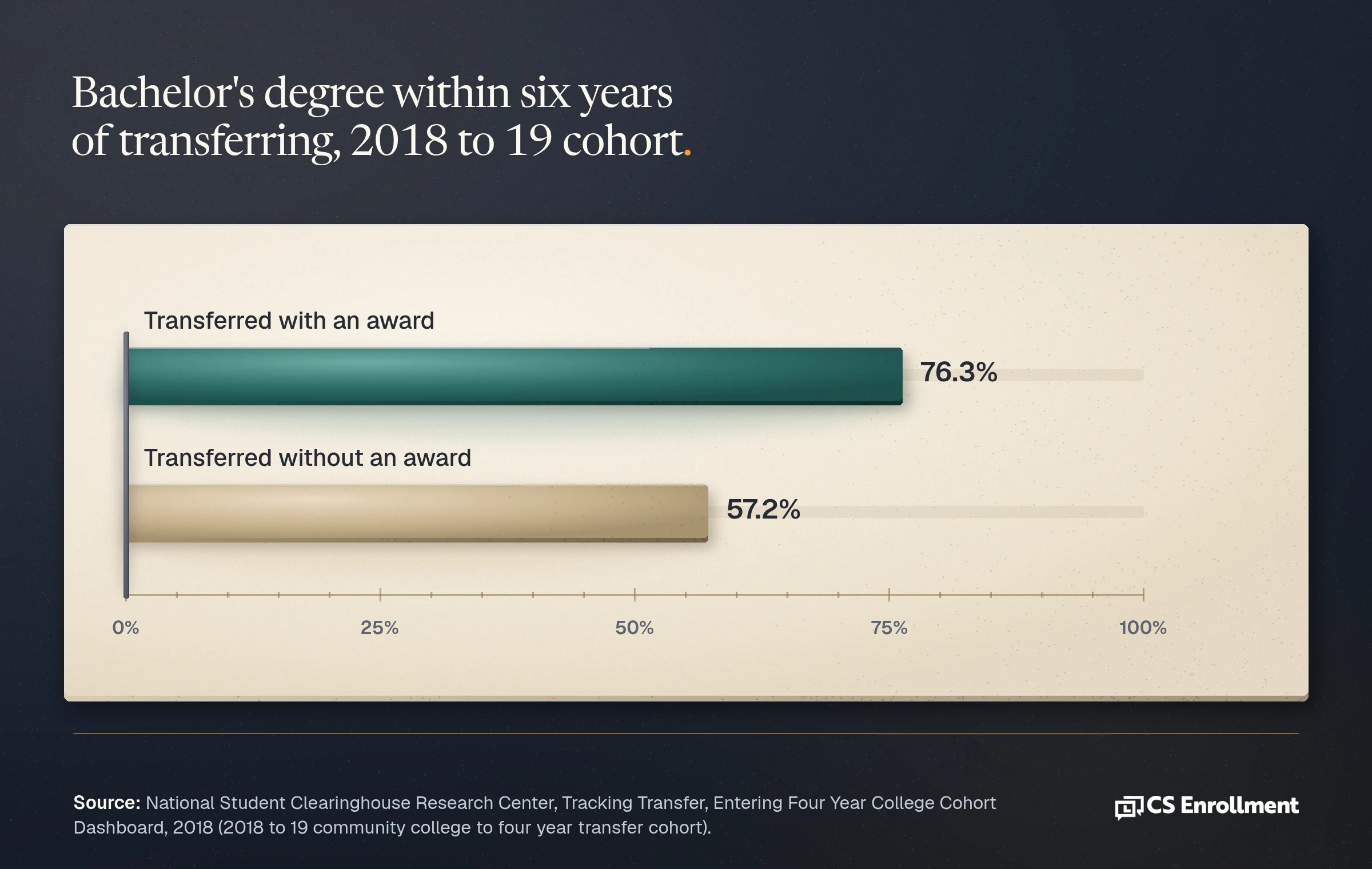
About two thirds, 65.7%, earned a bachelor's degree within six years of transferring, more than 315,000 students. Fewer than one in six, 15.3%, finished within two years. Six year bachelor's completion was 76.3% for students who transferred with an award, compared with 57.2% for those without one.
The Clearinghouse reports these differences but not their causes, and this post does not guess at them. Our reading: the first year after transfer deserves its own plan, with someone who owns it. Our post on retention and enrollment accountability covers who should own that handoff.
What happens to transfer credits
The federal estimate of credit loss is older, so read it as context. A 2017 report from the U.S. Government Accountability Office (GAO) estimated that students who transferred from 2004 to 2009, across all types of colleges, lost, on average, an estimated 43 percent of their credits. Students who transferred between public schools lost an estimated 37 percent.
In the same report, GAO reviewed a nationally representative sample of 214 school websites in 2016 and 2017. It estimated that about 29 percent of websites with credit transfer information did not include a list of other schools with which the school had articulation agreements. GAO recommended that the Department of Education require colleges to post that list online, or say plainly when they have no agreements. The Department later strongly recommended this to colleges in its Federal Student Aid handbook guidance.
Our reading: a student weighing two colleges wants to know how many terms are left. The college that answers that first, in writing, is easier to choose.
What a small college can do this cycle
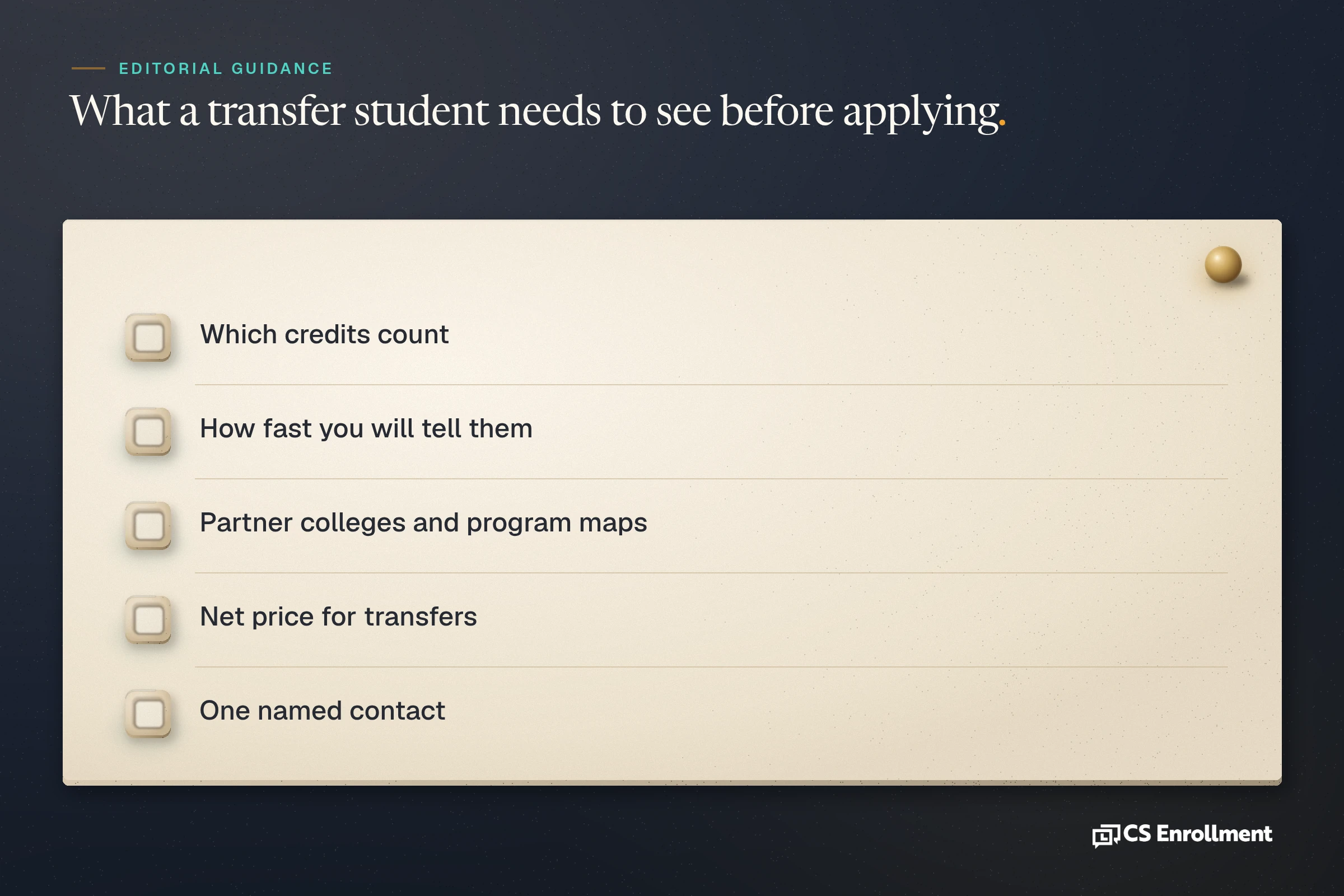
Editorial guidance. None of these steps is a promise of more transfer applications. They make your offer easier to understand.
1. Publish a real transfer page. Say how credits are evaluated, how fast, and who decides. List your partner colleges and program maps, or say plainly that you have none. 2. Offer an unofficial credit review before the application. Pick a turnaround you can keep and print it on the page. 3. Build two or three agreements with nearby community colleges. Start with programs that have room. Our post on how far students travel for college explains why nearby partners matter. 4. Help students near an associate degree weigh finishing it first. The Clearinghouse figures above show higher retention and completion for students who transferred with an award, though they do not show that the award caused it. 5. Show the net price for a transfer student early. Include transfer scholarships. Our post on showing net price before inquiry covers how. 6. Give each admitted transfer one named contact and a first term plan.
The first message to a transfer prospect
Editorial guidance. The first message should come from a person and ask one question, for example: "How many credits are you bringing, and what do you want to finish?" Then reply within days, not weeks. A transfer student often has a transcript in hand and a short list of colleges, so the useful answer is a specific one. Our post on the first message to prospective students covers tone and timing.
Common questions
How many students transfer from community college to a four year college? National Student Clearinghouse Research Center data show nearly 500,000 students moved from a two year to a four year institution in fall 2024, based on a five year fixed panel of institutions.
Where do most community college transfers go? In the 2018 to 19 transfer cohort, 73.1% attended a public four year institution, according to the Clearinghouse's Tracking Transfer series.
Do transfer students graduate? In the 2018 to 19 cohort, 65.7% earned a bachelor's degree within six years of transferring. For students who transferred with an award, the rate was 76.3%.
How many credits do transfer students lose? A 2017 GAO report estimated that students who transferred from 2004 to 2009 lost an estimated 43 percent of their credits on average. The data are older, and the loss varied by transfer path.
Where messaging fits
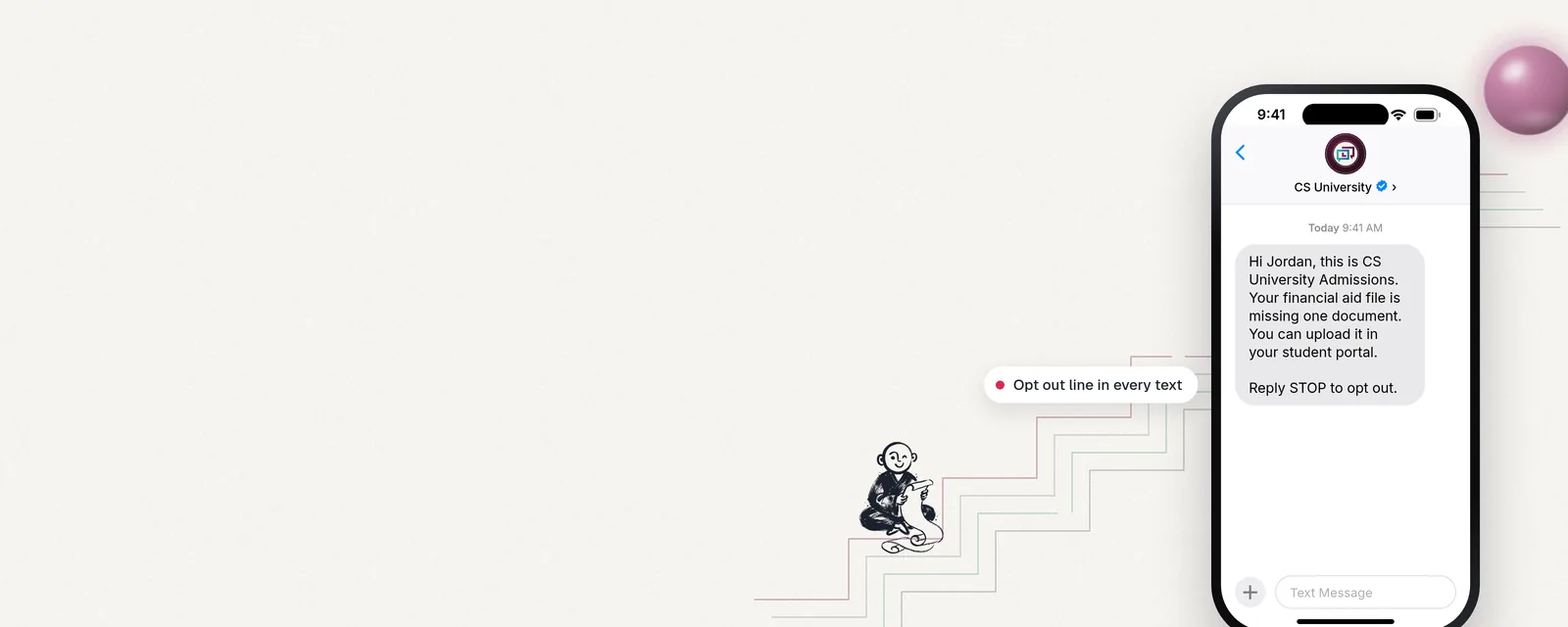
CS Enrollment Pathways lets your team reach transfer prospects in branded, verified text messaging from your college's name, so the answer to "will my credits count?" comes from a real person while they are still deciding. A one question start is how we work. Message only students who have agreed to hear from you.
Could a community college student find out today how many of their credits you would accept?
To see how a branded conversation with a prospective student can start, request the sample walkthrough.
Sources
- National Student Clearinghouse Research Center, Tracking Transfer. National Student Clearinghouse Research Center data: 2018 to 19 community college to four year transfer cohort highlights.
- National Student Clearinghouse Research Center, Tracking Transfer, Entering Four-Year College Cohort Dashboard, 2018. Introduction tab, highlights.
- National Student Clearinghouse Research Center, Transfer Enrollment and Pathways.
- National Student Clearinghouse, College Transfer Enrollment Grew for Third Straight Year.
- U.S. Government Accountability Office, Higher Education: Students Need More Information to Help Reduce Challenges in Transferring College Credits. What GAO Found; Recommendations.