
The short answer: in a 2026 peer reviewed study of 781 NAIA athletes, money came first. Financial factors rated highest (4.01 out of 5), followed closely by academic and coaching factors, and the top three single items were athletic scholarship, the right major and the chance to play. Campus size and family ties ranked near the bottom. For a small college, that makes recruiting an athlete an admissions conversation that a coach starts. Coaches need clear aid and program answers, the aid story has to be clear early, and the plan has to survive a coaching change.
Why athletes matter to a small college's class
The NCAA's Recruiting Facts sheet (October 2024, based on 2023 to 24 data) says about 1 in 5 students at Division III schools are athletes, and the median Division III school enrolls 1,617 undergraduates. The same sheet puts the share at 1 in 7 at Division II and 1 in 23 at Division I.
Our reading: when about one student in five at a Division III school plays a sport, athletic recruiting is enrollment work, and coaches are part of the admissions team whether or not the org chart says so. Whether adding a sport grows enrollment is a separate question, covered in our post on adding football.
What athletes say decided their choice
The study, by Cocco, Kopka, Spencer and Grosbach in the Journal of Issues in Intercollegiate Athletics (2026), with an NAIA coauthor, drew a stratified random sample of 2,500 from 87,084 NAIA athletes competing in 2023 to 24. The athletes were surveyed in March 2024, and 781 usable responses came back. Athletes rated 24 items from 1 ("not at all important") to 5 ("extremely important").
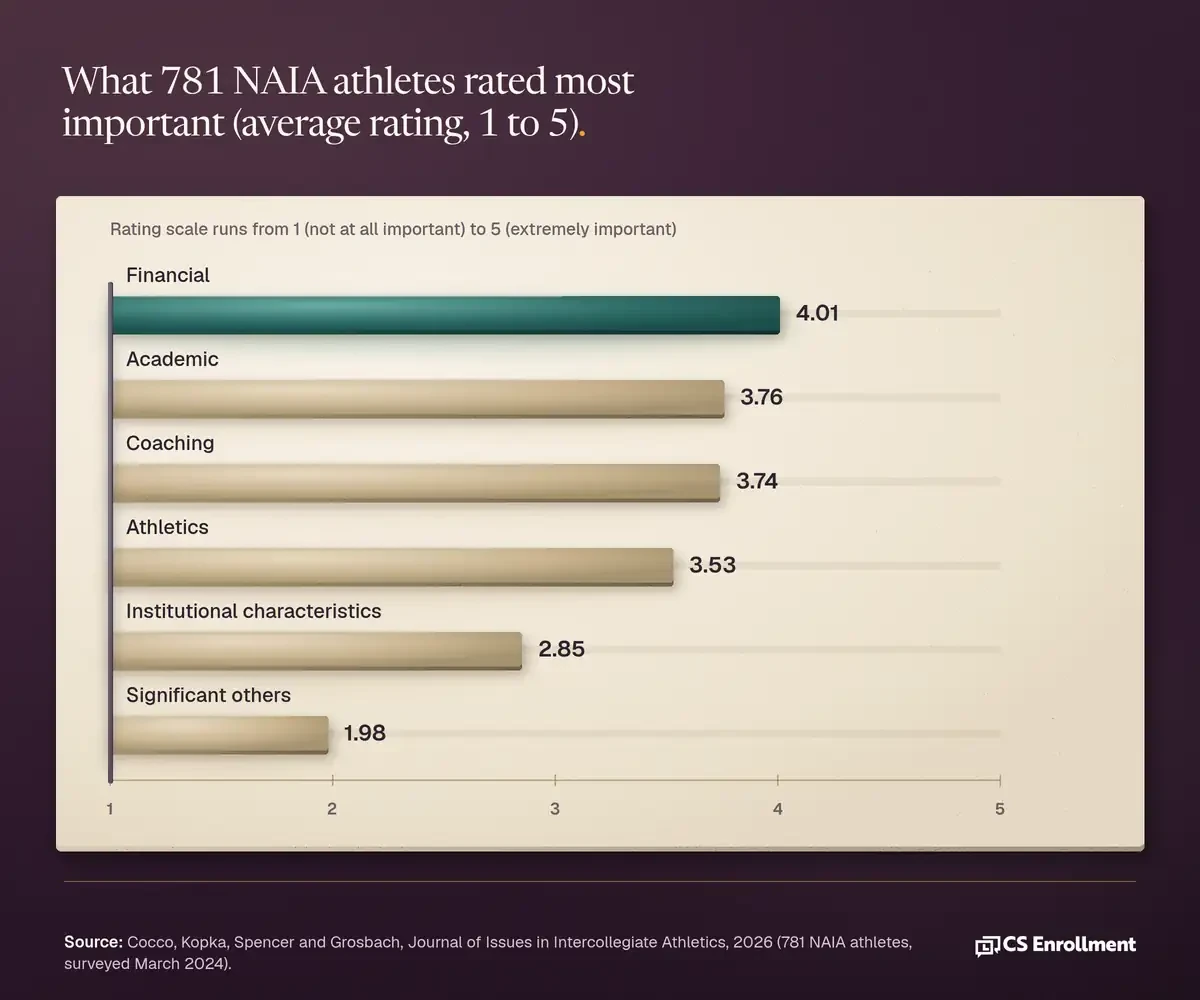
Grouped into factors, the average ratings were:
- Financial: 4.01 out of 5
- Academic: 3.76
- Coaching: 3.74
- Athletics: 3.53
- Institutional characteristics: 2.85
- Significant others (family and friends): 1.98
The top single items were athletic scholarship (4.16), preferred program or major offered (4.15), opportunity to play (4.04), financial aid received (3.97), affordability (3.92) and communication with the coach during recruitment (3.92). At the bottom were friends or family attending the same institution (1.70) and a parent or other family member having attended (1.48).
These are current athletes' own ratings of what mattered, given after they enrolled. The authors note recall may shift after enrollment, and students who chose another college are not in the sample. They show what athletes say mattered, not what caused their choice. The study covers NAIA athletes only. NCAA Division III schools do not offer athletic scholarships (NCAA), so at a Division III school the money question is about total aid, not an athletic award.
Money first: make the aid story clear early
Over 90% of the athletes in the study received some form of financial aid. Athletic scholarship, financial aid received and affordability were all among the top five items.
Our reading: a recruit comparing offers is comparing net price. Give the athletic award and institutional aid together, in one offer the family can read without a call. Our post on a clear financial aid offer covers what that looks like.
The coach is the first admissions officer
Three of the five coaching items rated in the top ten: communication with the coach during recruitment (3.92), the connection or relationship with the coach (3.85) and the coach's ability to develop players (3.83). The authors recommend that "athletic department personnel should be integrated into institutional discussions regarding enrollment and recruitment strategies," and that colleges consider training coaches on "financial aid communication and promotion of academic programs."
They also warn that unplanned coaching turnover disrupts the relationship between an athlete and the college and may lead athletes to reconsider their enrollment.
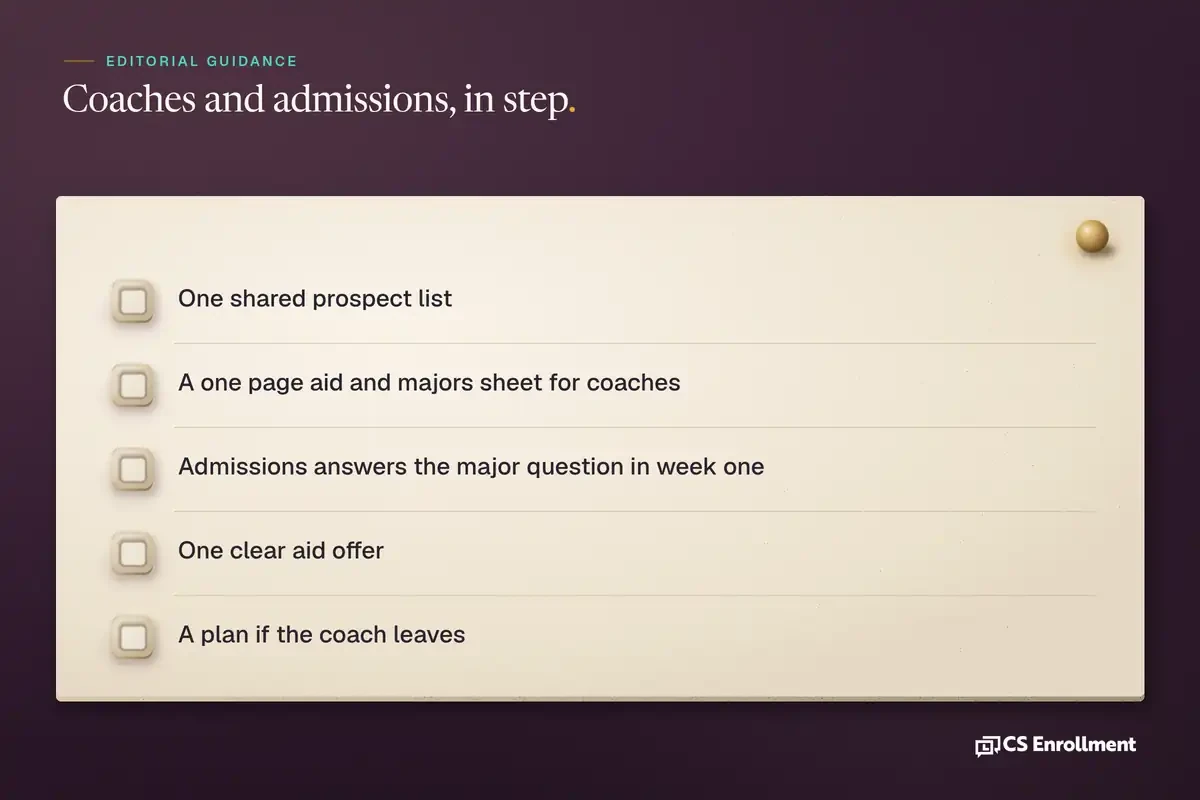
Editorial guidance for this cycle:
1. Keep one shared prospect list. Coaches and admissions see the same recruits, with one owner for the next step. 2. Give coaches a one page sheet. List majors with room, the aid process and dates, and who to call in financial aid. 3. Answer the program question in the first week. Preferred major rated 4.15 out of 5, nearly level with athletic scholarship. 4. Plan for a coaching change. Admissions keeps the relationship and the record, so a recruit is not dropped when a coach leaves.
Do athletes on men's and women's teams weigh things differently?
Somewhat. Athletes on women's teams rated academic, financial and institutional factors significantly higher than athletes on men's teams, but the authors describe the effect sizes as small. Coaching, athletics, and family and friends items showed no significant difference.
Our reading: the same core message works for every recruit. Lead with the academic path and a clear cost for everyone.
After the signature: plan the second year
About 22% of the athletes surveyed had transferred to their current college. The survey did not ask why. In their introduction, the authors, citing a 2025 source, write that NCAA and NAIA policies permitting immediate and unlimited transfer contribute to "retention and recruitment challenges." Our reading: the plan for an athlete's second year is part of recruiting them. Our post on retention and enrollment accountability covers who should own it.
Common questions
What matters most to athletes choosing a small college? In the 2026 study of 781 NAIA athletes, financial factors rated highest, an average of 4.01 out of 5. Athletic scholarship was the top single item at 4.16.
Do parents influence an athlete's college choice? In this study, athletes rated family and friends items lowest; a parent or family member having attended rated 1.48 out of 5. These are the athletes' own ratings, and athletes rated whether their parents thought it was the best choice higher, at 2.76. Our post on parent engagement covers that side.
How many students at small colleges are athletes? The NCAA's Recruiting Facts sheet (October 2024, based on 2023 to 24 data) puts it at about 1 in 5 students at Division III schools. That figure covers NCAA Division III only, not NAIA or other small colleges.
Should coaches and admissions work together? The study's authors recommend integrating athletic staff into enrollment and recruitment planning and training coaches on financial aid communication and academic programs.
Where messaging fits
CS Enrollment Pathways lets coaches and admissions reach recruits in branded, verified text messaging from your college's name, so the aid and major questions get answered by a real person while the recruit is still deciding. A one question start, "What would make this the right fit for you?", is how we work. Message only recruits who have agreed to hear from you, and follow your athletic association's own contact rules.
When a coach finds a recruit, how many days until that student hears from admissions and financial aid?
To see how a branded conversation with a recruit can start, request the sample walkthrough.
Sources
- Cocco, A. R., Kopka, N., Spencer, T., and Grosbach, A., Small Institutions, Big Decisions: Factors Influencing College Choice Among NAIA Athletes at Small Colleges and Universities. Peer reviewed study with an NAIA coauthor: 781 NAIA athletes, 2023 to 24, surveyed March 2024.
- NCAA, Recruiting Facts. Division ratios and median enrollment, page 1; Division III athletics scholarships, page 2.