
Do dual enrollment students come back to the college that taught them?
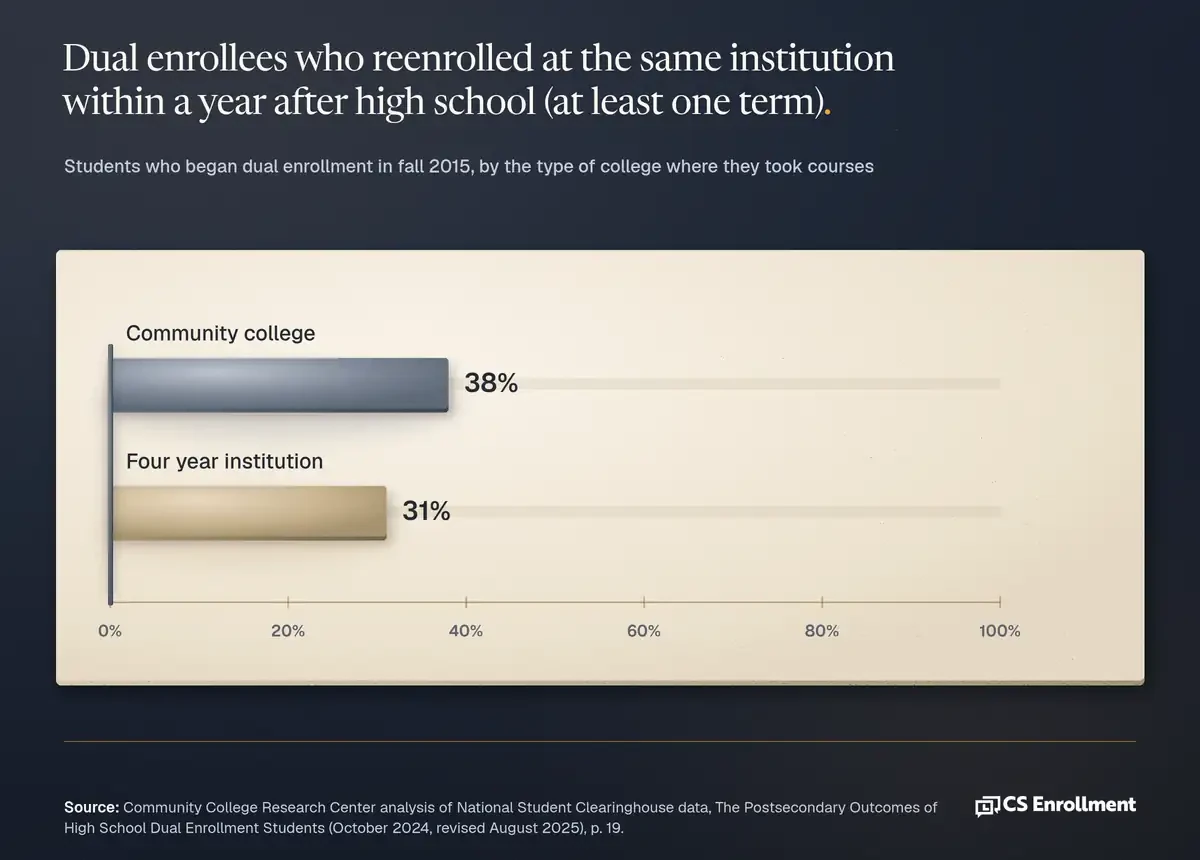
Some do, and many do not. In a Community College Research Center analysis of National Student Clearinghouse data on students who began dual enrollment in fall 2015, 31% of four year institution dual enrollees and 38% of community college dual enrollees reenrolled for at least one term at the same institution within the first year after high school. On a stricter measure, two or more consecutive terms, about a quarter did.
Read those figures with the scope in mind. They describe one national group of students who began dual enrollment in fall 2015, from a report published in October 2024 and revised in August 2025. The four year group combines public, private nonprofit and for profit institutions, so it is not a measure of small colleges alone. The community college figure also counts students who enrolled at another college in that same year.
The report shows who returned. It does not say why, and this post does not guess.
Most dual enrollees go to college somewhere
In the same cohort, 81% of dual enrollment students went to college in the first year after high school, and 51% went to a four year institution.
Our reading: the question for your college is not whether these students go to college. It is whether they choose you. They have already taken your courses, which is more than most prospects can say.
The stream is growing at community colleges
According to the National Student Clearinghouse Research Center, as reported by Higher Ed Dive, 38.4% of the fall 2025 enrollment increase at community colleges came from students age 17 or younger. The Clearinghouse uses that age range as a proxy for dual enrollment. That came to 66,000 more students under the age of 18 taking community college classes than a year earlier.
That is a figure for community colleges only, and it is a proxy based on age. It says nothing about four year colleges.
Our take: run dual enrollment as a recruiting stream
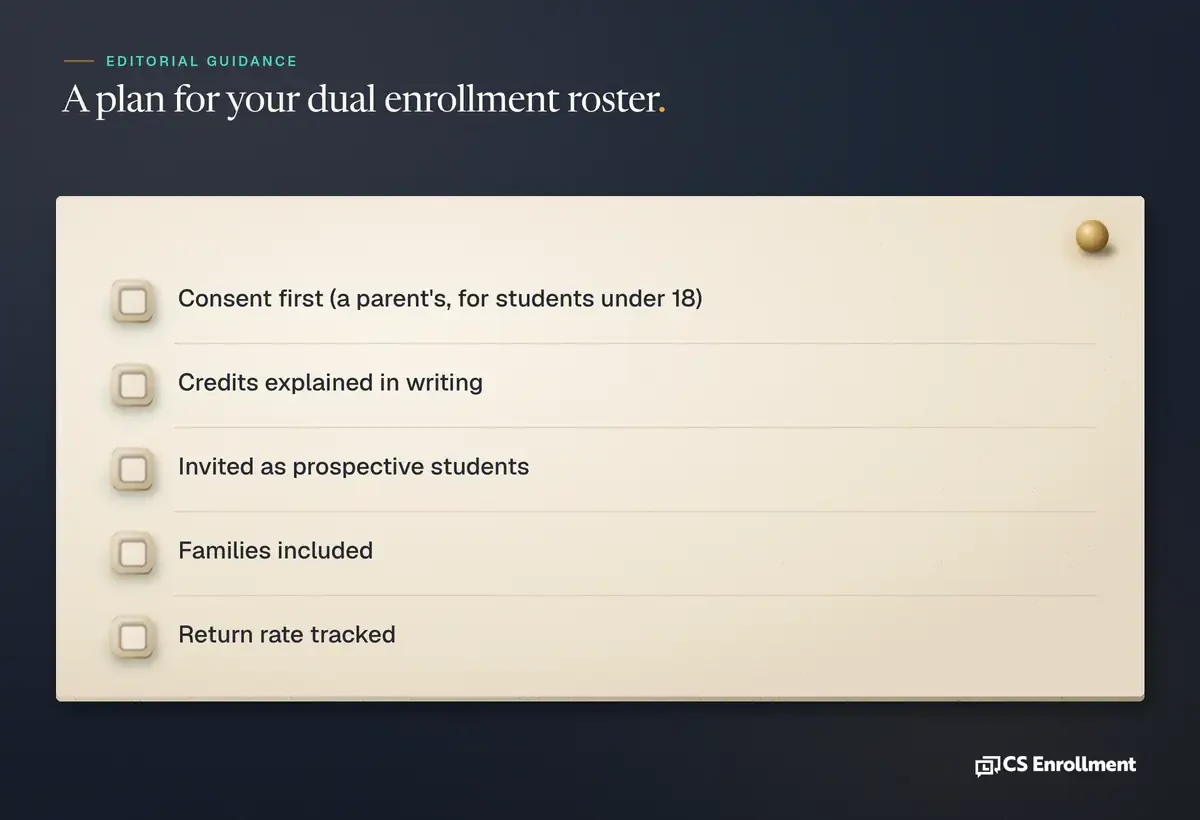
Editorial guidance. None of these steps is a promise of a higher return rate. They give a dual enrollment roster a plan of its own, so return is not left to chance.
1. Know who they are, and get consent first. Work with your registrar and the high school partner on what you may use. Ask what your partnership agreements allow before you build any list. For students under 18, get a parent's consent before any recruiting contact, and contact only people who have agreed to hear from you. 2. Tell them plainly how their credits count. Say in writing how credits apply toward a degree at your college and what admission looks like for them. A student who has to guess how credits count has extra work to do before choosing you. 3. Invite them to campus as prospective students, not only as course takers. Our post on campus visit strategy covers how to plan the day. 4. Bring families in. A high school student's family is part of the decision. Our post on parent engagement covers that side. 5. Remove small barriers. An application fee is a small barrier that a dual enrollee may not expect. Our post on application fee waivers covers the options. 6. Track your own return rate. Use the researchers' measure: enrolled at least one term at your college in the year after high school. That tells you your number. Ask your registrar to match last year's roster against your applications and enrollments. The report's authors say leaders should use their own data, from the Clearinghouse and other sources, "to benchmark outcomes, set improvement targets, and track progress." That is their advice for leaders, not a finding about any one step. 7. If you are a community college, plan the next step. For students who want a bachelor's degree, that next step is transfer. Our post on how to recruit transfer students covers that stage.
Start with last year's roster. Count how many of those students applied and how many enrolled. That baseline is yours, and every later step can be judged against it.
Common questions
Do dual enrollment students enroll at the same college after high school? In a Community College Research Center analysis of the fall 2015 national dual enrollment cohort, 31% of four year institution dual enrollees and 38% of community college dual enrollees reenrolled for at least one term at that institution within a year after high school.
How many dual enrollment students go to college? In the same cohort, 81% went to college in the first year after high school, and 51% went to a four year institution.
Is dual enrollment growing? At community colleges, the Clearinghouse reported that 38.4% of the fall 2025 enrollment increase came from students age 17 or younger, its proxy for dual enrollment.
Where messaging fits
CS Enrollment Pathways lets your team reach students and families who have agreed to hear from you in branded, verified text messaging from your college's name, so they see who is writing before they open it, and a real person can answer the question about credits, admission or cost. A one question start, "What would help you decide whether to keep studying with us after high school?", is how we work. Contact only people who have agreed to hear from you; for students under 18, that means a parent's consent first.
Do you know how many of last year's dual enrollment students applied to your college?
To see how a branded conversation with a prospective student can start, request the sample walkthrough.
Sources
- Tatiana Velasco, John Fink, Mariel Bedoya and Davis Jenkins, The Postsecondary Outcomes of High School Dual Enrollment Students: A National and State-by-State Analysis. Analysis of National Student Clearinghouse data on students who began dual enrollment in fall 2015.
- Laura Spitalniak, Fall 2025 enrollment increased 1% but the devil is in the details. Reports National Student Clearinghouse Research Center data.
- National Student Clearinghouse Research Center, Final Fall Enrollment Trends 2025, Methodological Notes. Defines undergraduates age 17 and younger as dual enrollees.