
In the National Science Foundation's 2025 survey of graduate students in science, engineering and health, first time, full time master's enrollment fell 10.0% from 2024 to 2025, and first time, full time doctoral enrollment fell 9.9%. Within it, first time, full time master's enrollment of U.S. citizens and permanent residents rose 7.1%. The survey covers research degree granting colleges in these fields, not all graduate programs. Our take: check your own starts first, then plan 2027 graduate recruiting around U.S. and part time students.
Did graduate enrollment in these fields fall in 2025?
Yes. The National Center for Science and Engineering Statistics (NCSES), part of the National Science Foundation, published its fall 2025 Survey of Graduate Students and Postdoctorates in Science and Engineering on Nov 18, 2026. It covers 635 eligible institutions that grant research based master's or doctoral degrees in science, engineering and selected health fields. Inside Higher Ed reported it Nov 24. Every figure here is for those fields only.
- First time, full time master's students: down 10.0% from 2024 to 2025, from 142,279 to 128,093.
- First time, full time doctoral students: down 9.9% from 2024 to 2025, to 46,264.
- All master's and doctoral students in these fields: down 2.7%, from 818,078 to 796,304.
"First time, full time" means students enrolled full time in a graduate degree program for the first time that fall, a narrower group than all enrolled students.
U.S. master's starts went the other way
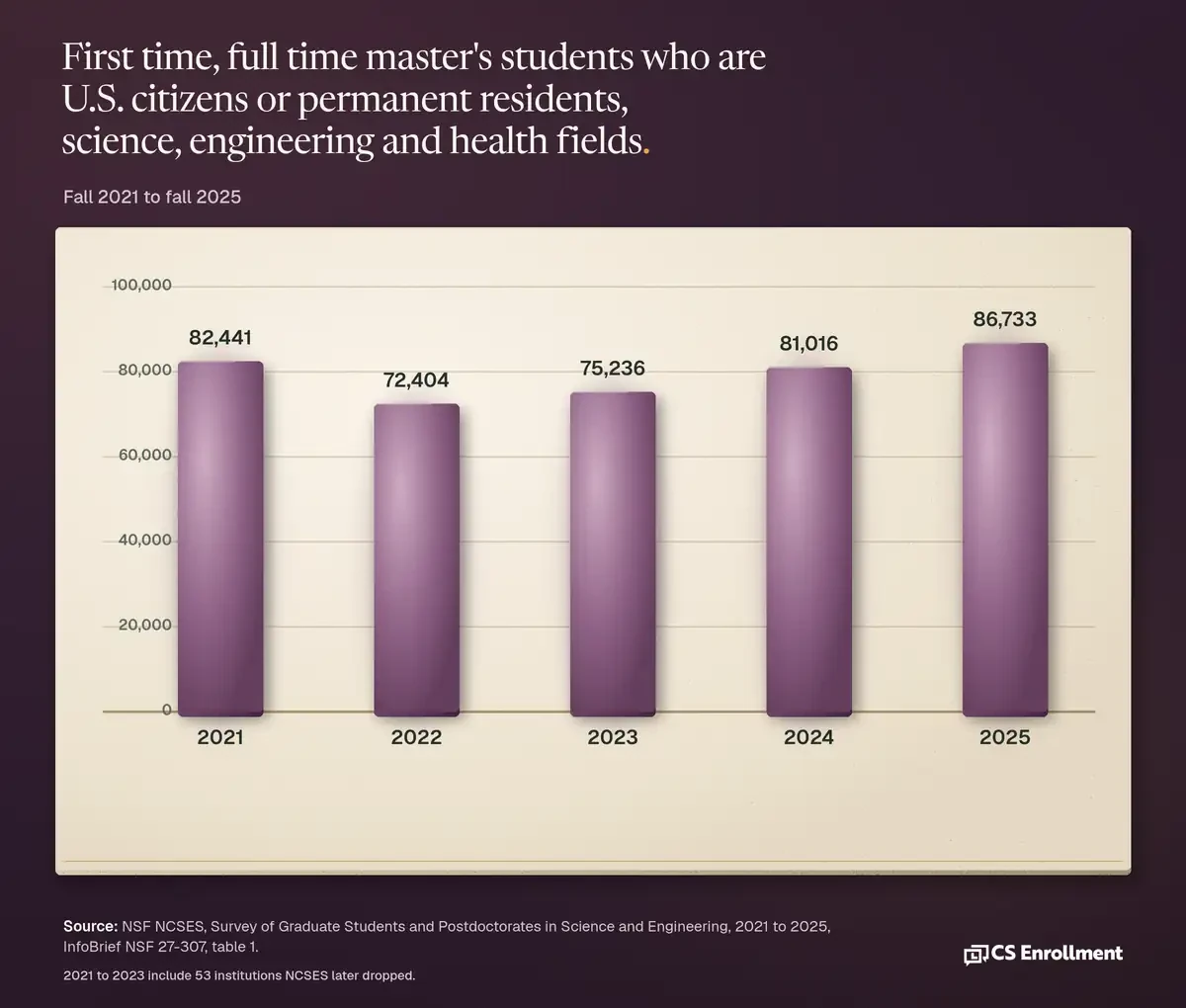
First time, full time master's enrollment of U.S. citizens and permanent residents rose 7.1% from 2024 to 2025, from 81,016 to 86,733 students. Total part time master's enrollment for this group, not only first time students, rose 3.4% to 156,232. These are master's figures only.
NCSES says the increases in U.S. citizen and permanent resident master's enrollment "only partially offset the decline in students with a temporary visa." For context, 19,903 fewer temporary visa holders started first time, full time master's programs in these fields, a decrease of 32.5%. Our post on international student enrollment in 2026 covers that group.
Part time master's enrollment held steady
NCSES describes part time master's enrollment as stable. Across all citizenship groups it rose 0.6% from 2024 to 2025, to 184,905 students in these fields.
Our reading: the part time graduate student, who often studies around a job, did not shrink in this survey. The survey does not record whether students work.
Health is in the mix, but only partly
Master's enrollment in the survey's health fields fell 1.1% from 2024 to 2025. That figure covers all master's students in those fields. NCSES notes that the health fields it counts are about a third of all health fields in the Department of Education's program classification.
Our reading: if your master's programs are in nursing, education or business, this survey may not count them.
Our take: plan 2027 graduate recruiting around domestic and part time students
Editorial guidance for a small or mid size college that runs master's programs. These steps are our view, not survey findings.
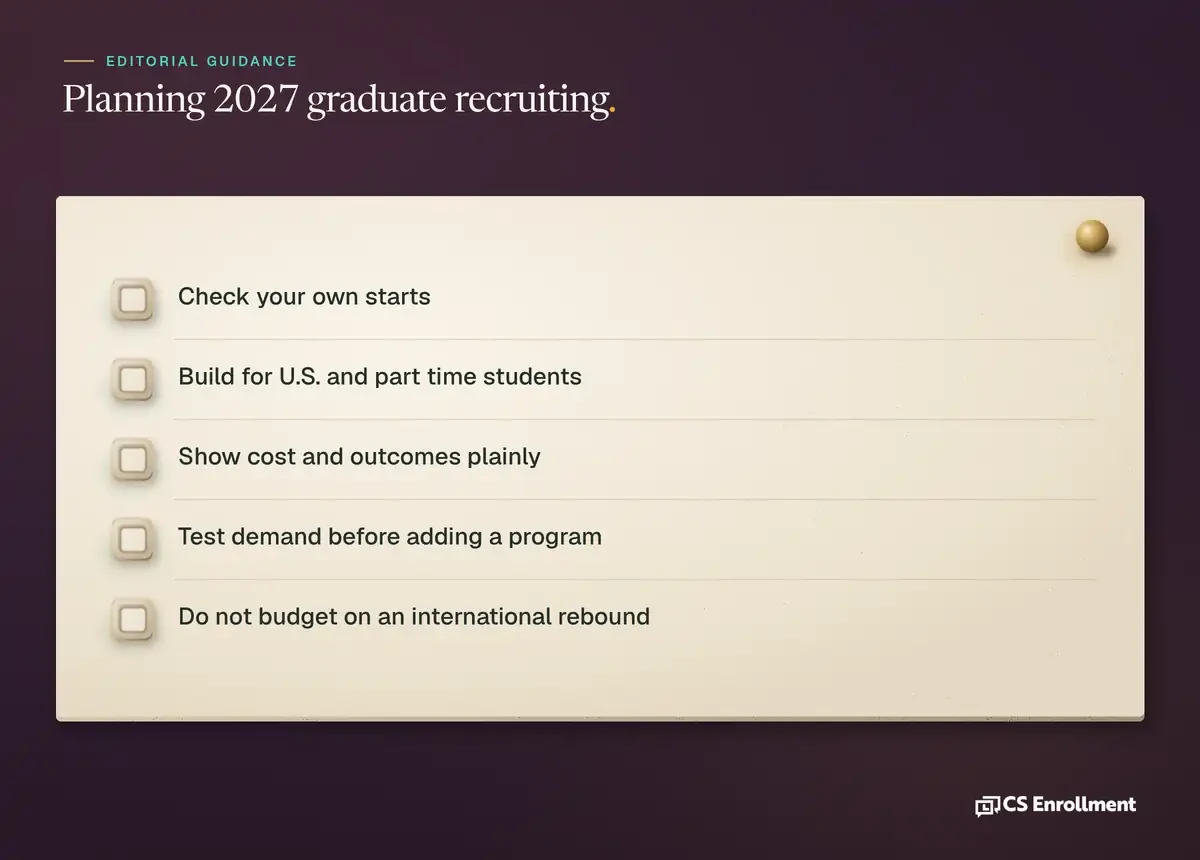
1. Look at your own starts first. Pull new master's students by citizenship and by full time or part time status, for recent fall terms. 2. Build for U.S. and part time students first. Check class times, formats and your first message against the schedule of someone who comes after work. 3. Show cost and outcomes plainly. Our post on the earnings test and small colleges covers program level outcomes. 4. Test demand before adding a program. Our post on how to market a new academic program covers it. 5. Do not budget 2027 on an international rebound.
Common questions
Did science, engineering and health graduate enrollment drop in 2025? In the National Science Foundation's 2025 survey, first time, full time enrollment fell 10.0% for master's and 9.9% for doctoral students; all master's and doctoral students in these fields fell 2.7%.
Did first time, full time U.S. master's enrollment rise in 2025? In the same survey, first time, full time master's enrollment of U.S. citizens and permanent residents rose 7.1%. Their first time, full time doctoral enrollment fell 4.4%.
Does this survey cover all graduate programs? No. It covers 635 eligible institutions that grant research based master's or doctoral degrees in science, engineering and selected health fields, and its health fields are about a third of all health fields.
Where messaging fits
CS Enrollment Pathways lets your team reach prospective graduate students who have agreed to hear from you in branded, verified text messaging from your college's name, so they see who is writing before they open it, and a real person can answer the schedule, cost or credit question that comes before an application. A one question start, "What would make a master's program fit around your job?", is how we work. Contact only people who have agreed to hear from you.
Which of your master's programs grew with U.S. students this year, and do you know why they chose you?
To see how a branded conversation with a prospective student can start, request the sample walkthrough.
Sources
- National Center for Science and Engineering Statistics, First-Time, Full-Time Enrollment in Master's and Doctoral Programs Declined in Science, Engineering, and Health Fields in 2025. Results of the 2025 Survey of Graduate Students and Postdoctorates in Science and Engineering (635 eligible institutions). Federal statistical agency.
- Ryan Quinn, New, Full-Time Enrollees in Science, Health Grad Programs Dropped 10% Last Year.