Short answer: for applicants and transfer students, often. For net tuition revenue, less often. In a July 2026 study by Lucie Lapovsky and Jacqueline E. King of 87 private nonprofit four year colleges that reduced published tuition by at least 15% between 2011 and 2023 (supported by Strada Education Foundation), 52% of the 71 colleges with sufficient admission data had more undergraduate applicants two years after the reset. Only 33% of the reset institutions had higher total net tuition revenue from first time, full time students two years later.
The authors put it plainly. Tuition resets, they write, "are not a panacea for the structural financial and demographic challenges facing higher education."
What is a tuition reset?
A tuition reset is a large cut in a college's published tuition, typically 15 to 50%, according to the study. The authors write that colleges use it to respond to declining enrollment, rising discount rates and price sensitivity among families.
The study looks at private nonprofit four year colleges that had a published tuition reduction of at least 15% at any point between 2011 and 2023. More than 100 colleges reset tuition in that window. The authors kept 87 after excluding seminaries and other special focus faith institutions, colleges with too few first time, full time students, and colleges with significant missing data. The data come mainly from the federal IPEDS survey, and each outcome is measured from the year before that college's reset to two years after it.
Most of the colleges were small. Their average total fall enrollment in 2010 was 2,200, and the largest undergraduate enrollment was 6,500.
A reset is not the same as giving back more of an unchanged sticker as institutional aid. That is the discount rate, which we cover in our post on the tuition discount rate. The authors describe the intent of a reset this way: "In most cases, the net price paid by students changes relatively little, but the lower sticker price is intended to increase transparency, expand the applicant pool, improve enrollment, and stabilize or increase net tuition revenue (NTR)."
That is a statement of intent. The rest of the paper measures what happened.
Did applicants and enrollment go up?
At about half of the colleges, yes. Transfers were the strongest result.
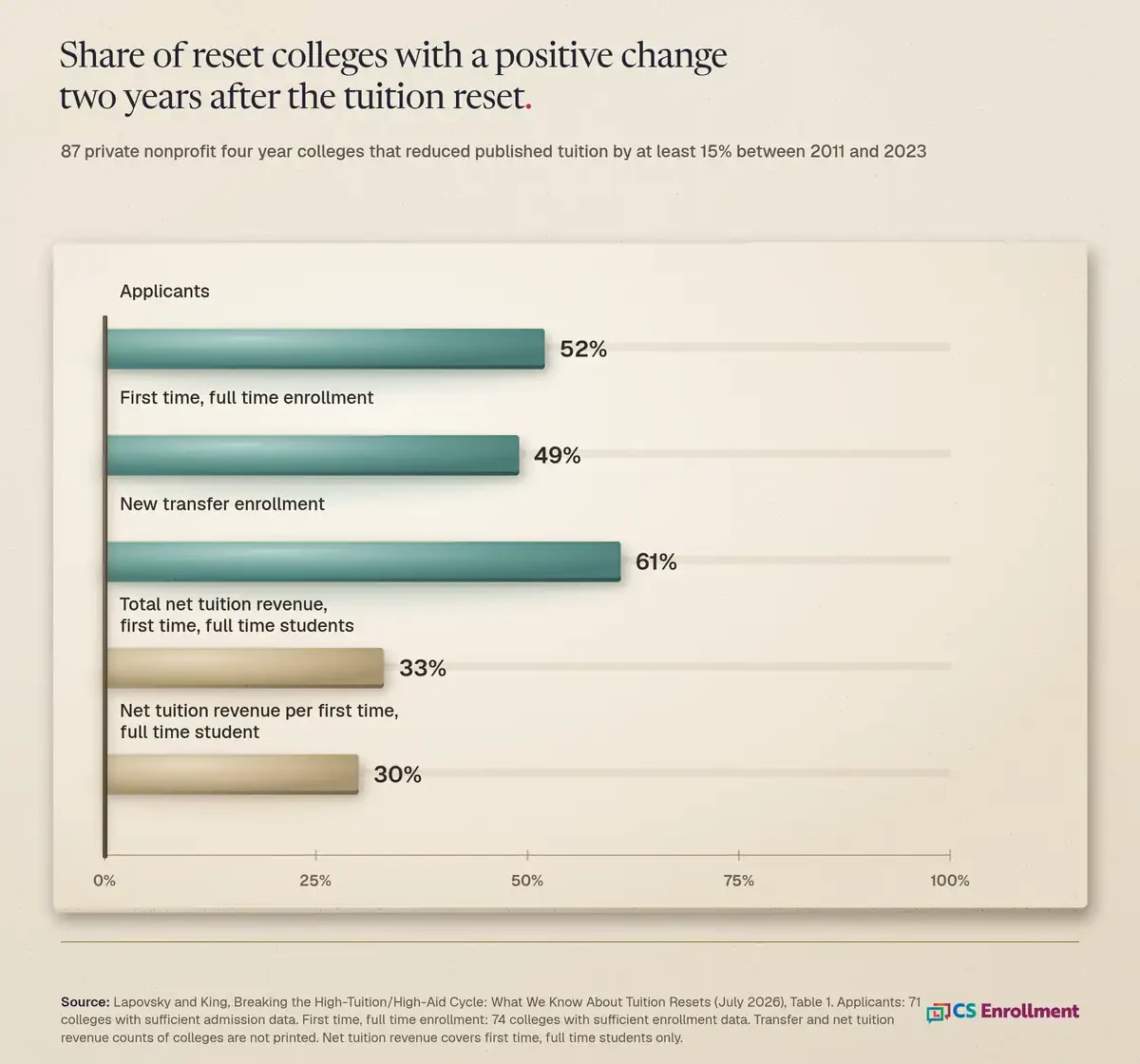
- Applicants. 52% of the 71 colleges with sufficient admission data had more undergraduate applicants two years after the reset. 48% had a change that exceeded their peers.
- First time, full time enrollment. 49% of the 74 colleges with sufficient enrollment data had a positive change. 53% exceeded their peers.
- New transfer enrollment. 61% of the reset institutions had a positive change in new transfer students, and 66% exceeded their peers. The paper does not print how many colleges are in this measure.
Not all 87 colleges appear in every measure. The peer group is 581 similar private nonprofit four year colleges that did not reset tuition, had no more than 10,000 students in 2023 and admitted at least 40% of first time, full time applicants.
These are counts of colleges that moved in a direction. They describe what happened two years after each reset. They do not show that the reset was the reason, and other changes on a campus can happen in the same years.
Did net tuition revenue go up?
Less often. In the authors' words: "One-third of the reset institutions had a positive change in total NTR in reset year +2." That is the 33% in their summary table, and 35% had a change in total net tuition revenue from first time, full time students that exceeded their peers.
Per student, the picture is similar. 30% of the reset institutions had a positive change in net tuition revenue per first time, full time student, and 31% exceeded their peers.
The authors explain the revenue result this way: many of the reset institutions "did not reduce their institutional aid as much as they reduced their tuition." They also note that IPEDS does not collect the data needed to measure net tuition revenue from transfer students. The revenue figures cover first time, full time students only; the authors did not look at revenue for the college as a whole. So the strongest enrollment result, transfers, is the one the revenue figures cannot see.
Our reading: a lower sticker is not the whole plan
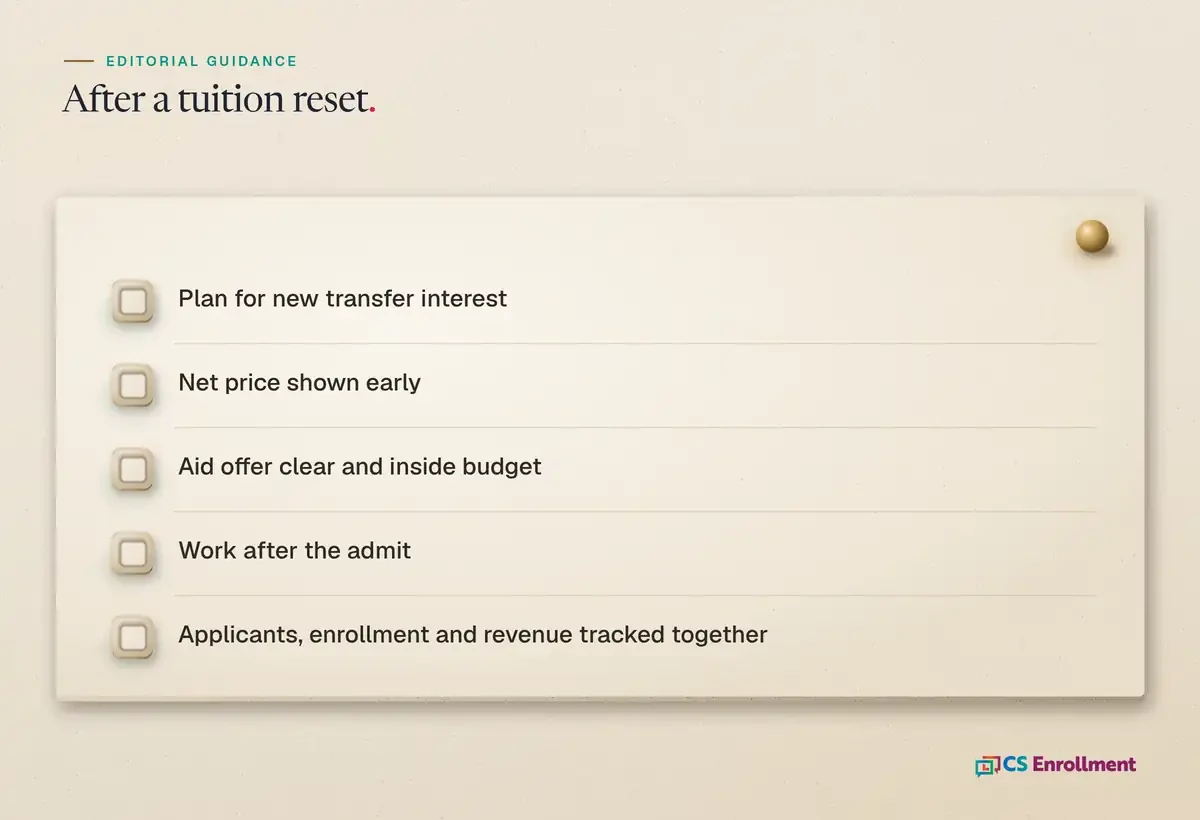
Editorial guidance, not findings from the study. A new price changes what families see first. It does not change the work that follows.
1. Plan for who starts looking. A lower published price is meant to widen who is willing to look at you, and in this study transfer students were the strongest enrollment result. Our post on how to recruit transfer students covers that stream. 2. Show the net price, not only the new sticker. Families still need to know what they would pay. Our post on showing net price before inquiry covers how to put it in front of them early. 3. Keep the aid offer clear and inside the budget. The authors' point about aid is the revenue story. Cutting the sticker without changing how aid is awarded leaves less room for revenue. Our post on a clear financial aid offer covers the offer itself. 4. Do the work after the admit. A bigger applicant pool still has to become a class. Our post on how to increase college yield covers that stage. 5. Track all three outcomes. Watch applicants, enrollment and net tuition revenue together, for first year and transfer students separately, for at least two years.
Common questions
Do tuition resets increase applications? In the July 2026 study of 87 private nonprofit colleges that cut published tuition by at least 15%, 52% of the 71 colleges with sufficient admission data had more undergraduate applicants two years after the reset.
Do tuition resets increase enrollment? 49% of the 74 colleges with sufficient enrollment data had more first time, full time undergraduates two years later. 61% of the reset institutions had more new transfer students.
Do tuition resets increase net tuition revenue? 33% had higher total net tuition revenue from first time, full time students two years after the reset, and 30% had higher net tuition revenue per first time, full time student. The authors write that resets "are not a panacea."
Where messaging fits
CS Enrollment Pathways lets your team reach students and families who have agreed to hear from you in branded, verified text messaging from your college's name, so they see who is writing before they open it, and a real person can answer the price, aid or transfer question that comes after a tuition change. A one question start, "What would make the new price clear enough to consider us?", is how we work. Contact only people who have agreed to hear from you.
If you lowered the sticker, do you know whether applicants, enrollment and net tuition revenue all moved, or only one of them?
To see how a branded conversation with a prospective student can start, request the sample walkthrough.
Sources
- Lucie Lapovsky and Jacqueline E. King, Breaking the High-Tuition/High-Aid Cycle: What We Know About Tuition Resets. Supported by Strada Education Foundation. A study of 87 private nonprofit four year colleges that reduced published tuition by at least 15% between 2011 and 2023, using mainly IPEDS data.