
Short answer: in a national look at 2019 high school graduates, 33% earned 3 or more career and technical education (CTE) credits in high school but took no dual enrollment course. A Community College Research Center (CCRC) report from October 2026 extrapolates that to over a million students each year. This post covers that gap and one Texas study. It does not claim that closing the gap would raise later enrollment or earnings.
The gap: CTE credits, but no college course
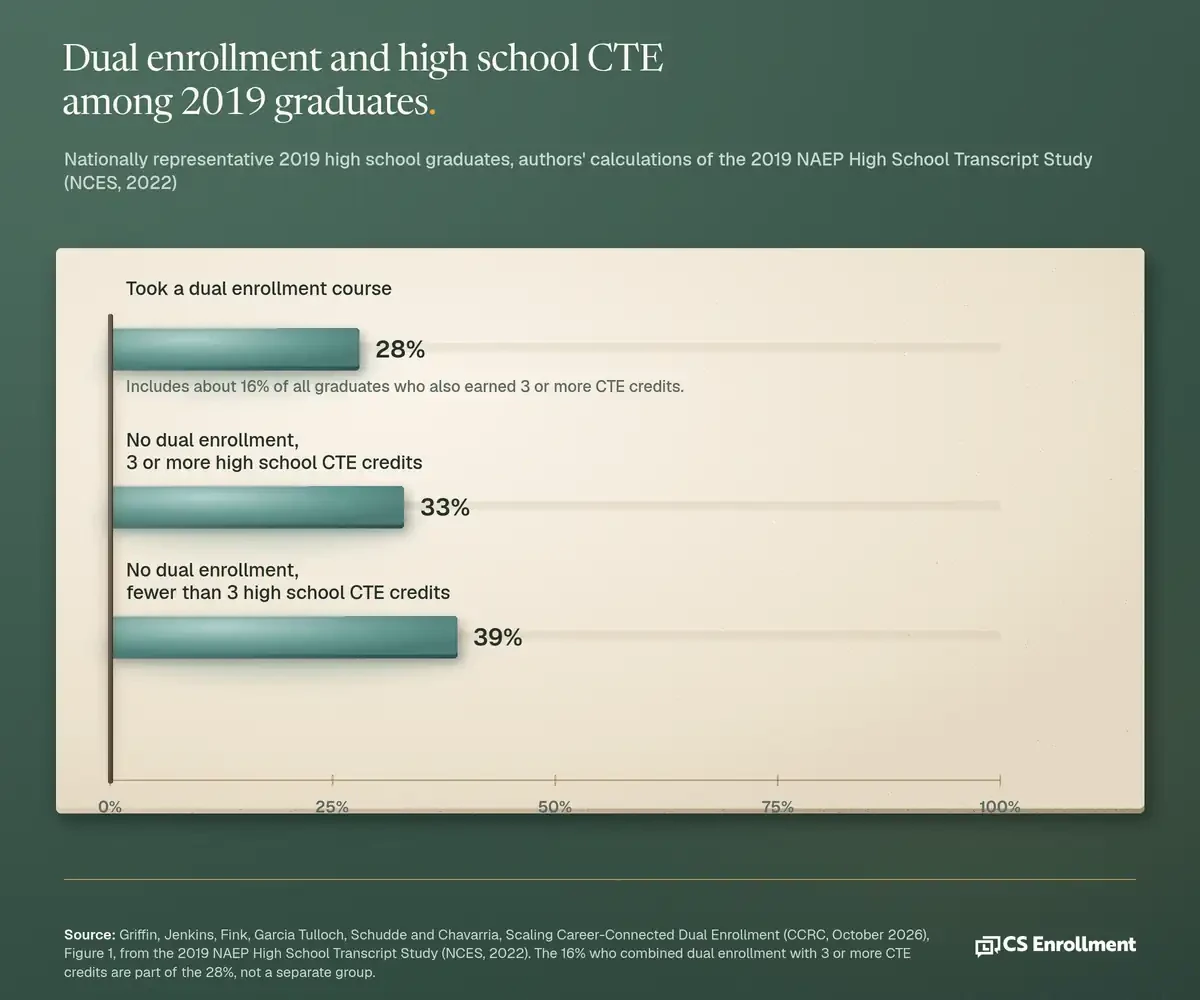
Using the 2019 NAEP High School Transcript Study (National Center for Education Statistics, 2022), a nationally representative look at 2019 high school graduates, the CCRC authors sorted graduates into three groups that do not overlap:
- 28% took at least one dual enrollment course. About 16% of all graduates both took dual enrollment and earned at least 3 high school CTE credits, and they sit inside this 28%.
- 33% never took a dual enrollment course but earned at least 3 high school CTE credits, which the authors equate to three full year courses.
- 39% never took a dual enrollment course and did not earn at least 3 high school CTE credits.
The authors then extend the middle group to the whole country: "Extrapolating to the 3.8 million graduates each year, this means that over a million students with 3 or more high school CTE credits graduate annually without ever taking a dual enrollment course."
The shares describe 2019 graduates. The "over a million" is the authors' extrapolation, not a new count.
What one state study found
The CCRC report cites a 2025 study of Texas high school students by Velasco and colleagues. Everything in this section comes from that study, as the report describes it.
In that study, students with a CTE focus who also took dual enrollment coursework were, after high school, more likely to enroll in college and complete a degree than students with a CTE focus who took no dual enrollment. By age 24, those who combined a high school CTE focus with dual enrollment earned 16% more than those with a CTE focus alone, after accounting for student and school characteristics.
A "CTE focus" has its own definition there: students who attempted at least 10 CTE courses in high school, equivalent to about 5 high school credits. About a third of the high school students who took CTE coursework in that sample had taken 10 or more. That is a different yardstick from the national 3 credit measure above.
The same study found that fewer than 5% of all students in its analysis combined a CTE focus with dual enrollment coursetaking. That is a Texas figure, not comparable to the national 16%.
This is one study of one state, and it shows an association, not a cause or a national result. The CCRC report also cites a 2024 review by Lindsay and colleagues. CCRC describes that review as finding consistent evidence that participation in high school CTE improves high school outcomes, employment after high school and enrollment in community colleges. It did not establish a connection between high school CTE participation and college degree completion or later wages.
What career connected dual enrollment means
The authors define their term this way: "the intentional integration of college coursework into high-quality high school career programs to create stronger on-ramps to postsecondary education and training that lead to high-opportunity careers."
The report's practice findings are qualitative. They come from interviews with 135 dual enrollment and CTE practitioners at colleges and high schools at 12 sites. That is practice, not a national rate or proof that an approach works.
The authors map what they saw to four practice areas in CCRC's DEEP framework: outreach, alignment of courses to degrees and careers, advising, and high quality instruction, including instructor supply.
The report also notes that 42 states now include dual enrollment participation or success as an indicator in at least one accountability system, citing Falcone and colleagues (2025). The Gates Foundation funded the research; the findings and conclusions are the authors' and do not necessarily reflect the foundation's positions or policies.
This is not the same as recruiting students who already take dual enrollment
Our post on recruiting dual enrollment students is about students who already took college courses in high school and whether they enroll after graduation. This post is about the CTE students who never took those courses. Here the question is whether a college course was part of a career program.
Our reading for a small college
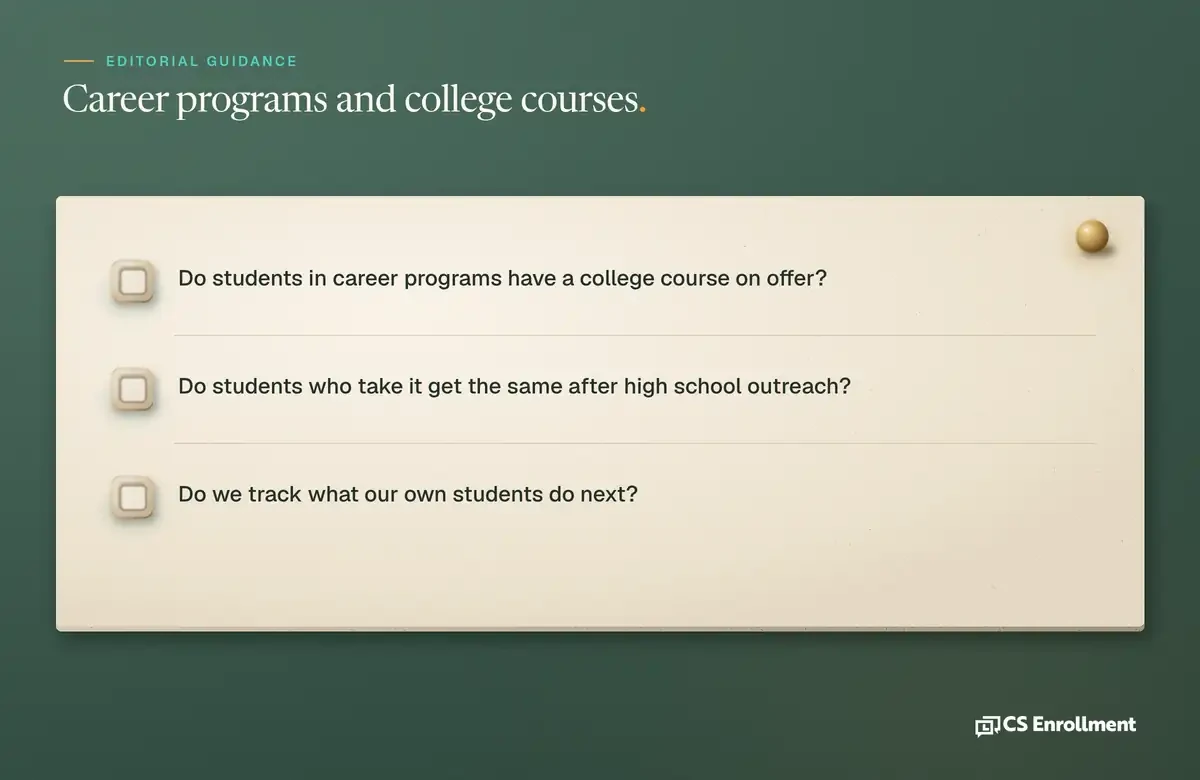
Editorial guidance, not findings from the report.
1. Ask the simple question. A small college that already works with nearby high schools can ask: are students in career programs being offered college courses, or only high school CTE credits? 2. Treat new dual enrollment students like the rest. If your college adds or expands those courses, the students who take them belong in the same after high school outreach as other dual enrollment students. The post linked above covers that work, and our post on how to increase college yield covers the step after it. 3. Do not promise the outcome. Nothing in the report shows that adding these courses raises later enrollment or earnings, at your college or nationally. Watch what your own students do.
Common questions
How many high school CTE students never take dual enrollment? The CCRC authors extrapolate from 2019 graduates that over a million students with 3 or more high school CTE credits graduate annually without ever taking a dual enrollment course.
Is combining CTE and dual enrollment linked to college completion or earnings? One Texas study, cited in the CCRC report, found that students with a CTE focus who also took dual enrollment were more likely to enroll in college and complete a degree than CTE students who took none, and had 16% higher earnings by age 24 after accounting for student and school characteristics. It is one state study, and it shows an association, not a national guarantee.
Is this the same as recruiting dual enrollment students after high school? No. That work starts with students who already took a college course. This post is about CTE students who never did.
Where messaging fits
CS Enrollment Pathways lets your team keep a clear, consistent conversation going with dual enrollment students as they finish high school, in branded, verified text messaging from your college's name, so they see who is writing before they open it and a real person can answer a question about credits, next steps or cost. A one question start, "What would help you decide whether to keep studying with us after high school?", is how we work. Contact only people who have agreed to hear from you; for students under 18, that means a parent's consent first.
If a student in a career program at a school near you took a college course this year, would your college know who they are by spring?
To see how a branded conversation with a prospective student can start, request the sample walkthrough.
Sources
- Sarah Griffin, Davis Jenkins, John Fink, Aurely Garcia Tulloch, Lauren Schudde and Melissa Chavarria, Scaling Career-Connected Dual Enrollment: How College and K-12 Partners Can Strengthen Pathways and Expand Opportunity. Funded by the Gates Foundation; the findings and conclusions are the authors' and do not necessarily reflect positions or policies of the foundation. National figures are the authors' calculations from the 2019 NAEP High School Transcript Study (NCES, 2022).