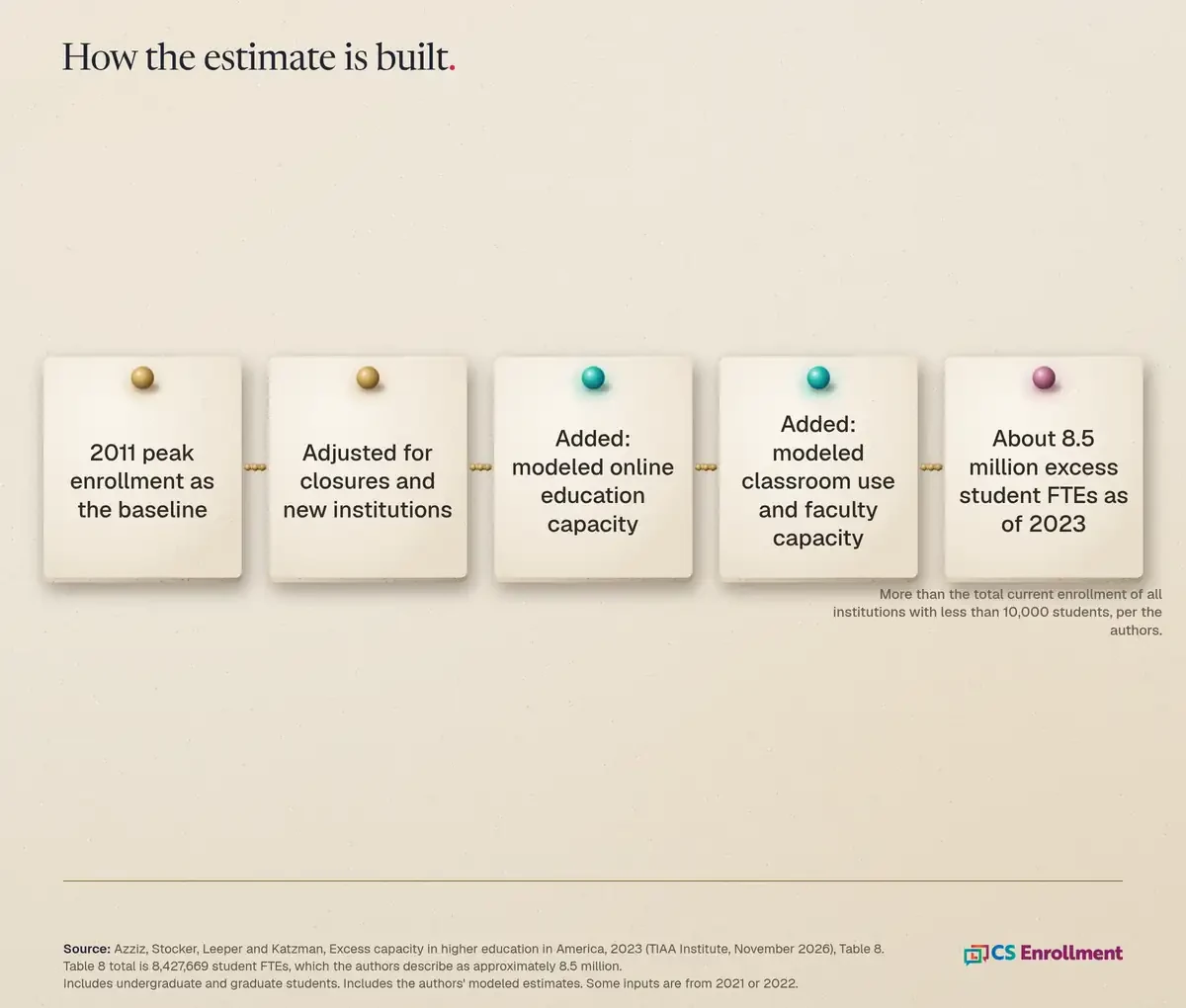
A November 2026 TIAA Institute analysis estimates excess capacity at U.S. colleges as of 2023 at "approximating 8.5 million" student full time equivalents (FTEs), which the authors say is "equal to more than the total current enrollment of all institutions of higher education with less than 10,000 students." Our take: read it as context and keep your follow through with nearby students steady.
The new estimate, in plain terms
Ricardo Azziz, Gary Stocker, Karla Leeper and Rich Katzman published "Excess capacity in higher education in America, 2023" in the TIAA Institute's Trends and Issues series. Table 8 prints a total of 8,427,669 student FTEs, which the authors describe as approximately 8.5 million.
A full time equivalent counts full time students plus the full time equivalent of part time students. The abstract calls the figure undergraduate full time equivalents, but a note to Table 8 says the total includes both undergraduate and graduate students, so this post says student FTEs. "Empty seats" in the headline is shorthand for the authors' estimate of excess teaching capacity, not a count of vacant chairs. Most of the total comes from the authors' modeling of what online education, classroom use and faculty could teach, so it is an estimate of capacity, not a head count of seats that are empty today.
The authors write that institutions with less than 10,000 students account for 87.1% of all institutions of higher education in America. Their table of institutions by size is for fall 2021. That band includes colleges of about 250 to 10,000 students.
Disclosure: the authors are with the Center for Higher Education Mergers and Acquisitions at the Foundation for Research and Education Excellence. The paper states: "Any opinions expressed herein are those of the authors, and do not necessarily represent the views of TIAA, the TIAA Institute or any other organization with which the authors are affiliated."
How they built the number, and what they warn about
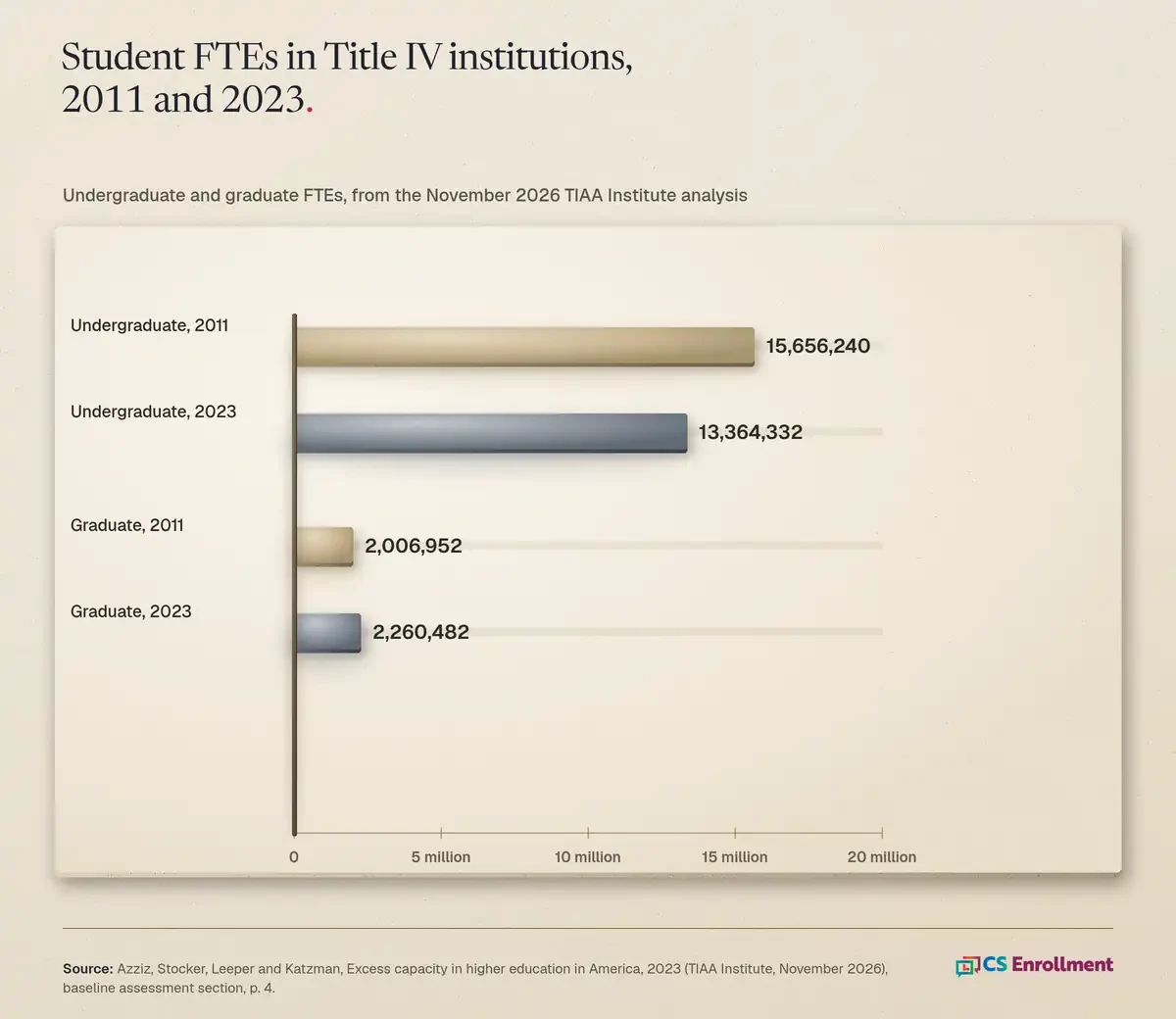
Enrollment peaked in 2011. The authors start from 2011 and assume there was no excess capacity that year. Undergraduate FTEs in Title IV institutions fell from 15,656,240 in 2011 to 13,364,332 in 2023, a decrease of 2,291,908, or 14.6%. On that change alone, and assuming all other factors stay unchanged, they write, "undergraduate excess teaching capacity currently approximates 2,300,000 undergraduate FTEs." That is a simple first cut for undergraduates only, not a line in their final table. Graduate FTEs rose from 2,006,952 to 2,260,482, and the authors "did not find significant evidence of excess capacity in graduate (postbaccalaureate) education at baseline."
They then add later changes to build their total. Closures from 2011 to 2023 reduced capacity by an estimated 84,000 FTEs, undergraduate and graduate combined. New institutions added 151,602 FTEs, also combined. Table 8 also adds three modeled amounts, for online education, classroom use and faculty. The authors say their assumptions are "primarily centered on the ability of institutions to make modest improvements in the effectiveness of using online education, and their facilities and professoriate."
The authors state the limits. They mixed headcount and FTE data, and degree granting and Title IV institutions, and sometimes used 2022 or 2021 data in place of 2023. They may have double counted faculty excess, since online and facilities capacity depend in part on faculty. They assumed no excess capacity in 2011, which they say "potentially has resulted in our underestimating the current level of excess capacity."
They also put the size of the number in their own words. First: "even if we eliminate all excess capacity due to the growth in the professoriate, excess capacity is still significant at 6,250,400 student FTEs." Second: "even if the estimated 8.5 million excess student FTEs were 6.5 million, this still would be a very large amount of excess capacity indeed." The second is an illustration, not a second estimate.
What the number does not mean
- It is not a campus count. It is not a count of empty seats at each college, or a claim that every small college is under enrolled.
- It does not account for distance. The authors write the estimates "do not account for the fact that most students prefer to attend higher education at an institution close to them." See how far students travel for college.
- Closures do not close the gap on their own. In this analysis, new institutions added more FTE capacity than closures removed. See college closures in 2026.
- It is not the demographic cliff. That is the coming decline in traditional age students. This estimate is about capacity as of 2023. See fall 2026 enrollment.
Our take for a small college
Editorial guidance, not findings from the paper.
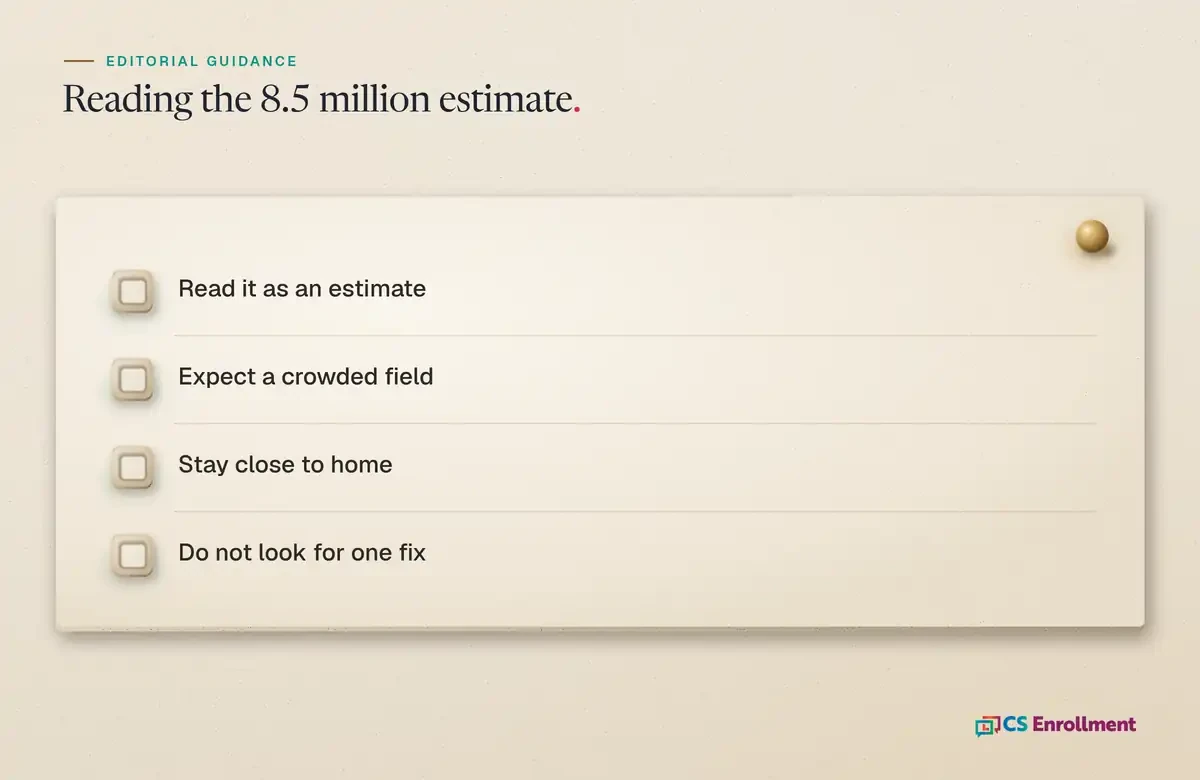
1. Read 8.5 million as an estimate. It is the authors' national figure, not a census of your classrooms. 2. Expect a crowded field. If the authors are roughly right, the sector has more teaching capacity than students, and most institutions have fewer than 10,000 students (87.1% in fall 2021, per the authors). 3. Stay close to home. The authors say most students prefer a college close to them, so clear, consistent contact with nearby inquiries and admits still matters. 4. Do not look for one fix. Nothing here says a price cut or a new program fills national excess capacity. On price, our post on whether tuition resets work covers one study.
Common questions
What does 8.5 million excess capacity mean? The authors' estimate of unused student FTE teaching capacity as of 2023, built from peak 2011 enrollment plus their modeling of online, classroom and faculty capacity.
Does every small college have empty seats? No. It is a national aggregate that, the authors say, does not account for students' preference to enroll close to home.
Is graduate education also overbuilt in this estimate? At baseline, the authors "did not find significant evidence of excess capacity in graduate (postbaccalaureate) education." That is a baseline finding, not a claim about graduate capacity after later adjustments.
Where messaging fits
CS Enrollment Pathways lets your team stay in contact with inquiries and admitted students, in branded, verified text messaging from your college's name, so a real person can answer the next question. A one question start, "What is still unclear about choosing us?", is how we work. Contact only people who have agreed to hear from you.
When a nearby student asks a question, how long does your college take to answer?
To see how a branded conversation with a prospective student can start, request the sample walkthrough.
Sources
- Ricardo Azziz, Gary Stocker, Karla Leeper and Rich Katzman, Excess capacity in higher education in America, 2023. Industry research published by the TIAA Institute, a division of TIAA. The authors are with the Center for Higher Education Mergers and Acquisitions at the Foundation for Research and Education Excellence. The paper names no funder. The opinions are the authors' and do not necessarily represent the views of TIAA or the TIAA Institute.